


3. Your first reaction and your first impression
The previous two chapters were about the message. This chapter is about you. About what happens inside you the moment someone interrupts you, and about the impression someone has of you before you have said your name. Both play out in a matter of seconds, and both can be steered once you know they are there.
After this chapter:
- You know the difference between a primary and a secondary reaction.
- You recognise your own pattern under pressure.
- You have three ways of taking the pause between stimulus and reaction.
- You know which three factors determine your first impression.
- You know why self-presentation is not a trick but your own style, used more deliberately.
What happens when someone touches a nerve
Suppose a colleague interrupts you during a meeting with the remark that your proposal is unrealistic. What happens inside you then? Perhaps you feel your heart beat faster, a defensive sentence shoots through your head, or you withdraw and say nothing more. That is your primary response: fast, automatic, driven by emotion. It comes before you have thought about it, and it happens to everyone.
A secondary reaction is of a different order. It arises when you pause for a moment between stimulus and answer. You notice what is happening, you feel your impulse, and you deliberately choose how you respond. Not suppressing, but steering. The difference lies not in what you feel, but in what you do with that feeling.
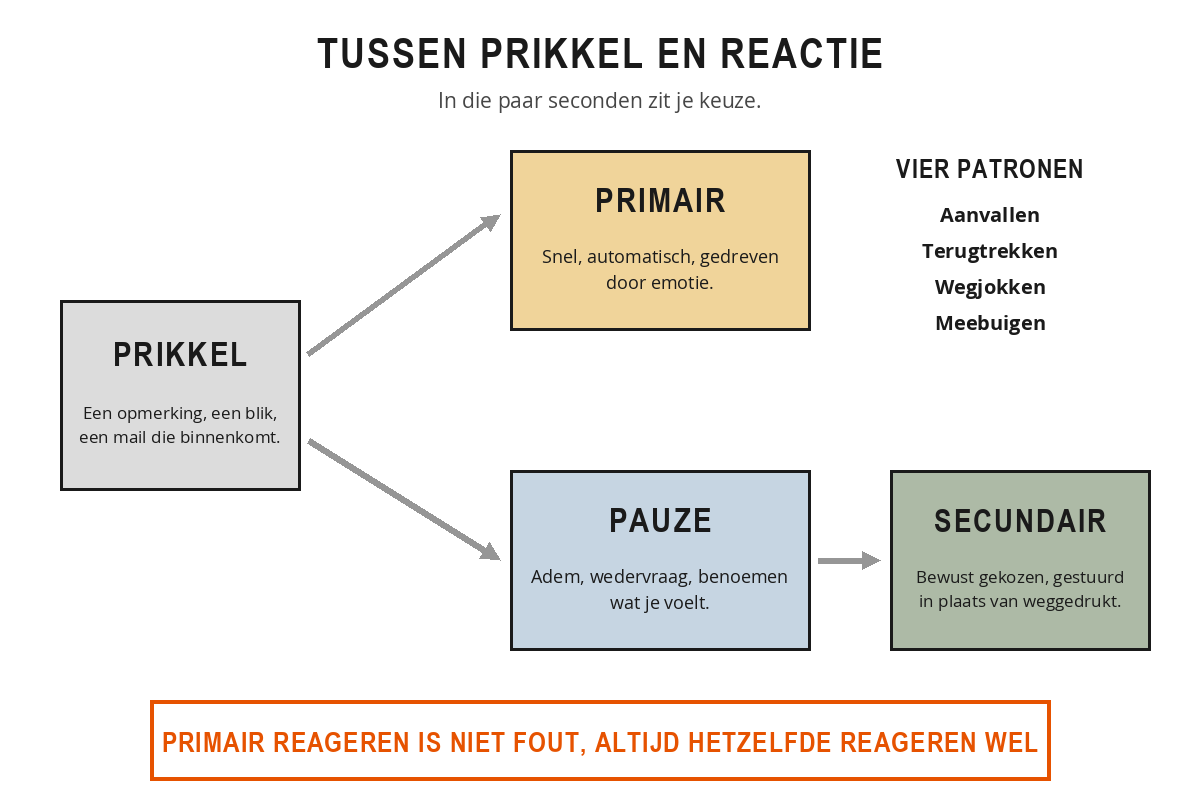
Reacting primarily is not wrong. It is fast, honest and sometimes exactly what a situation calls for. But if your primary reaction always goes in the same direction, you are stuck in a pattern. And a pattern also works at the moments when it does not help you.
Four patterns under pressure
Most people recognise themselves in one of these four:
- Attacking: you become sharp, your voice rises and within two seconds you have a counter-argument ready. Afterwards you think: I should have put that differently.
- Withdrawing: you say nothing more, you look at your screen and you let it wash over you. The discussion carries on without you and your point never makes it to the table.
- Joking it away: you turn it into a joke to take the tension away. It works in the room, but the substance has disappeared.
- Accommodating: you say "yes, you're right" before you have thought it through, simply to make the discomfort stop. Two days later you regret it.
Do you recognise one of them? Then that is valuable information, because your pattern predicts what you will do the moment things get tense. And whoever knows what they are going to do can choose something else.
In a project meeting with eight people, Joost presents a schedule he has worked on for three weeks. After four minutes, the finance manager says: "This simply isn't feasible." Joost feels the heat in his neck and says straight away: "You shot down the last schedule as well." The meeting spends ten minutes on tone rather than on the schedule, and the decision is pushed back to the following week. Two weeks later the same thing happens with another proposal. Joost then notices that he has one fixed button: he attacks. The third time, he takes a sip of water and says: "What makes it unfeasible in your view?" The finance manager turns out to have one objection, about the contract hires in week 12. That was resolved in five minutes.
Taking the pause
The difference between primary and secondary lies in the pause. A breath, a sip of water, a brief silence in which you think. In those few seconds you regain control. Three aids that help here:
- Breathe in and out before you answer. One full breath is often enough, and nobody notices.
- Ask a question back. "What exactly do you mean by that?" That gives you thinking time and the other person the chance to clarify. Often the objection turns out to be smaller than you thought.
- Name what you are feeling. "I notice I need a moment to think about this." There is nothing to argue with there, and it buys you half a minute.
Does the pause not work because you are too far gone? Make it bigger. "I will come back to this tomorrow morning" is a perfectly acceptable answer in almost any work meeting, and it is always better than a response you will regret for the rest of the week.
The first impression in seven seconds
Within seven seconds people form an impression of you. Before you have even said your name, the other person has already assessed: trustworthy or not, likeable or not, competent or not. That judgement has little to do with your words.
That sounds unfair, and it is. But it works both ways. You too are constantly forming first impressions of others, and those colour how you go into a conversation. Once you know that mechanism, you let it steer you less, and you sharpen up your own presentation.
Three things together determine how you come across in those first few seconds:
- Posture: your posture says more than your words. Upright, relaxed shoulders and open arms send the signal: I'm here, I'm approachable.
- Voice: a calm, steady voice inspires confidence. Speaking too fast reads as insecurity, too loud as pushiness. Pauses are fine.
- Eye contact: look the other person in the eye, not staring but engaged. Looking away during the greeting is often read as little interest or little self-confidence.
Two candidates come in for an interview for the same role, both with a CV that fits and six years' experience. Candidate A walks in with his eyes on the floor, gives a limp handshake and mumbles his name. Candidate B looks the panel in the eye, gives a firm handshake and says calmly: "Good morning, I'm Daan." In terms of substance they are comparable. Even so, the panel has a preference within ten seconds, and that preference colours the whole hour that follows. Not consciously, but noticeably: with candidate B the critical questions are asked as help, with candidate A as a test.
Self-presentation is not a mask you put on. It is your own style, simply used more sharply and more consciously. You don't have to become a different person to come across better. What you can do: check your posture before you walk into a room, let your breathing settle, and allow yourself the space to be there.
Think of a recent conversation that afterwards made you think: I would have wanted to do that differently.
- Situation: what happened and who was there?
- Trigger: which remark or attitude got to you?
- Primary reaction: what did you say or do straight away? Which of the four patterns was that?
- Pause: what space could you have taken?
- Secondary response: what would you have wanted to say or do?
Write it out. The more often you review this afterwards, the sooner you will recognise it in the moment itself.
Summary
- A primary reaction is fast and automatic; a secondary reaction arises after a short pause in which you make a conscious choice.
- Reacting on instinct is not wrong, but always giving the same reaction means you are stuck in a pattern.
- Four common patterns under pressure: attacking, withdrawing, joking it away and giving in.
- Taking a breath, asking a question back or naming what you feel all help you to switch gear.
- Within seven seconds someone forms a first impression, mainly based on posture, voice and eye contact.
- Self-presentation is your own style used more consciously, not a role you play.
What characterises a secondary response?
A colleague cracks a joke in a meeting the moment things get tense, after which the substance is off the table. Which pattern is this?
According to this chapter, which three factors mainly determine your first impression?