


2. Authority and responsibility in balance
Delegating stands or falls on two sliders. How much room to decide do you hand over, and how much responsibility do you place with the other person? Four combinations are possible, with four very different outcomes. If a delegated task isn't working, the cause is almost always in this chapter and not in the person doing the work.
After this chapter:
- You can name the four combinations of authority and responsibility and tell them apart.
- You know which outcome goes with each combination: perfection, deflection, attrition or anarchy.
- You can check whether the two sliders are in balance for a task you have handed over.
- You recognise the signs that delegating has broken down, both in yourself and in your team.
- For each quadrant, you know the smallest intervention that breaks the pattern.
Two sliders, four outcomes
You set the two sliders separately for each task. The first is the authority that you assign along with this task: what may your colleague decide without you? The second is the responsibility that you hand to him: is he held to account for the result, or does that remain non-binding?
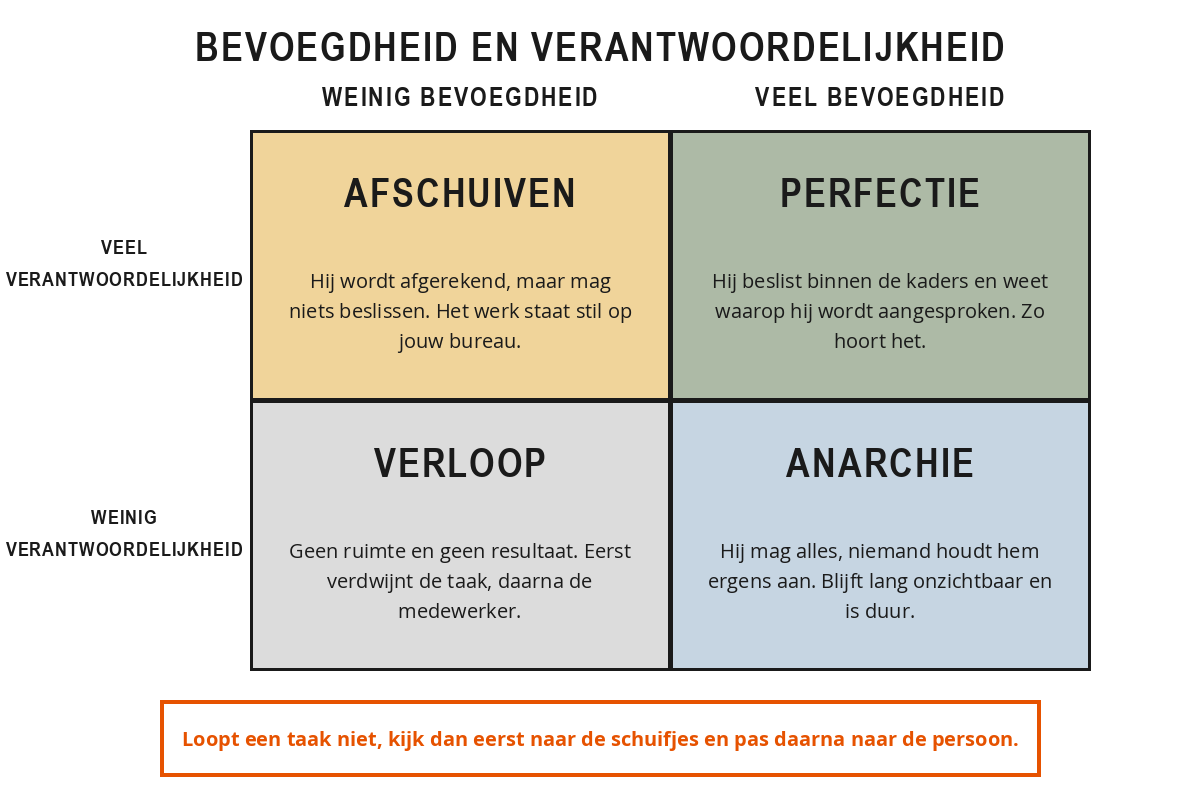
Set both high and delegating works; that is the quadrant perfection. If one of them lags behind, problems are predictable. A lot of responsibility with little authority feels like deflection. A great deal of authority without responsibility ends in anarchy. If both sliders are low, first the task disappears and in time the employee does too; that is called attrition. Below, the four quadrants are covered one by one.
Passing the buck: responsibility without authority
This is the combination you come across most often, and the most insidious one. Your colleague is held to account for the result, but may decide almost nothing along the way. Every choice goes through you. To you it feels like delegating; to him it feels like carrying a risk he can do nothing about.
What you see happening is that the work comes to a standstill on your desk. Your colleague has the job, but not the key. He is waiting for approval of an eighty-euro expense, for your sign-off on an email to a customer, for your decision on the schedule. If things go wrong as a result, he is the one who has to explain it. After a few rounds he stops asking and starts waiting. The work does not move forward, and the mistake lands lower down.
The signals can be recognised on both sides of the table. In yourself: you feel you have to chase everything up, your inbox is full of requests for approval, and you regularly take tasks half back. In your employee: he asks permission for trivial things, he reports problems late, and he says "I didn't know whether I was allowed to" more often than "this is how I sorted it".
The solution is small and concrete: you hand over three decisions he may take without you, each with a limit attached. An amount, a type of client, a part of the planning. It isn't about everything at once, it's about enough room to keep working.
Sander has been made responsible for scheduling the service engineers. In the monthly meeting he is held to account when a customer waits too long. But he may not commit to a single hour of overtime, may not hire an external engineer and may not reschedule an appointment without consulting his team leader. In April the waiting time rises to eleven days, because his team leader is on a course for three weeks. In the meeting that follows, Sander is asked how he let this happen.
The intervention that breaks the pattern is not more supervision, but three decisions: Sander may approve up to eight hours of overtime a week himself, may reschedule appointments within the same week himself, and may hire an external engineer himself up to 1,500 euros a month.
Anarchy: authority without responsibility
Set the authority slider high and leave the responsibility slider low, and you get anarchy. Your colleague may decide, spend and make commitments, but no one holds him to anything. No result has been defined and there is no moment at which he accounts for it.
That sounds unlikely, but it arises more quickly than you might think. It often starts with an enthusiastic employee who takes on a lot and to whom you are happy to give room. You arrange the rights in the system, you call him project leader and you tell the team that he is in charge of this. What you don't add is when it has to be finished and how you can tell it is good. In a team of four, four working methods then emerge, four interpretations of "on time" and four different answers to the same client. Usually that isn't a deliberate choice, but the result of well-meant trust: you didn't want to come across as controlling and so you put nothing in writing.
Bram is given the set-up of the new client system. He may call suppliers, may spend up to 5,000 euros and decides on the structure himself. After four months, half the department turns out to be working with its own interim solution, the budget has run out and nobody has reported that the old data hasn't been migrated. Bram doesn't feel this reflects on him: he was never asked how it was going.
Anarchy is expensive, because it stays invisible for a long time. There are no complaints, because there is nobody who is missing anything. Only when a client or your own manager asks about it does it become clear how much has drifted. And because you carry ultimate responsibility, you are the one left explaining it.
You repair this on the responsibility side, not by taking back authority. Someone who is given room and then loses it again will disengage. Three steps raise the second slider without taking anything away. You names the result: you describe what has to be in place three months from now, in sentences you can tick off. Your agrees feedback moments: two fixed slots in the diary work better than an agreement that he drops by if something comes up. And your asks about figures and choices: not "is it going well", but "which three decisions have you taken and why".
Attrition: no authority and no responsibility
That leaves the quadrant in which both sliders are low. Your colleague may not decide anything and is not held to account for anything. The task lies with him, but no result is attached to it and there is no moment at which anyone asks about it.
This quadrant requires more explanation than the other three, because it does not stop at a single task. Someone who is given work in which he has nothing to decide and for which no one holds him to account reads a message into it: this does not matter much, and neither do I. The work is rushed through or left undone, and for months nobody notices. After that it is no longer about the task but about motivation, and eventually about whether someone is still in the right place here.
Fleur has been managing the supplier folder since January. She may not amend any contract, agree any prices or cancel any supplier. Nor has anyone ever said what a well-managed folder looks like or when someone will be checking it. In September, procurement asks for the current rates and it turns out the folder hasn't been updated since March. In the conversation afterwards, Fleur says: "I thought nobody cared." Two months later she hands in her notice.
Here it doesn't help to move just one slider. More responsibility without room leads to deflection; more room without a result leads to anarchy. So both sliders go up in the same conversation: you state what the task must deliver, you add the decisions needed to achieve that, and you put one feedback moment in the diary. Often that conversation is already half the repair, because it shows that the work matters.
Perfection: both high
If both sliders are high, delegating works as it is meant to. Your colleague decides within agreed boundaries, he knows which result you will hold him to and at what moment that happens. You do not hear every choice, but you do hear the outcome and the problems he cannot solve himself. Final responsibility stays with you, without you looking over his shoulder.
In practical terms this quadrant consists of four agreements that you make in a single conversation. Together they take a quarter of an hour and prevent months of repair work. The result: what is finished, when, and how you can tell it is right. The decision-making scope: which choices he makes himself and up to which limit. The feedback moment: when you speak to each other, and about what exactly. And the exception: in which situation he comes straight to you rather than deciding himself.
Rachid takes over complaint handling for the web shop. He may grant goodwill himself up to 250 euro, he reports monthly on the number of complaints and the average turnaround time, and above 250 euro he calls you. After two months, the only thing you hear about complaints is the figure in the report. The exception is there too: if a complaint appears on social media, he comes by the same day.
If a delegated task isn't working, look at the sliders first and only then at the person. In most cases what is missing is room or an agreement, not the will to do it properly.
Take the task you chose in chapter 1 and score the two sliders.
- Authority: which three decisions may this person take without you? If you can't come up with three, the slider is set to low.
- Responsibility: which result do you hold him to, and at which moment? If you name no moment, the slider is set to low.
- Which quadrant do you end up in: deflection, anarchy, attrition or perfection?
- Which signals from this chapter do you recognise in yourself, and which in your employee?
- Which slider will you move this week, and with which single agreement will you do it?
Add a date on which you will check whether the pattern has changed.
Summary
- For every task you set two sliders: the authority that goes with it and the responsibility you place with the other person.
- Responsibility without authority is passing the buck: the work stalls on your desk and the mistake lands lower down.
- Authority without responsibility is anarchy: a lot happens, nobody explains what, and it stays invisible for a long time.
- If both are low, first the task disappears and then the employee.
- If both are high, your colleague carries the work and you keep the overview.
- You fix deflection with three delegated decisions, anarchy with a result and two feedback moments, and attrition with both at once.
An employee is held to account for customer waiting times, but may not authorise overtime or reschedule an appointment. Which quadrant does this task fall into?
A project leader may decide everything and spend up to 5.000 euro, but no result has ever been named and no moment has been agreed. What is the right intervention?
Why does this chapter consider the quadrant in which both sliders are low the most damaging?