


3. Which tasks do you hand over
A full diary says little about what really belongs to you. You only see that difference once you write out your work and put the same question next to each task: does this have to come from me? Without that overview, delegating remains a matter of gut feeling. You give away whatever irritates you most at that moment, and you hold on to what you are used to doing.
After this chapter:
- Can you make a task inventory of your own working week, with the right level of detail.
- You assess for each task whether it lends itself to handover, using four criteria.
- You can name your own core tasks and explain why they stay with you.
- Do you know how to split a borderline case into a part that goes and a part that stays.
- You know how to hand over a development task in stages without the interim step staying in place for years.
Your tasks in a list
A task inventory is a complete overview of everything you do in a normal working period, broken down by task, alongside the time it takes, how often it recurs and the question of whether it should stay with you. It therefore goes further than a to-do list. A to-do list tells you what still needs doing; an inventory tells you where your hours go.
You put it together in five steps. Keep track of what you do for two weeks, per day, in half-hour blocks. Work you pick up in between counts too, because that is often where most of the hidden traffic sits. Two weeks gives a more reliable picture than one week, because monthly and irregular jobs would otherwise stay out of view. Add to it from your diary and your inbox by scrolling back three months: there you will find the quarterly report and the preparation of the annual plan that just fell outside your measurement period. Split large chunks into separate tasks: "departmental meeting" is not a task but a collection, made up of drawing up the agenda, circulating the documents, chairing, taking minutes and maintaining the action list. Some of those parts can go straight away, others cannot, and you only see that if you write them down separately. Add the hours per week, and convert non-weekly tasks into a weekly average: a quarterly report of eight hours works out at roughly 0.6 hours per week. Sort by hours, from largest to smallest, because at the top of your list are the tasks where the return on delegating is highest.
What you are left with is a list of fifteen to thirty lines. For most managers, the top five contains at least one task that ended up there by accident years ago and has never left again.
Next to each task, write in three words the reason it ended up with you. "Always did it", "no one else had time", "no team back then", "my boss asked". Tasks with a historical reason are often the first candidates for handover. Tasks that are there because they belong to your role usually stay put.
Karin manages a team of nine people at a service bureau. She keeps track of what she does for two weeks and arrives at 27 tasks. Her three biggest items: drawing up the weekly rotas (4 hours), checking and forwarding the time sheets (3 hours) and updating the knowledge base (2.5 hours). Together almost a quarter of her week. None of the three appears in her job description. All three date from the period when the team consisted of four people and she was largely doing the work herself.
Four criteria for handing over
A list of thirty tasks does not mean you have made a choice yet. For each task you put four questions side by side. One "yes" is enough to consider handing it over seriously, and the more criteria that apply, the stronger the case.
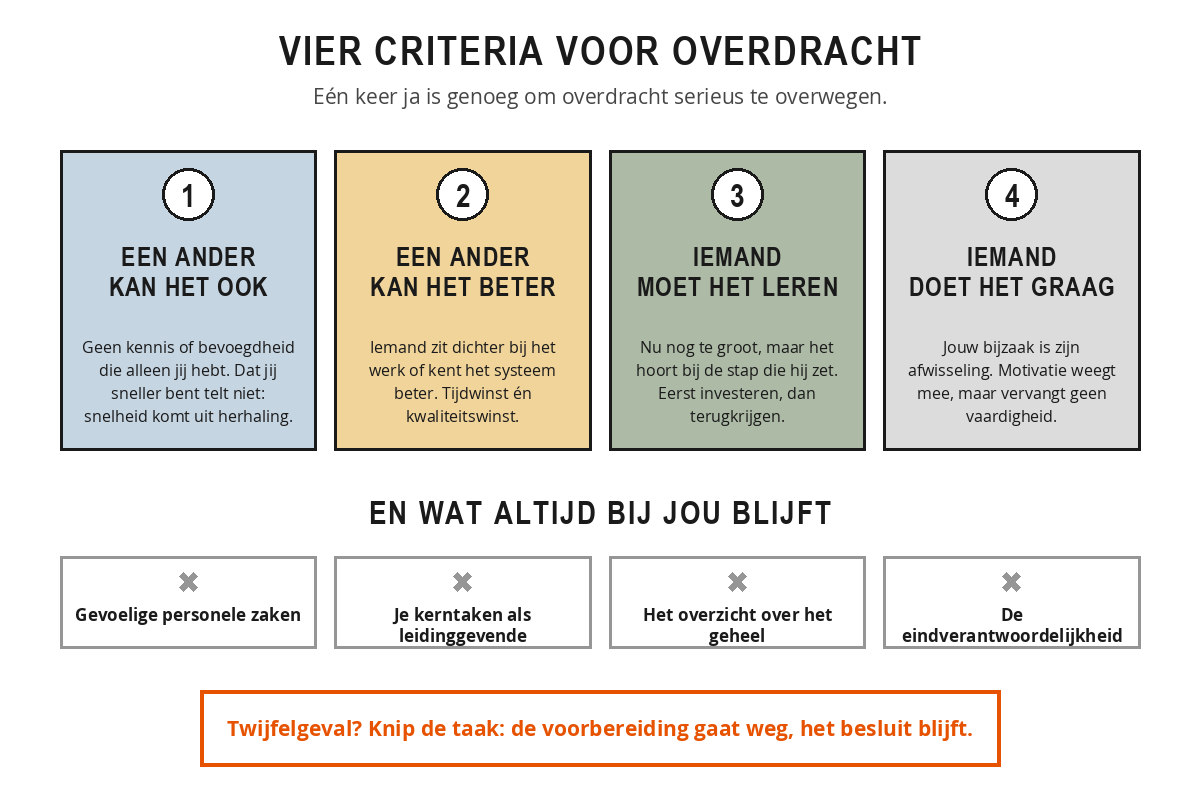
- Someone else can do it too: the task requires no knowledge or authority that only you have. Often it is work you do routinely: filling in a report, passing on a request, holding a standard conversation. The fact that you do it faster is not a counter-argument. Speed is the result of repetition, and someone else can build that up too.
- Someone else can do it better: someone in your team is closer to the work, knows the system better or has more feel for it. Here delegating saves time and improves quality as well. Checking invoices is a good example: someone who has the suppliers on the phone every day spots a discrepancy sooner than you do.
- Someone needs to learn it: the task is still too big for your employee at the moment, but it fits the step he is taking. Here you delegate with a development goal: you invest time first before you get time back. The same applies to tasks where you are the only point of contact. As long as no one else can do it, the continuity of your department depends on your holiday planning.
- Someone enjoys doing it: work that you experience as a side issue is sometimes a welcome change for someone else. That makes the handover easy and the result better. This criterion deliberately sits alongside the other three: motivation counts, but it does not replace skill.
Karin runs through her three biggest items. Drawing up the weekly rotas: someone else could do it too, and Fatima already handles staffing when people call in sick. Checking time sheets: her administrative assistant spots errors faster because he enters the changes himself. Updating the knowledge base: no one else can do it at the moment, whereas it would come to a standstill the day she left. All three go on the handover list, each for a different reason and at a different pace.
What you do not delegate
Four kinds of work stay with you, however busy you are. They have something in common: someone else might technically be able to carry them out, but the result loses its value as soon as you do not do it yourself.
Sensitive personnel matters, such as announcing a dismissal, resolving a conflict between two team members or addressing someone's performance. This work affects people's position and income. Anyone who takes it over from you lacks the authority to say anything about it, and also damages their own relationship with the rest of the team. Your core tasks as a manager, such as conducting appraisals, defending the annual plan to your board, setting the direction of your department and determining budgets. These tasks are the reason your role exists; if you hand them over, you are delegating away your own role. The overview: individual tasks can be farmed out, the overall picture cannot. You are the one who knows which five projects are running, where they get in each other's way and what happens if one of them falls through. And the ultimate responsibility for what you have already delegated, that stays with you and therefore never appears on your handover list.
There is also a category that is less a matter of principle but in practice causes more friction: work that involves confidentiality. Salary data, absence records, information about a reorganisation that has not yet been finalised. Here it is not about your colleague's ability, but about whether he is allowed to see that information.
For every task you think "I'll keep this one myself", write the reason behind it in four words. If it says "sensitive" or "my core task", it is right. If it says "it's quicker this way" or "I want to do it myself", you are looking at a borderline case, not an exception.
Borderline cases: split the task
Most tasks on your list do not fall into the column "gone entirely" or "entirely mine". They sit somewhere in between, and then the question is not whether you delegate but which part. A task often consists of preparing, carrying out, deciding and reporting back. Those four parts do not have to sit with the same person. The preparatory work is usually the largest part in hours and the smallest part in sensitivity.
Karin conducts the annual appraisals with her twelve staff members. The meeting itself is a core task and stays with her. Gathering the figures from four systems, requesting feedback from project leaders and preparing the files takes her nineteen hours per round. She gives that part to Ilse, with access to the systems and a fixed template. Karin keeps the meeting, the appraisal and the report. She hands over no sensitive task at all and saves seventeen hours.
For tasks your colleague cannot yet handle independently, you shift the boundary in stages. First he watches, then he does it under your eye, then he does it and reports back, and finally he does it and you only hear about it if something out of the ordinary happens. Put the moment when you shift the boundary again straight into your diary. Without a checkpoint, an interim step stays in place for years.
A separate category is the tasks you are good at, enjoy doing and that nobody takes off your hands. They are rarely a core task. One question helps here: if you were starting in this role today, would you pull that task towards you? If the answer is no, it belongs on the handover list, even if that hurts.
Make a first version of your task inventory based on your diary for the past month and your sent mail.
- Note down at least fifteen tasks, each split so small that a single verb covers it.
- Put the estimated hours per week after each task, and in three words how it ended up with you.
- Mark the five tasks that cost you the most time, and run through the four criteria for each one. For every plus, note the name of the person you have in mind.
- Put a letter after each task. K: core task or sensitive, stays with you. O: can go already. D: divisible, you split it up. G: development task, someone needs to learn this first.
- Add up the hours per letter. Does the total for K fit within your working week, and does every reason you wrote down hold up?
Finally, mark the three tasks you will set in motion first. Those are the ones you take with you into the next chapter.
Summary
- A two-week task inventory, supplemented from your diary and mailbox, shows where your hours really go.
- Break large chunks down until one verb fits each task, and sort by hours.
- You delegate what someone else can also do, can do better, needs to learn or enjoys doing.
- Stays with you: sensitive personnel matters, your core tasks as a manager, the overview and the ultimate responsibility for delegated work.
- Confidentiality does not limit your colleague's skill, but it does limit their access.
- You resolve borderline cases by splitting the task: the preparatory work often goes, while the decision stays with you.
- With development tasks you shift the boundary step by step and put the next checkpoint straight into your diary.
You have been producing a report yourself for years and are twice as fast at it as anyone else. What does this chapter say about that?
According to this chapter, which task should always stay with the manager?
A task is partly sensitive and partly routine work. What is the approach from this chapter?