


4. The delegation conversation
Handing over work between two doorways costs you more time later on than the conversation you skipped. A task only really moves across when you set aside a moment for it. In this chapter you set up that conversation: what you say, in what order, and how you check whether it has landed.
After this chapter:
- Whether you can explain how a delegation conversation differs from a passing question in the corridor.
- Do you know the five parts of the conversation and the proportions in which you divide them.
- Whether you can turn a task into an assignment that starts with the end result.
- Whether you can fill in the four result standards quality, time, cost and other for your own task.
- Whether you know how to check that your message has landed without asking "is that clear?".
Why the middle ground doesn't work
A delegation conversation is the conversation in which you hand over a task along with the accompanying authority and resources, and in which you jointly set out what result you expect, within which boundaries and at which points you will come back to it. It is an appointment in the diary with a beginning and an end, not something you mention while putting on your coat.
In a passing handover your colleague mainly hears the headline of the message: "you're going to do the customer survey". The rest of the information is in your head and stays there. What is missing he fills in himself from his own picture of the situation, and that picture is not yours. People are walking past, you have haste in your voice and meanwhile he is thinking about the work he has just been pulled away from. And there is something else: a task passed on between two doorways takes on the weight of a shopping list. Your colleague has had no moment at all to respond, to ask questions or to say yes.
The corridor version, a team leader to Youssef by the printer: "Say, you could clean up the supplier list, couldn't you? Have a quick look at it this week." Youssef cleans up 40 of the 300 lines, because "have a quick look" sounded like an hour's job. He emails no one, because he had no instruction to do so.
The conversation version, Tuesday at eleven, half an hour set aside: "I want the supplier list cleaned up before the June purchasing round, and I want to put that job with you because you know the purchasing system better than I do. What I want to see back is a single list in which every supplier has an up-to-date contact person, a valid contract and a category. Duplicates removed. You have sixteen hours, spread over three weeks, and you may email suppliers yourself. What do you need from me to get started?"
Youssef now knows what finished looks like, how much time he has and that he may make contact himself. And he knows why he was asked.
The five components and their proportions
How extensive the conversation becomes depends on how independently your colleague can handle this task. With an experienced member of staff twenty minutes is often enough; with someone doing it for the first time you sit down for longer and come back to it sooner. The components themselves stay the same. Reason and choice: what is the task, where does it fit into the bigger picture and why are you placing it with them. Result and standards: exactly what has to be finished, and how you measure that. Authority and resources: what he may decide himself, what he is given, and for which exceptions he comes to you. Approach and interim steps: here your colleague has the floor, they explain how they want to do it and you hear where the gaps are. And feedback and check: when the two of you will speak and whether you have the same picture of the agreement.
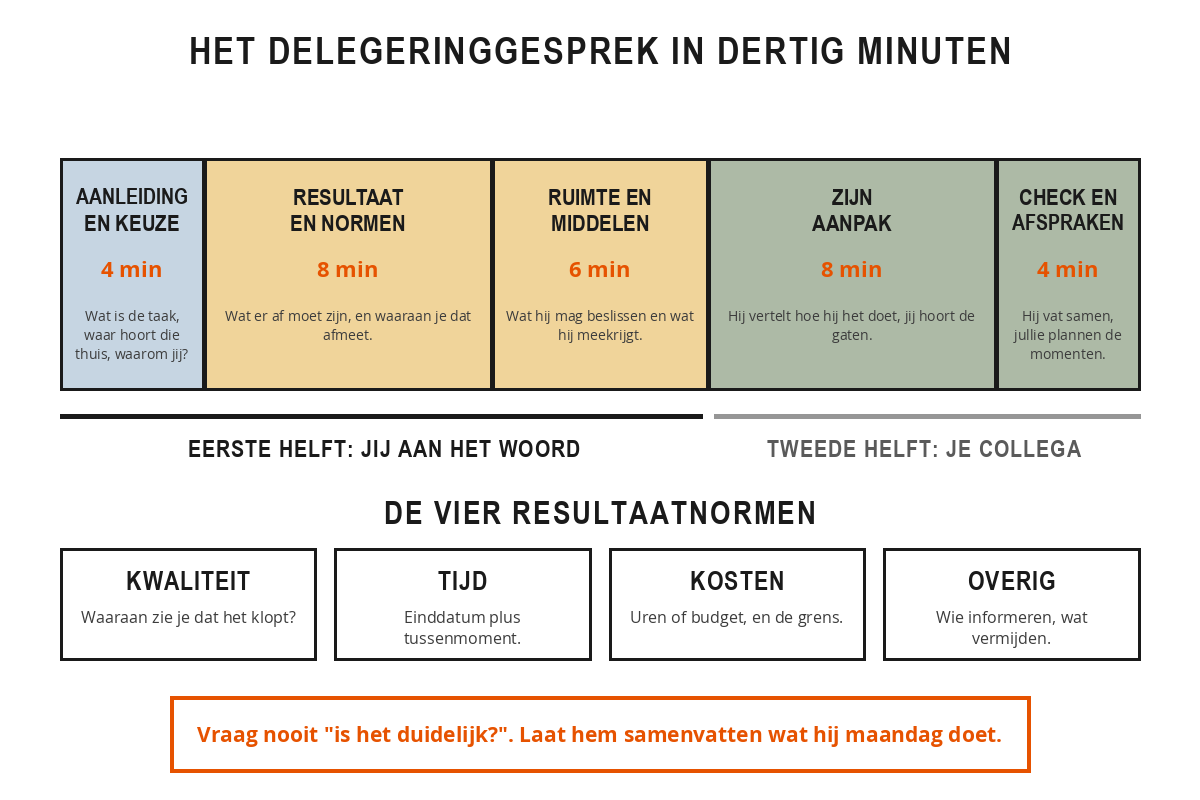
The ratio matters more than the exact minutes. In the first half you do most of the talking, in the second half your colleague does. If you notice that you are still talking yourself after twenty minutes, it is no longer a delegation conversation but an instruction. In practice, things mainly go wrong because you spend twenty minutes on the approach and two minutes on the result, while it is precisely on that result that your colleague will be judged.
Don't schedule the conversation at the end of the day, and not as the last item of a team meeting either. Your colleague needs room to ask questions and to object if necessary. Anyone given a task at twenty past five mainly nods so they can go home.
From task to assignment
A task is what is on the table. An assignment is what you agree about it. When you formulate an assignment you say in one or two sentences what you want to see back, and only then what the work looks like. So not "could you pick up the supplier talks", but "I want us to have a price agreement with three suppliers by 1 July that holds for twelve months; the talks and the preparation are yours".
This is how you build up that formulation. You start with the end result: what will be finished, and what does that look like when it is done? Then the purpose behind it: who uses the result, and what for? Without that framework your colleague cannot make a single judgement call himself. In that case the work in outline: three to five steps, not fifteen, because the detail belongs to their approach and not to your assignment. And finally what falls outside it: what explicitly stays with you or with someone else? That prevents them from starting to feel responsible for the whole file.
Outcome standards: quality, time, cost and other
A result standard is a measurable statement about the result, phrased in such a way that afterwards you cannot disagree about whether it went well. Four types of standards cover virtually every delegated task.
- Quality: what must the result meet? "Every agreement recorded in writing and signed by the supplier" is a standard, "properly sorted out" is not.
- Time: when is it finished, and which interim moments are fixed? An end date without an interim date means you only discover on the final day that it isn't going to work.
- Cost: what budget or number of hours goes with it, and where is the limit above which they come back to you? Hours are costs too, even when there is no invoice attached.
- Other: everything else that counts. Who gets informed, what tone you want to strike externally, which systems have to be used, which colleagues stay involved.
Ilse hands over the customer satisfaction survey to Merel. Quality: at least one hundred and fifty completed questionnaires and a report of no more than four pages with three recommendations. Time: finished on 15 October, with an interim update on 20 September. Cost: forty hours and a maximum of EUR 800 for the survey package. Other: the questionnaire does not go to customers who had a complaint in the past month, and the head of sales is told about it before the first email goes out.
Four sentences, and there is little left to argue about afterwards regarding whether it went well.
The comprehension check
The comprehension check is the final step of the conversation, in which you establish whether you both have the same picture of the agreement. The question "is that clear?" does not do that. Almost everyone says yes to it, even when they don't know, because saying no means losing face.
What does work is having your colleague summarise: "I want to be sure I've explained it properly. What will you do first on Monday, and what will you come back to me about?" Two things then come to light: the outcome standard they did not hear, and the authority they interpret more broadly or more narrowly than you intended.
The relationship and letting go
A conversation that is sound in substance can still fail. If your colleague feels a job is being dumped on him, he works through the list rather than towards the result. You usually won't notice it in the words. Someone says "yes, fine" with half a second's delay and without eye contact. Someone asks nothing, even though the task is new to him. Someone asks three times about the deadline and not once about the purpose. What helps then is naming what you see. That gives him permission to object, and that objection is exactly the information you need.
You don't stick motivation on with a compliment at the end. You draw it out of the conversation itself, in three ways. You explain why you are asking this particular colleague, and make that concrete by referring to something they have done before. You grant authority that they actually notice, because room to decide says more about trust than any word can. And you let them determine the approach within your standards, so that it becomes their plan and not your plan that they carry out.
Then the difficult part begins. Many managers hand a task over neatly and then half take it back within the first two weeks, usually without noticing. Letting go becomes easier if you set out what you do still do: at which two moments you will hear something from them, in what form that happens and what they may drop in about in between. You put those moments in your diary, not in your head. Anyone who does not schedule a feedback moment will ask about it in between, and to the other person that feels like control. Two of the agreements are with yourself: you do not ask about it in between, not even informally at the coffee machine, and you do not send an email saying "how is it going" on a day when nothing has been agreed.
The first time your colleague makes a choice you would not have made is the moment on which delegating stands or falls. The question is not whether he does it the way you would, but whether his choice falls within the agreed standards. If it does, you let it stand, even if it irritates you. If it doesn't, you discuss it at the agreed moment and not in the corridor.
Take the task you put at the top in chapter 3 and write out the conversation before you have it.
- The end result in one sentence, and what the result serves.
- The four standards: quality, time (end date plus one interim checkpoint), cost (hours or budget plus a limit) and other.
- What explicitly falls outside the assignment, and for which exceptions he comes straight to you.
- Why this colleague in particular: one sentence that you are going to say word for word.
- The question with which you get him to summarise.
- The two feedback moments, with date and duration, and what you do not do in between.
Then have a colleague read your standards and ask: where would you still put your own interpretation on this? Every answer points to a standard that needs sharpening.
Summary
- The delegation conversation is an appointment in the diary, not an announcement in the corridor.
- It shifts from you to the other person: first half assignment and frameworks, second half their approach.
- An assignment starts with the end result and the purpose, not with the steps.
- You set outcome standards on four points: quality, time, cost and other.
- You carry out a comprehension check by having your colleague summarise, not by asking whether it is clear.
- Without attention to the relationship you end up with someone who carries out the work rather than someone who owns it.
- You arrange letting go by fixing your own role: two feedback moments in the diary and no questions outside them.
How should a thirty-minute delegation conversation be divided up?
Which of these agreements is a usable outcome standard?
At the end of the conversation you want to know whether the agreement has landed. What do you do?
Ready for the next step?
You have completed the free starter of Delegating. The next chapter in the full course is Communication as the foundation of delegating: The communication model, three types of noise, the three channels and the formula effect equals quality times acceptance.
Take the 2-day course →From €1250,- excl. VAT · with an experienced trainer included