


4. Giving and receiving feedback
Feedback is one of the most powerful instruments for influencing behaviour and improving cooperation. At the same time, it often goes wrong: too vague, too late, too accusatory, or wrapped up so cautiously that the message fails to land at all. This chapter gives you a structure that does work, and shows how to receive feedback without immediately becoming defensive.
After this chapter:
- Structure your feedback using the 4G model: behaviour, feeling, consequence, desired outcome.
- You distinguish between an observation, an interpretation and a judgement.
- You know the four features of INGE and the three steps of LSD.
- Recognise the pitfalls that make feedback ineffective.
- You know in which order to receive feedback, and why thanking someone is not the same as agreeing.
The 4G model
Good feedback is concrete, behaviour-focused and inviting. The 4G model gives you a structure that works in most situations, in this order: first what you saw, then what it did to you, then what it resulted in, and only at the end what you would rather see.
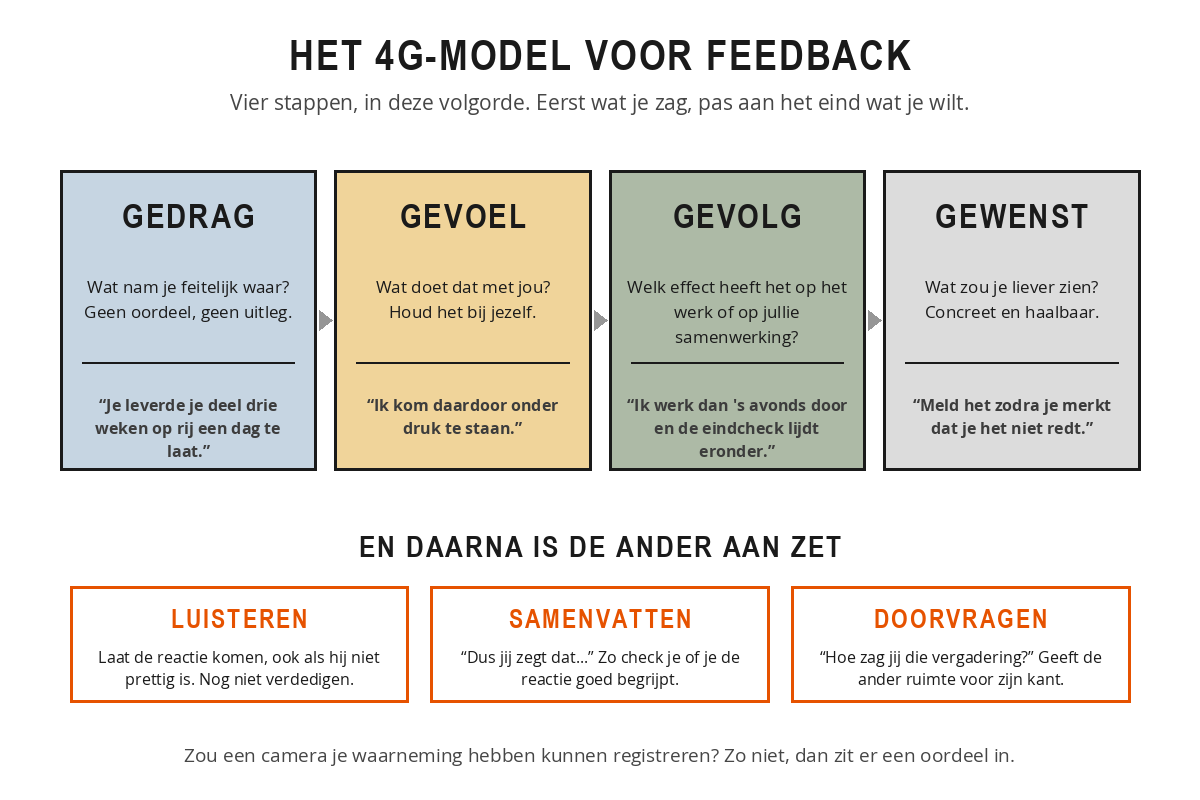
Behaviour. You describe factually and concretely what you have observed. No interpretation, no judgement. Not "you are uninterested", but "you looked at your phone three times during the meeting".
Feeling. You state what this behaviour does to you. By keeping it about yourself, you stop the other person from becoming defensive. "It makes me lose my focus" lands very differently from "you're disturbing everyone".
Consequence. You make clear what effect the behaviour has: on you, on the work or on the working relationship. This makes it clear why you are raising it and why it is worth doing something about.
Desired. You close with what you would rather see. Concrete and achievable, not a vague wish. "I would like you to put your phone away during the meeting" is workable; "be a bit more involved" is not.
Anne is working with Joost on a quarterly report. Joost consistently delivers his part later than agreed. Anne tackles it like this:
Behaviour: "Over the past three weeks, you have delivered your part of the report a day later than we agreed every time."
Feeling: "I notice that this puts me under pressure and makes me tense."
Consequence: "I have to work into the evening to meet the deadline, and that comes at the expense of the final check."
Desired: "I would like us to look together at whether that deadline is realistic, and for you to say so as soon as you notice you are not going to make it."
Compare that with what Anne almost said: "You're always late as well, I really can't rely on you any more." The same irritation, but not a single handle for changing anything.
Observation, interpretation and judgement
The most common pitfall with feedback is presenting an interpretation or a judgement as though it were a fact. "You don't listen" is an interpretation. "You interrupted me three times today before I had finished my sentence" is an observation.
The difference is considerable. To an observation, the other person can respond with information: "that's right, I thought you had finished". To an interpretation, the other person usually responds with resistance, because you have already drawn a conclusion without checking the facts. The conversation then turns to whether your conclusion is correct, rather than to what actually happened.
Test your feedback before you say it out loud: could a camera have recorded this observation? If not, then there is an interpretation or a judgement in it. In that case, rephrase it as what was literally visible or audible.
INGE and LSD
Two acronyms help you to deliver feedback in a structured way and keep the relationship intact. INGE gives you the structure of your message, LSD describes the listening attitude you need afterwards.
INGE stands for four characteristics. I-message: start with yourself, with "I noticed" or "I had the impression that", instead of "you always do". You speak for yourself, not on behalf of a tribunal. Here and now: stick to recent behaviour, because feedback about something from today or this week lands and feedback about something from three months ago does not. Bringing up old incidents also makes the message heavier than it is, so the other person feels ambushed rather than addressed. Concrete behaviour: describe what you have observed, as specifically as possible, including the situation and the moment. Not a summary of a pattern, but one concrete incident. Naming the effect: say what the behaviour did to you, to the work or to the working relationship. Without an effect, feedback hangs in the air.
LSD is what you do next, when it is the other person's turn. Listening without immediately defending or explaining yourself: the other person may respond first, even if that response is not pleasant. Summarising to check whether you have understood the response correctly: "So you're saying that..." This prevents you from putting your own interpretation on the response. Asking follow-up questions to get deeper: "What made you look at your phone at that moment?" or "How did you see that meeting?" gives the other person room to tell their side. LSD is not a technique for talking the other person round. It is the attitude that prevents feedback from becoming one-way traffic.
Femke gives feedback to a colleague about a meeting the day before: "I want to share something with you about yesterday's meeting. When I presented my proposal, I saw that you were looking at your phone and then asked a question I had already answered. That gave me the feeling that my point was not landing, and it made me unsure about how to continue."
The response: "Yes, sorry, I had just had a message from the client about that deadline and my mind was on that." Femke does not defend herself and does not start explaining that the meeting takes priority. She summarises: "So you had that client on your mind and you missed my explanation." And she asks further: "What would help, should we deal with that kind of thing before the meeting?" Two minutes later there is an agreement about phones during the Monday meeting, instead of an atmosphere that lingers for a week.
Receiving feedback
Giving feedback is difficult, but receiving feedback is even harder for many people. Your first reaction is almost always to defend, explain or play things down. That is human, but it costs you information. What helps is to keep to a fixed order.
- Listen to the end. Do not interrupt, even if you disagree with something. Let the other person finish speaking.
- Summarise what you hear. "So you saw me interrupt you three times yesterday, and that made you feel you weren't being taken seriously." That way you check whether you have understood correctly, and at the same time give yourself time to think.
- Ask follow-up questions. "Can you give me another moment when this happened?" or "What would you have preferred from me?" makes the feedback usable.
- Thank the other person. Someone who gives feedback takes a risk. Thanking them is not the same as agreeing; it acknowledges that the other person took the trouble.
- Only then decide what to do with it. You don't have to accept all feedback. You may weigh it up and set it aside, but only after you have really heard it.
Do you feel the urge to defend yourself? First breathe calmly in and out, and ask a question instead of raising an objection. A question keeps the conversation open; an objection closes it.
Think of a situation in the past two weeks in which you wanted to give someone feedback but did not do so. Now write out the message using the four G's.
- Behaviour: which moment are you describing, and what exactly did you see or hear? Would a camera have recorded it?
- Feeling: what did it do to you?
- Consequence: what effect did it have on the work or on the collaboration?
- Desired: what would you rather see, concretely and realistically?
- And then: what response do you expect, and what follow-up question will you have ready?
Read your message aloud. Does it sound like something you could actually say? Adjust it if necessary until it fits the way you speak.
Summary
- Build feedback using the four G's: behaviour (what did you see), feeling (what did it do to you), consequence (what effect did it have) and desired outcome (what would you prefer).
- Separate observation from interpretation. Could a camera have recorded your observation? If not, there is a judgement in it.
- INGE is the structure of your message: I-message, now and here, concrete behaviour, naming the effect.
- LSD is the attitude with which you receive the response: listen, summarise, ask follow-up questions.
- When receiving feedback: listen to the end, summarise, ask further questions, say thank you, and only then decide what to do with it.
- Thanking someone is not the same as agreeing. You may weigh up feedback, but only after you have genuinely heard it.
Which sentence is an observation and not an interpretation?
What does the last G of the 4G model stand for?
You receive feedback you do not agree with. According to this chapter, what do you do first?
Ready for the next step?
You have completed the free starter of the Conversation Techniques course. The next chapter in the full course is The communication process: The communication model, the laws of communication, and how noise and frames of reference distort your message.
Take the 2-day course →From €1250,- excl. VAT · with an experienced trainer included