


3. The Leary Circumplex
A conversation always runs in two directions. What you do prompts something in the other person, and what the other person does prompts something in you again. Usually this happens by itself and you do not notice it, until you ask yourself why you keep ending up in the same role in the same conversation with the same person. Leary's Rose makes that pattern visible, and shows how to break it.
After this chapter:
- You understand how one person's behaviour provokes predictable behaviour in the other.
- You recognise the two axes on which Leary's Rose maps conversations.
- You can name the four basic positions and the eight behavioural styles.
- You know the two rules that predict what your behaviour elicits in the other person.
- You know how to deliberately choose a different position in order to get a stalled conversation moving again.
Behaviour invites behaviour
Imagine this: a colleague walks in, sits down and says with a sigh: "I really don't know how to approach this project any more." There is a good chance that you sit up, firm up your voice a little and start giving advice. A few minutes later you are wondering why you are working so hard on a problem that is not yours.
That is no coincidence. Your colleague's attitude ("I don't know, help me") almost automatically invites you to adopt the opposite attitude ("I do know, I'll help you"). Tim Leary, an American psychologist, discovered in the 1950s that such patterns are surprisingly predictable and summarised them in the model we now call Leary's Rose.
Behaviour never stands on its own. It is always a response to, or an invitation to, the other person's behaviour. Someone who dominates elicits submission. Someone who makes themselves small elicits direction. Someone who is friendly usually gets friendliness back, and someone who responds in a distant or critical way usually gets something cool back too.
That sounds logical, but the practical gain lies in reversing the reasoning. If you notice that you keep ending up in the same role in conversations, always the one offering solutions, always the one giving in, always the one defending yourself, then that is not a coincidence but a pattern. And you break a pattern by changing your own behaviour, not the other person's. That is also the heart of this chapter: the only dial you can actually reach is your own.
Marit has a team member who says at every meeting: "Just tell me what to do." At first Marit found that pleasant, nice and clear. After a few months she had had enough: she noticed that she was doing all the thinking and that her colleague never took the initiative.
Once she saw the pattern, she changed her response. To the question "what should I do?" she answered: "What would you do yourself if I weren't here?" Silence. Then, hesitantly, an idea of her own came. By letting go of her steering role, she gave the other person room to take that role herself.
Two axes, four quadrants
The Rose maps behaviour along two dimensions. The first axis concerns influence: do you take the lead (above) or follow the other person (below)? The second axis is about the relationshipdo you go along with the other person (together) or do you set yourself against them (opposed)? Combine those two and you get four basic positions.
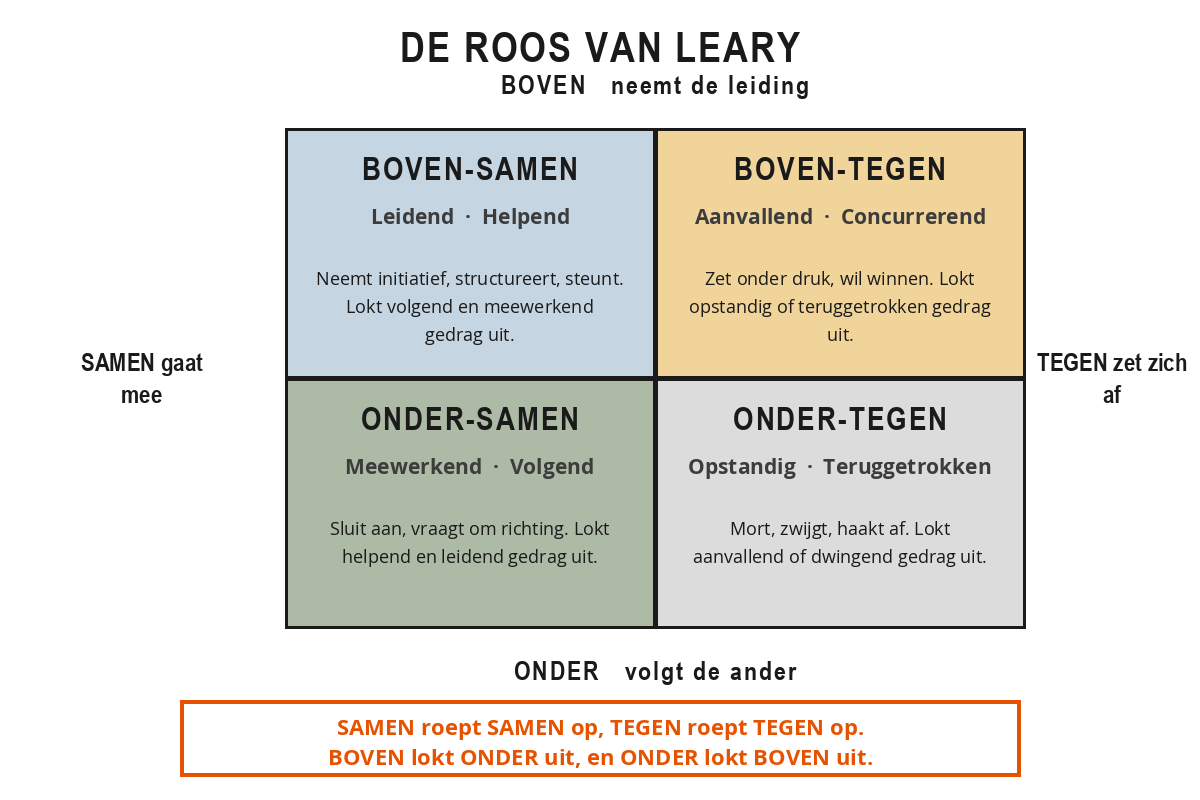
Above-together is the position of someone who takes the lead and at the same time goes along with you. The two styles that belong to it are leading (you take the initiative, structure the conversation, put forward proposals and make the final call) and helping (you show care, offer support and think along from the other person's interest, in a warm tone). This behaviour prompts following or cooperative behaviour in the other person.
Above-against leads without taking the other person along. This is where aggressive (you put the other person under pressure, criticise, your tone is sharp and your attitude coercive) and competitive (you want to win or to be proved right, you pull the conversation towards you and push the other person away). This provokes rebellious or withdrawn behaviour.
Under-summarising is moving with the other person without claiming the lead. The styles are cooperative (you join in, think along, make your contribution and seek cooperation) and next (you leave the lead to the other person, take a modest position and ask for direction). This provokes helping and leading behaviour in the other person, and that is exactly what happens.
Under-versus is opposing without taking the lead. This is where rebellious (you resist what the other person proposes without offering an alternative of your own: you grumble, sigh or disengage) and withdrawn (you keep your distance, say little and avoid contact). The other person often responds with an attacking or coercive tone.
Remember the two rules and you have the model at your fingertips. On the horizontal axis, like evokes like: together invites together, opposed invites opposed. On the vertical axis it works the other way round: top invites bottom, and bottom invites top. Those who lead get followers. Those who attack get resistance or withdrawal.
Working with the Rose in practice
The model only becomes really useful when you use it to steer a conversation. Three questions help with that: where am I now, where is the other person, and what do I need in order to change the dynamic?
Suppose you are talking to a colleague who keeps raising objections. That is rebellious behaviour, against-below. You notice that you yourself become stricter and more directive, moving towards attacking, against-above. According to Leary's Rose, this only reinforces the resistance, because against invites against. If you want to get things moving, you have to break the pattern in your own behaviour. Switch to helping behaviour: ask what the colleague needs, show that you understand the objection. There is a good chance you will get cooperative behaviour in return.
Team leader Rob is holding an appraisal interview with Daan. Daan sits withdrawn in his chair, gives three-word answers and looks out of the window. Rob feels the urge to press harder and become more concrete: "I really want to know what is going on here." That is attacking behaviour, and according to Leary's Rose it reinforces exactly the withdrawal he wants to break through.
He chooses a different approach: "I can see this is difficult for you. What would help you to talk about it?" That is helping behaviour, above-together. Daan says nothing at first. Then: "I never know whether this conversation ends up in my file." That was the issue. Rob explains what is and is not recorded, and the conversation gets going.
Two things matter here. First: this is not about right and wrong behaviour. Attacking behaviour is not forbidden and helpful behaviour is not always the right choice. Anyone who always helps ends up with colleagues who always come to take. The point is that you choose rather than react. Second: a style is not a personality. The same person is rebellious in one meeting and leading in another, depending on what the other person does. You look at behaviour in a conversation, not at a character.
Think of a conversation from the past few weeks that did not go the way you wanted. Answer for yourself:
- Which style did you predominantly display: leading, helpful, cooperative, following, withdrawn, rebellious, attacking or competing?
- Which style did the other person display?
- Does that match the two rules (together invites together, opposed invites opposed, above elicits below)?
- Which other style could you have chosen to break the dynamic?
- So what exactly would you have said? Write down that one sentence.
That last step is the most important one. An insight without a sentence you can say out loud will not change the next conversation.
Summary
- Behaviour provokes behaviour. If you keep ending up in the same role in a conversation, that is a pattern and not a coincidence.
- The Leary Circumplex maps behaviour along two axes: above-below (influence) and together-against (relationship).
- That gives you four quadrants: above-together (leading, helping), above-opposed (attacking, competing), below-together (cooperating, following) and below-opposed (rebellious, withdrawn).
- Together invites together and opposed invites opposed. Above elicits below, and below elicits above.
- You get a stalled conversation moving again by changing your own behaviour. That is the only lever you can reach.
- No style is wrong, and a style is not a personality. It is about choosing consciously instead of reacting.
A colleague keeps raising objections to your proposal without offering an alternative, and you become increasingly directive. What does Leary's Rose predict?
Which two behavioural styles belong in the below-together quadrant?
You want to get a stalled conversation moving again. According to this chapter, what is the effective step?