


3. What you can do if you see something
Most people who see something happen do nothing because they do not know what they should do. Between "saying nothing" and "filing an official complaint" there seems to be nothing at all. That is a misunderstanding: there are five steps in between, and the lightest one costs you two sentences. This chapter is about that choice, and about the route your organisation has in place for it.
After this chapter:
- You can separate fact, interpretation and judgement in your own observations.
- You know the five levels of intervention, from setting a norm in the moment to a protective measure.
- You know which four questions determine how firmly you intervene.
- You know what a confidential adviser does and does not do.
- You can explain the route in your own organisation within two minutes.
Look first, interpret later
Within a few seconds an observation condenses into a judgement, and that judgement then determines what you still notice. Once you think Sanne is not resilient, you see every silent moment as confirmation and every sharp retort as an exception. Climbing back out is possible, and that is exactly what this requires.
A fact passes the camera test: a camera would have captured it, with no room for discussion. A interpretation is the meaning you attach to that fact, and it may or may not be correct. A judgement is a statement about who someone is, and that is precisely the form in which people feel attacked. Interpreting is not wrong; without interpretation you would never notice anything. The mistake lies in presenting your interpretation as an observation, after which the other person starts defending instead of talking.
Three habits keep that separation in place. Make a note on the day itself: date, place, those present, and what was literally said or done, in quotation marks where you know the exact words. Put your interpretation separately underneath and leave out the conclusion; you only draw that once you have several notes side by side. Find two other explanations that also fit the same fact. And check with the person concerned, because they are the only one who can tell you which explanation is correct. So not "I notice you're withdrawing", but "you didn't say anything in this morning's meeting, whereas you're normally the first to respond".
Yasmin has said nothing in the planning meeting for about three weeks now, whereas she is normally the first to respond. Her colleague Bart notes it down on the day itself: the date, who was present, and the sentence from the team leader after which it went quiet. His first interpretation is that Yasmin can no longer cope with the team leader's tone. He keeps two others alongside it: perhaps she does not find the subject interesting, perhaps something is going on at home. Over coffee he puts the fact on the table and asks what it means for her. It then turns out that it is indeed about the meeting, but about something other than he thought.
Five ways to intervene
Intervening is not a matter of yes or no. It runs from the lightest, most informal correction to the heaviest, most formal measure. Each level costs more time, more visibility and more relationship than the level below it, and at the same time offers more protection.
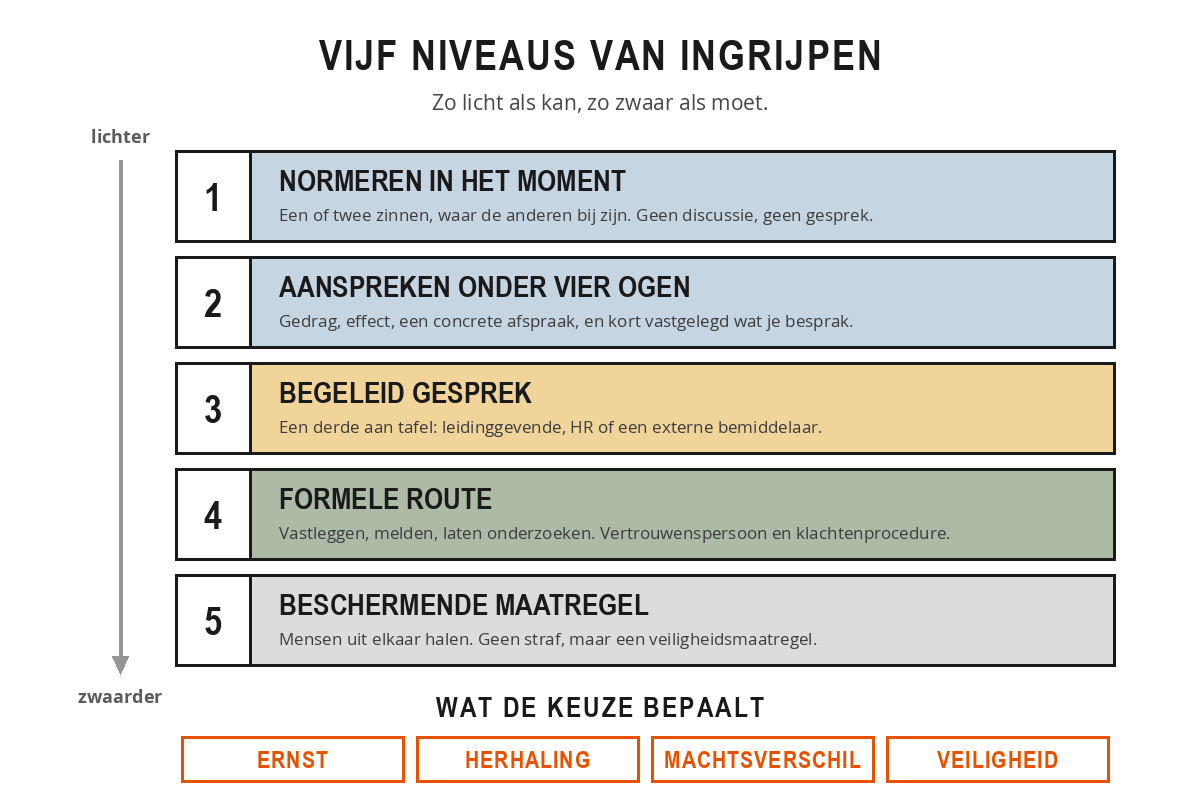
Setting the norm in the moment is the first step. You interrupt and name it, in one or two sentences, in front of the others. No discussion, no conversation. This is the cheapest intervention there is and at the same time the most underused.
Addressing it one to one is the second. You state what you observed, what it did to you, what the consequence is and what you want to be different. You make one concrete agreement and briefly note down what you discussed. This suits behaviour that recurs or that is too serious for a passing correction.
A facilitated conversation is the third. A third party joins the table: a manager, an HR adviser or an external mediator. That is needed as soon as those involved no longer hear each other, or as soon as the power imbalance is so great that a one-to-one conversation works out unfairly.
The formal route is the fourth. You put things on record, report them and have them investigated. This is where the confidential adviser and the complaints procedure come in. The relationship between those involved almost always hardens; that is the price you knowingly pay.
A protective measure is the fifth. You separate people: a different rota, a different workplace, temporary leave. That is not a punishment but a safety measure, and you use it as soon as someone is at risk.
How firmly do you intervene
Which level is appropriate is not something you decide on instinct, but with four questions. Severity: is it an awkward remark, or is it threat, assault or structural humiliation? In the case of a criminal offence, you skip the lighter levels. Recurrence: a first incident leaves room for ignorance, but by the third time the pattern is the problem and setting the norm in the moment no longer works. Power imbalance: is the person on the receiving end of the behaviour dependent on the person displaying it? With a temporary contract, a work placement or an appraisal relationship, a one-to-one conversation is rarely safe enough. And the safety of the person involved: what happens to this person the moment you act? You ask that question out loud to the person concerned, before you make any move.
The rule of thumb is: as lightly as possible, as firmly as necessary. Intervening too lightly confirms the very norm you set out to correct. Intervening too firmly costs you trust you will need later on, because people learn that every remark ends up in a file.
At a service desk, team leader Rachid makes a remark three times in two weeks about a new employee's "lack of overview", each time in the team meeting. The employee is on a temporary contract and says nothing. Severity: moderate. Repetition: three times. Power difference: large, because Rachid decides on the extension of her contract. Safety: the employee does not dare to say anything herself. Level 1 is ruled out, because the pattern is too big for a single sentence in the moment. A conversation between the employee and Rachid is also ruled out, because that is not safe. It becomes a conversation between Rachid's own manager and Rachid, followed by feedback to the employee about what has been agreed.
Do not choose a level on your own. Put your reasoning to someone who is not involved in the situation: an HR adviser, a fellow manager or the confidential adviser. The question is then not "what do you think of it", but: "which level would you choose, and why?"
The route in your own organisation
From the fourth rung onwards it no longer runs through you, but through your organisation's procedure. That consists of two parts. The confidential adviser is the only place where someone can tell their story without something automatically being set in motion: no procedure starts there unless the person reporting wants it to. The confidential adviser listens, explains what routes are available and what each route means, provides support if a formal step is taken and refers on to the occupational health doctor, a lawyer or the police. What a confidential adviser does not do is just as important: no investigation, no hearing of both sides, no judgement about what is true and no confronting anyone about their behaviour. That role sits explicitly alongside the person reporting.
The second element is the complaints procedure. This sets out who handles a formal complaint, within what time frame, with what rights for both parties, who takes the decision and how the outcome is fed back. Without such a procedure every report is a one-off, and a one-off here mainly means arbitrariness.
This free course is not a reporting point and not a support service. Learnit does not handle reports, does not carry out investigations and does not mediate. Nor does the course replace the confidential adviser or your own organisation's procedures: those always take precedence over what you read here.
If something is going on at work, the confidential adviser is the first port of call, alongside your manager, HR, the works council and the occupational health physician. If there is no confidential adviser, or you are getting nowhere, you can turn to your trade union, the Juridisch Loket or the Netherlands Labour Authority. In the case of a criminal offence, the police are the appropriate route. If you yourself are suffering from sleep problems, tension or low mood, discuss this with your GP or occupational health physician.
Map out the route within your own organisation. For each answer, note down where you found it.
- Who is the confidential adviser, and how can they be reached?
- Is it internal or external, and how can you tell?
- Where is the complaints procedure published?
- Who takes on a complaint, and within what time frame do you hear back?
- Which question could you not answer within ten minutes?
That last question is the most important one. What you cannot find within ten minutes, a colleague who needs it will not find either.
Summary
- A fact passes the camera test; an interpretation is your own reading of it and a judgement is about the person.
- Make a note on the day itself, keep two other explanations open and check with the person concerned.
- Five levels of intervention: setting the norm in the moment, a one-to-one conversation, a facilitated conversation, the formal route and a protective measure.
- Four weighting factors determine the level: severity, recurrence, power imbalance and the safety of the person involved.
- The rule of thumb is as lightly as possible, as firmly as necessary. Too lightly confirms the norm, too firmly costs trust.
- The confidential adviser listens and informs, but does not investigate and does not confront anyone.
- The complaints procedure sets out who does what, within what time frame and with what rights for both parties.
Which of these four sentences is a fact that passes the camera test?
For the third time, an intern receives a belittling remark from the supervisor who also writes his appraisal. What is the argument against a one-to-one conversation between those two?
What is not part of the confidential adviser's role?
Ready for the next step?
You have completed the free starter of Inappropriate Behaviour. The next chapter in the full course is How unwanted behaviour arises: Power as a breeding ground, the triggers in the work situation and the norm that shifts step by step.
Take the 1-day training course →From €625,- excl. VAT · with an experienced trainer alongside you