


2. What it does to a team
From the outside, inappropriate behaviour looks like a matter between two people. Usually it is not. Whether behaviour is given room depends on what the group around it has come to regard as normal, and on what happens when somebody speaks up. This chapter is about that group.
After this chapter:
- You know how unwritten group norms arise and how to recognise them.
- Can you explain what Asch's research says about going along with the group.
- You know the five steps between noticing and intervening, and where bystanders drop out.
- Whether you recognise the three roles of the drama triangle and their healthy counterparts.
- You can distinguish a scapegoating pattern from a performance problem.
Unwritten rules determine what is normal
Group norms are the shared, usually unspoken expectations about what you do and do not do in a team. They concern the work itself, and just as much the way people treat each other: which jokes are acceptable, how blunt you may be with one another, whether you may say that something affects you.
No one set such a norm. It grows out of repetition. Someone does something, no one responds, and the next time someone else does the same. After a few months it is a habit, and after a year it is "just how we are here". Four things reinforce one another in this. The the example set by influential figures carries more weight than any code of conduct: if the manager laughs along with a humiliating joke, the joke has been approved. Absence of correction is the second, because silence is not a neutral signal; anyone who says nothing confirms that it falls within acceptable limits. The third is reward and punishment on a small scale: an approving nod, laughing along, being invited for coffee or not. Those small reactions steer behaviour more powerfully than an annual review. And the fourth is the stories that circulate. "Do you remember when that intern filed a complaint?" That way newcomers learn, without a single instruction, what speaking up costs around here.
You notice a norm most sharply at the moment someone breaks it. The newcomer who says in week two that he is not okay with that remark gets a brief silence and then a joke to take the tension away. That reaction is the norm in action.
Ask new colleagues after six weeks: "What surprised you here at first, and what have you got used to by now?" That second part yields the most information. Whatever someone no longer notices has become a norm.
Why people go along with the group
In the 1950s the social psychologist Solomon Asch studied how far people go along with a group that is visibly wrong. Participants were shown a card with a single line and a second card with three lines of clearly different lengths, and had to say which one was the same length. Those who did it on their own were nearly always right.
The test subject, however, was in a group of seven to nine people who had all been briefed by the researcher. In some of the rounds they gave the same wrong answer out loud, just before the real participant's turn. About three-quarters of the participants went along with that wrong group answer at least once; across all rounds, more than a third of the answers were wrong.
If people already go along with a group on something you can check with the naked eye, you can imagine how that works with a question such as: did that remark go too far? There is no ruler for that.
Why nobody says anything
The more people witness unwanted behaviour, the smaller the chance that anyone steps in. Social psychologists Bibb Latané and John Darley described this in 1968 as the bystander effect. Between noticing something and doing something about it there are five links, and each link can go wrong.
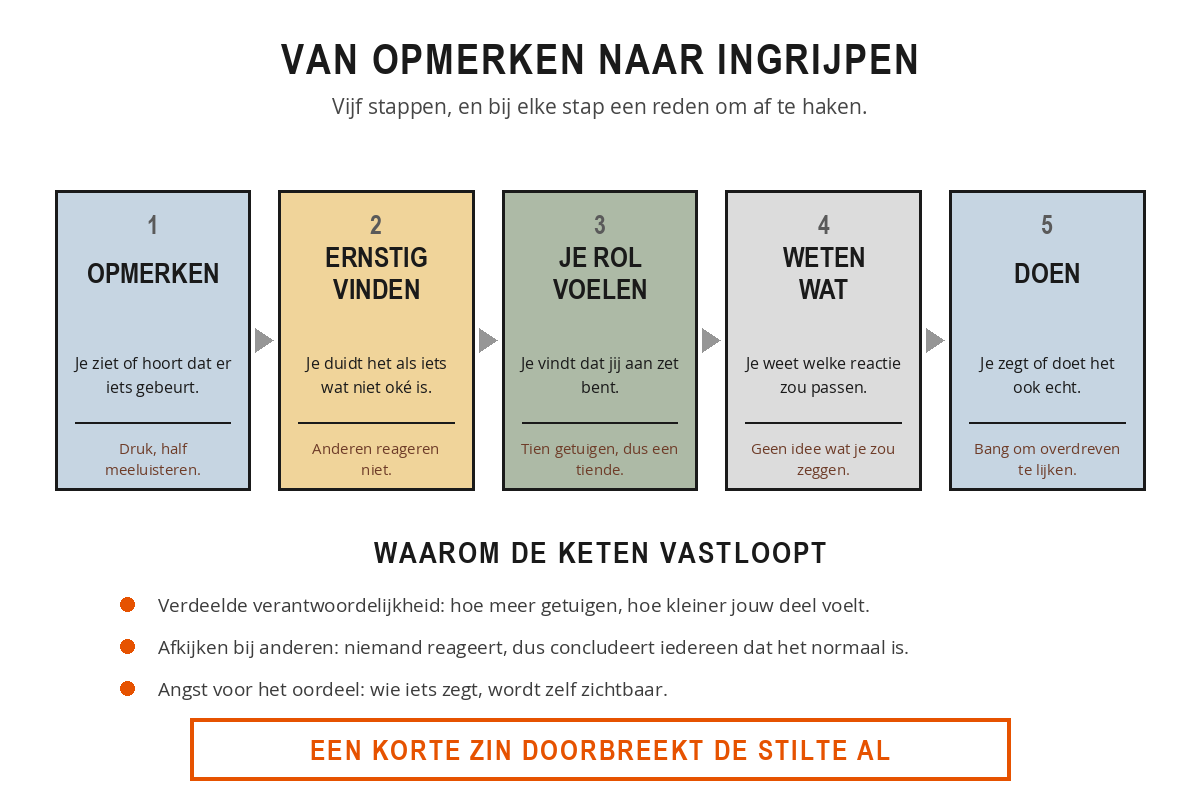
The first step is noticing that something happens; anyone who is busy or only half listening gets no further than this. The second is the taking it seriously: you have to interpret the situation as something that is not okay. The third is feeling responsible. The fourth is knowing what you could do, and the fifth is the actually doing it.
In the workplace, three mechanisms in particular cause that chain to jam. With diffusion of responsibility you are standing in the canteen with ten colleagues and therefore carry only a tenth of the responsibility. Everyone works it out that way, so nobody moves. With pluralistic ignorance you look at other people's reactions to decide whether something is serious; they are doing the same, and because nobody reacts, everyone concludes that it must be normal. And with evaluation apprehension the fear of being seen as overreacting or humourless keeps people quiet, certainly when the person displaying the behaviour has influence in the team.
During a team meeting, Rick makes a remark about Amina's accent for the third time. People laugh. Seven people at the table feel that this is not OK. Nobody says anything. Afterwards, at the coffee machine, four of them tell each other that it really went too far. Amina does not hear that conversation. What she takes home with her is that the whole team laughed along.
The good news is that the effect is easy to break. As soon as someone removes the anonymity, the shared responsibility disappears. A look, a short sentence or mentioning a name is enough, and after the first response the chance of a second one rises sharply.
You don't have to resolve the situation in order to break the silence. One sentence is enough: "I saw Amina flinch" or "this makes me uncomfortable". You state an observation, not a judgement. That makes it easier for the next person to join in.
Three roles that keep each other going
In 1968, Stephen Karpman described a pattern that you see again and again in teams that have got stuck. People unconsciously take on one of three roles, and those roles keep each other going. The Victim feels powerless: "there's nothing I can do about it." That attracts attention and it costs influence. The Persecutor points and accuses: "it's your fault." That gets you the upper hand and it costs you the relationship. The Rescuer steps in without being asked to: "just let me sort it out." That earns appreciation, and it keeps the Victim small.
What makes the triangle so persistent is the role switch. The Rescuer who isn't thanked becomes the Persecutor. The Persecutor who is challenged becomes the Victim. That is how it keeps turning, and how the behaviour itself remains undiscussed. In 1990 Acey Choy set a healthy variant alongside it. The Victim becomes Vulnerable: you acknowledge that it affects you and you say what you need. The Persecutor becomes Challenger: you name the behaviour and the boundary, without tearing the person down. The Rescuer becomes Coach: you ask what the other person wants to do themselves, instead of taking it over.
Sanne tells her team leader that Boris repeatedly belittles her in meetings, adding that there is nothing she can do about it herself. Without consulting Sanne, the team leader removes Boris from the project team and sends him a firm email about his attitude. Boris feels ambushed and tells colleagues that he has been dismissed without being given a hearing. The team takes sides. Three roles, two role swaps, and the behaviour it was all about has never been discussed.
When the team singles out one person
In teams under pressure, tension builds up that has nowhere to go. Often the group places that tension with one person. That person becomes the explanation for everything that is not working, and as long as he fulfils that role the team does not have to look at itself. That is a group process, even though from the outside it looks like a matter between two people.
The choice is rarely random: it is usually someone who stands out. The newcomer, the one who asks critical questions, someone who has just returned after sick leave, or the person who reported someone else's behaviour. In the short term it works for the team, because there is a shared explanation and no one has to tackle the real cause.
The group always has its arguments ready: he simply isn't performing, she has a part in it herself. Sometimes part of that is true, which is why the distinction matters. With a performance problem it is about concrete work and people differ in their views on how bad it is. With a scapegoat pattern it is about the person, the team is strikingly unanimous, and the problem does not disappear when that person leaves. The role then simply passes to the next one.
Think of one occasion when several people saw something happen and nobody responded.
- Which of the five steps broke down: noticing, considering it serious, feeling responsible, knowing what to do, or acting?
- Which mechanism played a part in this: diffusion of responsibility, copying others or fear of being judged?
- Which sentence could you have said at that moment, in twelve words or fewer?
- What would that sentence probably have done to the others at the table?
This exercise is not meant to make you blame yourself. A chain that gets stuck is the rule, not the exception.
Summary
- Group norms arise from repetition, exemplary behaviour, the absence of correction, small rewards and the stories that circulate.
- Asch's research shows that three quarters of people go along at least once with a group that is visibly wrong.
- Between noticing and acting there are five steps: noticing, considering it serious, feeling responsible, knowing what you can do, and doing it.
- More witnesses means less intervention, because responsibility is divided, people copy others and fear being judged.
- One response breaks the silence; it does not have to solve the situation.
- In the drama triangle, people switch between Victim, Persecutor and Rescuer; Vulnerable, Challenger and Coach are the healthy counterparts.
- With a scapegoat pattern it is about the person, the team is united, and the role passes on to someone else once that person leaves.
Seven colleagues hear a hurtful remark and nobody says anything about it. What best explains that?
A colleague takes over someone else's problem without being asked to. Which role is that?
How do you recognise a scapegoating pattern rather than an ordinary performance problem?