


2. Pyramid writing
Your reader decides within the first twenty seconds whether to read on. Pyramid writing therefore puts your conclusion at the top and the supporting evidence underneath. Exactly the opposite of what you were taught at school.
After this chapter:
- you explain what pyramid writing is and why it works for business readers.
- You put the key point of your text in the first paragraph, with your supporting evidence beneath it.
- You organise your information in layers, with each layer answering the question raised by the layer above it.
- You choose deliberately between four structural models for the order beneath your key point.
- you assess whether a text of your own is easy to scan.
The key point at the top
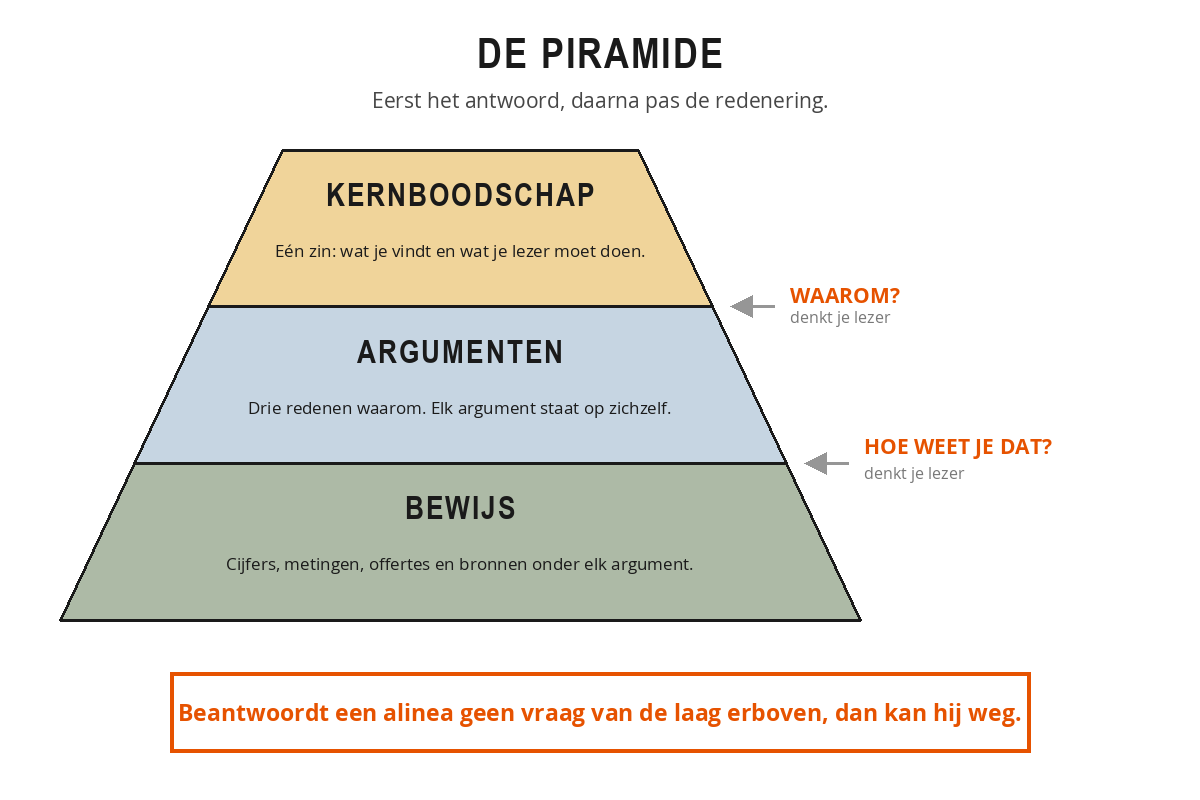
Pyramid writing is a way of structuring in which you start with your conclusion and only then explain what it rests on. The name comes from the shape: a single point at the top, a broad layer at the bottom. Your reader gets the answer first and then, layer by layer, the reasoning.
That feels awkward at first. In your education you were probably taught the opposite: first your background, then your method, then your findings and, right at the end, your conclusion. That structure follows the path you took as the writer. A business reader has little use for it. He reads under time pressure, he reads your piece in among twenty others, and he wants to know what is expected of him.
There are three advantages to putting the core message at the top. Your reader can stop whenever they want. Anyone who drops out after the first paragraph still knows your message; anyone who wants to know more reads on to whatever level of detail he needs. Everything that follows takes on meaning. A figure on page three means nothing if the reader does not yet know which conclusion it is supposed to support. If your conclusion is at the top, every piece of data after it falls into place. And you force yourself to take a position. As long as your conclusion is on the last page, you can keep writing around it. Put it at the front and you notice straight away whether you really have a view.
The opening paragraph
The first paragraph of a pyramid text contains three things: the occasion in one sentence, your core message from chapter 1, and the action you are asking of your reader. Nothing more. All nuance, all caveats and all explanation of how you reached your judgement come later.
Classic structure, conclusion at the end: "In the spring, a survey was started into the use of the meeting rooms on the second floor. Occupancy rates, booking behaviour and the number of no-shows were examined. The results were compared with those of last year. On that basis, a number of scenarios were costed out. It is recommended that two rooms be converted into flexible workspaces."
Pyramid structure, key point at the top: "Convert two meeting rooms on the second floor into flexible workspaces. Occupancy there has been below 30 per cent for two years, while there is a structural shortage of quiet spaces. The conversion costs 18,000 euros and can take place during the summer recess. Please give your approval before 1 May, so that the contractor can still be scheduled in."
The second version is shorter, and after one paragraph the reader knows what he is saying yes or no to.
Not sure whether your core message is in the right place? Read only your opening paragraph aloud to a colleague who does not know the file. If they can then say in their own words what you want and what they should do, you are on the right track. If they first have to leaf through the rest, your core message is too far down.
Hierarchy in your information
Putting the core message at the top is the first half of the work. The second half is that everything below it is arranged in layers, with each layer answering the question raised by the layer above it.
Suppose you open with: "Convert two meeting rooms into flexible workspaces." Your reader immediately thinks: why? That is the question the second layer answers. You give three arguments: occupancy is too low, there is a shortage of quiet spaces, and the costs are limited. With each argument your reader thinks again: how do you know that? That is the third layer: the measurement data, the waiting list, the contractor's quotation.
By working down that chain from top to bottom, you find the paragraphs that do not belong. If a paragraph answers no question raised by the layer above it, it can go. Often it is information you came across during your research and felt it would be a shame to throw away.
Choosing a structure that fits
The pyramid tells you what goes at the top. It does not tell you in what order the arguments beneath it should come. For that you choose a structural model: a fixed pattern that your reader recognises, so that he knows where to find which information. Four models cover virtually all your business texts.
- Problem-solution. You sketch the situation, identify what is going wrong, present the solution and show what it delivers. This works in advisory notes and improvement proposals, where your reader first has to acknowledge the problem before taking your solution seriously.
- Comparing options. You set out the question, give the criteria you are assessing against, work through the alternatives and close with your recommendation. Useful when choosing a supplier or making an investment decision. You state the criteria before the options, otherwise your conclusion looks like an afterthought.
- Chronological. You follow the timeline: background, course of events, current state of play, next steps. This suits progress reports, evaluations and incident reports. For a piece of advice it works badly, because your reader then has to wait until the last page for your point.
- Thematic. You divide the material into parts that sit side by side: by department, by target group, by policy area. This suits an annual report or a survey in which no single part is more important than another.
Your aim determines the choice, not your convenience. If you want to prompt a decision, use problem-solution or comparing options. If you want to inform people about what is going on, chronological or thematic will do. A common mistake is to follow the order of your own research. You started with the occasion, did four weeks of work and only reached your conclusion at the end. For your reader you reverse that order.
Karin has to choose a new time registration system and is writing to the board about it. Her first draft is chronological: how the question arose, which four suppliers she spoke to, in what order, and what came out of the last conversation.
Her aim is a decision, so she switches to comparing options. She opens with her recommendation: supplier B, 14.000 euro per year, live on 1 September. She then names the three criteria she assessed against: integration with the payroll system, price per user and implementation lead time. Only after that does she take the four suppliers through those criteria.
The difference: in the first version, the management team has to work out for itself what Karin looked at. In the second, both the yardstick and the outcome are there, in that order.
Writing for scanning
Your reader rarely starts at the first word and rarely finishes at the last. They scan: they read the title, hover over the first paragraph for a moment, slide past the subheadings and pick out the sentences that stand out. Writing for scanning means arranging your text so that this scan already gives them most of your message. Four choices do most of the work here.
- Put the essence of each paragraph in the first sentence. Anyone who reads only the opening sentences should come away with the broad outline of your story. The rest of the paragraph is explanation.
- Write subheadings that make a claim. "Occupancy fell to 34 per cent" says more than "Occupancy figures". A reader who reads only the headings then still reads your line of argument.
- Use lists for anything that forms a series. Three criteria, four steps, five risks: set them out one below the other. In a running sentence the third item disappears.
- Leave white space. A page without white space looks like work. Bold type only helps as long as you use it sparingly: mark five things on a page and you have marked nothing.
Before: "On the basis of the measurements carried out in the second quarter, it may be concluded that the occupancy rate of the meeting rooms falls short of the norm."
After, as a subheading plus opening sentence: "Occupancy remains well below the standard. The second-quarter measurements show an occupancy rate of 34 per cent, against a standard of 70 per cent."
Take a report, a piece of advice or a longer email that you have written in recent months.
- Underline the sentence containing your conclusion and note which paragraph or page it is on.
- Rewrite your opening paragraph along the three elements: occasion, core message, requested action. Keep it to five sentences at most.
- Work out which of the four structural models you used unconsciously, and which model would have suited your purpose better.
- Copy only the title, the subheadings and the first sentence of each paragraph into a blank document. Is your core message there, and does a reader know what he has to do?
- Rewrite the three weakest subheadings as claims.
Summary
- The pyramid puts your conclusion at the top, your arguments below it and your evidence at the bottom.
- That works because your reader can stop whenever they want, everything that follows acquires meaning, and you are forced to take a position.
- Your opening paragraph contains three things: the reason for writing, your key message and the action requested.
- Each layer answers the question raised by the layer above it: why, and then how do you know.
- The pyramid determines what goes at the top; the structural model determines the order beneath it. Problem-solution and comparing options suit decision texts; chronological and thematic suit informative texts.
- You write for scanning by putting the core message in the first sentence, using headings that make a claim, putting series into bullet points and leaving enough white space.
According to this chapter, what belongs in the first paragraph of a pyramid text?
You have to let the board choose between four suppliers. Which structural model fits best?
How does the pyramid help you find the paragraphs that can go?