


3. Writing clearly and concisely
Two people can write down exactly the same message, and yet your reader will only understand one of the two versions. The difference lies in your choice of words, the length of your sentences and the amount of noise around them.
After this chapter:
- You choose concrete words instead of abstract catch-all terms.
- You recognise noun style and convert it into verb style.
- You assess the average sentence length of your text and adjust it.
- You remove filler words, verbosity and superfluous auxiliary verbs from your sentences.
- You determine whether your text should be formal, neutral or informal.
Five choices that make your text clear
Writing comprehensibly means that your reader reads your sentence correctly the first time. Not twice, not with a frown, not wondering "what does this actually say?". You achieve that not by dumbing things down, but by keeping your words and your sentence structure close to reality.
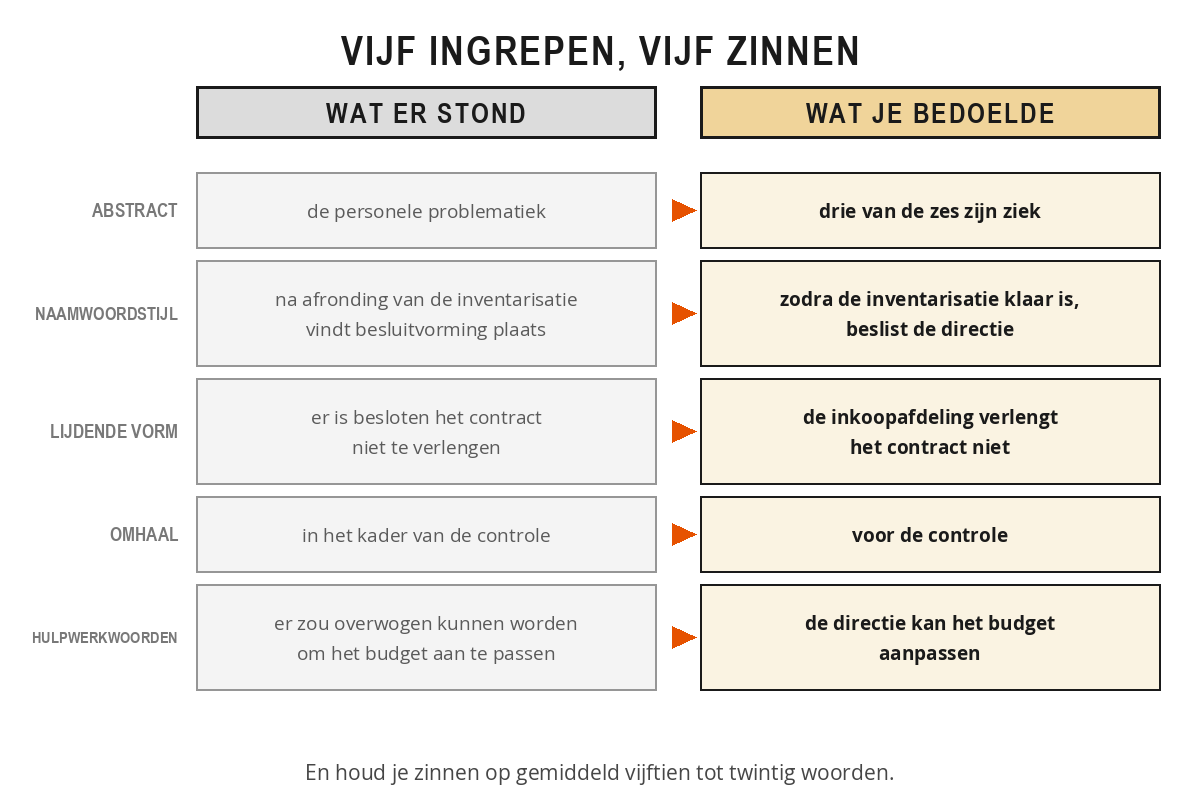
1. Concrete over abstract. Words such as issues, aspects, factors and preconditions cover everything and say nothing. Write what you mean: not "the staffing issues at the reception desk", but "three of the six reception staff are on long-term sick leave".
2. Verb style over noun style. Nominalisation is the habit of turning a verb into a noun: to check becomes "the carrying out of the check". The action then disappears from the sentence and all that remains is a vague assertion. "Following completion of the inventory, decision-making takes place" becomes: "Once the inventory is finished, the board decides." Words ending in -ing, -ation and -ness are your signal to check whether a verb is hidden inside.
3. Active over passive. A passive sentence often leaves out who is doing something. "It has been decided not to renew the contract" leaves your reader with a question. "The purchasing department is not renewing the contract" is just as long and a good deal clearer. The passive is fine, but only when the person acting really is beside the point.
4. Use technical terms only with a reader who knows them. Your reader profile from chapter 1 tells you how much prior knowledge your reader has. If your text lands with a director outside your field, explain a term once or replace it. Two unfamiliar terms in one paragraph will cost you his attention.
5. One thought per sentence. Sentences become incomprehensible as soon as three statements are crammed into them. At every "and", "whereby" or "which" you can split the sentence and see whether two proper sentences emerge.
Sentence length as a yardstick
For business texts, an average of fifteen to twenty words per sentence works well. That is an average, not a maximum: alternating between a sentence of seven words and one of twenty-five keeps your text alive. What does stand out is a text in which every sentence runs to thirty words. That reads like a wall.
You check your own sentence length in four steps. Choose a paragraph of five to six sentences from a text you wrote last week. Count the words per sentence and write the figures out side by side. Work out the average and find the longest sentence. Split it into two sentences and read the paragraph again.
Erik writes to his team leaders: "With regard to the appraisal forms supplied by the HR department, it can be reported that the processing thereof, partly in view of the holiday period, is expected to take place in week 34, after which feedback to the managers will follow."
One sentence, 39 words, and nobody does anything. Erik counts, splits and cuts: "HR has supplied the appraisal forms. We will process them in week 34, after the holidays. You will hear from us after that."
Three sentences averaging nine words, and in each one you can see who does what. From 39 words to 23, without any information disappearing.
Writing concisely
Writing concisely means that every word in your sentence does some work. A concise text is not automatically a short text: you may well need three pages for your subject. What is not allowed is that your reader has to plough through thirty words for a message that could have been made in ten. Four categories yield the greatest gains when you start cutting.
- Padding around a preposition. "In the context of" becomes "for", "with regard to" becomes "about", "in respect of" becomes "for", "at the moment that" becomes "when". One word does the work of four.
- Filler words and hedges. Words such as actually, in principle, perhaps, somewhat, though, rather and of course weaken your statement without adding anything. "In principle this is actually rather a good solution" says less than "This is a good solution".
- Stacked auxiliary verbs. "It could be considered to adjust the budget" contains four verbs for one action. "The management can adjust the budget" is enough.
- Empty introductions. "It is important to mention that", "We hereby inform you that" and "As you know" can almost always be left out. The message itself begins after them.
Use your word processor to search for your personal filler phrases: "in the context of", "with regard to", "actually" and "could possibly". Three minutes of searching often yields ten per cent fewer words, without changing anything about your content.
Pace in your sentences
A correct, concise text can still be dull. You create pace with the active voice, with verbs instead of nouns, and with concrete figures and names. "The lead time has been considerably reduced" says less than "The lead time went from eleven days to four". A figure, a name or an example sticks; an abstraction slips away. Vary your sentence length as you do so: five sentences of the same length sound like a metronome, and a short sentence after a long one automatically gains emphasis.
Choosing your register
Your register is the pitch at which you write. You can deliver the same message formally, neutrally or informally, and that choice determines how your reader feels treated. Three things point you in the right direction. Your relationship with the reader: the greater the distance and the stakes, the more formally you write. The medium: a grant application can carry formal language, while an internal email sounds distant in the same style. And the convention within your organisation: some companies address their customers informally as standard, others never do.
The same message, three times. Formal: "We hereby inform you that your application has been taken into consideration and that you will receive notification within six weeks." Neutral: "Your application is being processed. You will hear from us within six weeks." Informal: "Your application is on our pile. We'll let you know how things stand within six weeks."
The information is identical. The relationship the sentence proposes is completely different.
Within a single text you keep your register consistent. A letter that opens with "Dear Mr De Vries" and halfway through switches to "just to be clear" shows that two writers were at work, or one writer who lost sight of the reader.
Rewrite these three sentences and note for each one which choice you applied and how many words you saved.
- With regard to the reimbursement you have requested, it can be reported that the assessment thereof will take place in week 12.
- The implementation of the new registration system has led to an improvement in lead times.
- Managers are required to ensure that the appraisal forms are submitted in a timely manner.
Then take a text you sent in the past month. Count the words in your five longest sentences, split them, and work out where your text sits on the scale: formal, neutral or informal. Does that register suit this reader and this medium? If not, rewrite your opening paragraph.
Summary
- You write comprehensibly by using concrete words, verb style, the active voice, technical terms geared to your reader and one thought per sentence.
- You can recognise nominal style by words ending in -ing, -ation and -ness: there is usually a verb hidden inside them.
- Fifteen to twenty words per sentence works well as an average. Alternate short and long sentences.
- Concise writing means cutting in four categories: padding around prepositions, filler words, stacked auxiliary verbs and empty introductions.
- Concrete figures and names stick; abstractions slip away.
- Your register follows from your relationship with the reader, the medium and the convention within your organisation, and stays the same throughout a single text.
"Following completion of the inventory, decision-making will take place." What is mainly going on here?
According to this chapter, what is a usable average sentence length for business texts?
Which of these four changes makes your text more concise without losing information?