


4. Polishing your own text
Two words that say the same thing, or a qualifier that is already contained in the word itself: you read straight past them until someone points them out. After that you see them in every paragraph. Vagueness works in exactly the same way.
After this chapter:
- You recognise a pleonasm and a tautology in your own text and delete the redundant word.
- You assess when a duplicated formulation does do useful work.
- You convert vague quantities, deadlines and catch-all terms into concrete information.
- You convert a passive sentence into the active voice, and you know when to leave it as it is.
- You check your text in three focused reading rounds.
Pleonasm and tautology
Both mistakes amount to the same thing: you are saying something twice. The difference lies in how you do it.
In the case of a pleonasm you add a qualifier that is already part of the meaning of the word. Snow is white, so "white snow" tells your reader nothing new. In business texts the variants are less visible, but just as redundant. "A new innovation" is an innovation. "The definitive final version" is the final version. "A future forecast" is by definition about the future. "Planning in advance" cannot be done afterwards. Your test is simple: remove the qualifier and see whether the meaning changes. If the sentence still says the same thing, the word was redundant.
In the case of a tautology two synonyms stand side by side, usually joined by "en": "helder en duidelijk", "haalbaar en realistisch", "enkel en alleen", "al reeds". Signal words are fond of doubling up too: "dus daarom", "echter maar", "maar toch". That last group is the most treacherous. Two signal words with the same function do not make the connection stronger, they make the sentence longer. One linking word per connection is enough.
Not every duplication is a mistake. Some combinations are set expressions that you use as a whole: "wis en waarachtig", "hulp en bijstand", "kort en goed". And sometimes you deliberately add a word for emphasis, for instance in a speech or a quotation. The question to ask: does the second word do any work, or is it just filling space?
Original: "We would hereby like to inform you clearly and unambiguously about the new innovation that we have scheduled in advance for the coming future quarter."
Rewritten: "We are informing you about the innovation that takes effect next quarter."
From 21 words to 11, without any information disappearing. What went: a tautology ("clear and unambiguous"), two pleonasms ("new innovation", "planned in advance") and an empty introduction.
Vagueness in business language
Repetition makes your text longer. Vagueness makes it unusable. Your reader reads the sentence, nods and afterwards still knows nothing. That happens in three places: with quantities, with deadlines and with big words that mean everything and nothing.
"A number of employees", "various complaints", "regular consultation", "in the short term": it sounds as though there is information there. Yet your reader cannot base a decision on it. Are we talking about three employees or thirty? Is "the short term" next week or this quarter? Three replacements make such a sentence usable. Replace the quantity with a number: "a number of customers have complained" becomes "seven customers have complained". Replace the deadline with a date: "implement in the short term" becomes "implement before 1 March". Replace the frequency with an interval: "evaluate regularly" becomes "evaluate every quarter".
If you do not know the figure, write that down: "an estimated fifteen to twenty". An honest estimate gives your reader more to go on than a word that pins nothing down.
Catch-all terms are the third place to look. Words like policy, process and communication fit every situation and therefore cover none. "We are improving communication" only becomes usable once it says who reports what to whom: "The team leader emails the schedule to the team every Monday."
Go through your draft using the search function for "a number of", "various", "in the short term", "regularly" and "shortly". Every hit is a place where your reader is left with a question that you could have answered.
The passive voice
The passive voice is the hardest to spot, because the sentence is grammatically sound. You recognise it by a combination of be or to be with a past participle: the decision is taken, the complaints have been handled. In both sentences, the person doing it is missing. You rebuild such a sentence in three steps.
- Look for the combination. Using the search function for "wordt", "worden", "werd", "is ge" and "zijn ge" will find you virtually every instance.
- Question: who is doing this? If the answer is in the sentence, usually after "by", bring it to the front. If it is not there, you have to look it up. That looking up is exactly what this exercise gains you.
- Put the person performing the action first. "It has been decided to extend the pilot" becomes "The steering group is extending the pilot". Your sentence gets shorter and your reader knows who to approach.
Not every passive sentence has to go. In three situations it is the best choice. When the agent is irrelevant: "The questionnaire was sent out in March" - who sealed the envelope is of no interest to your reader. When the action matters more than the person carrying it out, as in a process description: "The application is assessed within five days." And when you deliberately want to protect someone: with a sensitive announcement, it can be unpleasant to pin a decision on one individual.
Passive: "In response to the signals received, it has been decided that the process will be reviewed again."
Active: "Prompted by reports from twelve customers, the Quality department is reviewing the process again."
The second version is shorter, mentions a number and names a sender. With the first version, no one can check who holds that view.
If you come across three passive sentences in a row in a single paragraph, it is no longer a matter of choice. Convert at least two of them. A text in which nobody does anything reads like a machine doing the talking.
Revising in three rounds
Revising almost always fails for the same reason: you read for everything at once. While you are moving a comma, you miss the fact that your third paragraph actually belongs at the front. By focusing on one thing at a time, you see more in each round.
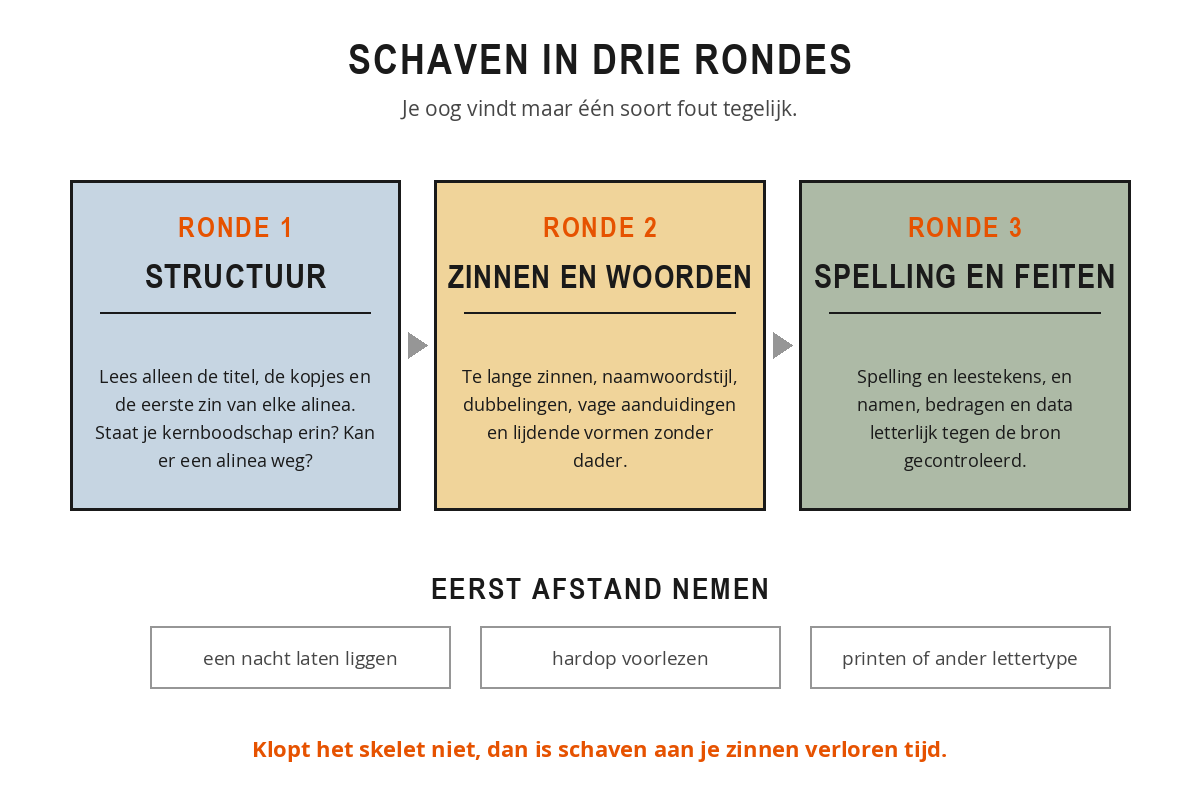
In round 1 read only the title, the headings and the first sentence of each paragraph. Is your key message in there? Is the order right? Can a paragraph go? If that skeleton isn't right, polishing your sentences is time wasted.
In round 2 you tackle the sentences using the points from chapter 3 and the pitfalls from this chapter: overly long sentences, nominal style, redundancies, vague references and unnecessary passive forms.
In round 3 check your spelling and punctuation, and check names, amounts and dates literally against the source. A wrong amount costs you more credibility than ten clumsy sentences.
Before you begin round 1, you take some distance. You read your own text in your head as you meant it, not as it stands on the page. Three methods break through that blind spot. Leave the text overnight; half an hour's break already helps, a night works better. Read aloud: where you run out of breath, your sentence is too long, and where you stumble, there is a wrong preposition. Or change the appearance: print the text, or temporarily put it in a different typeface, so that your eyes slide less easily over familiar lines.
Sander sends a one-page progress email and polishes it in three rounds. In round 1 he sees that his last paragraph, containing the request for approval, belongs at the top. It moves. Two paragraphs about a colleague's induction do not answer any question his reader has; they go out.
In round 2 he counts seven passive sentences, converts four of them, and replaces "in the short term" with "before 15 October" and "a number of outages" with "four outages".
In round 3 he finds two spelling mistakes and, more importantly, an amount that differs by 4,500 euros from the quotation. His email goes from 480 to 310 words. The reply came the same afternoon.
Cross out the redundant word in each sentence and note whether it is a pleonasm or a tautology.
- The project group has already previously sent the definitive final version.
- We ask you to check the data in advance before you submit it.
- The proposal is feasible and realistic and therefore thus fits within the budget.
- In the near future we expect a future rise in demand.
- This approach is solely and exclusively intended for new employees who have only just joined.
Then take a business text of at least one page that you sent yourself. Search for "is", "are" and "been" and count how many passive sentences you find. Pick the three in which the missing actor leaves your reader with a question and rewrite them in the active voice. Finally, go through round 1 and note which paragraph can be dropped, plus your own top three recurring mistakes.
Summary
- You remove pleonasms and tautologies with the omission test: if the meaning does not change, delete it.
- A redundancy may stay if it is a fixed expression or if you are deliberately adding emphasis.
- Replace vague indications with a number, a date or an interval, and catch-all terms with who does precisely what.
- If you do not know the number, give an honest estimate. That offers more to go on than "a number of".
- You recognise the passive voice by a form of 'to be' plus a participle. Ask "who is doing this?" and put that person at the front.
- Leave the passive voice in place if the actor is irrelevant, if the action is what matters, or if you are deliberately protecting someone.
- Revise in three rounds: first the structure, then the sentences and words, then spelling, punctuation and facts.
- Taking some distance, reading aloud and changing the appearance of the text are what make your own mistakes visible.
"Het voorstel is haalbaar en realistisch en past dus daarom binnen het budget." What appears twice here?
In which of these sentences may the passive voice remain, according to this chapter?
According to this chapter, why do you proofread your text in three separate rounds?
Ready for the next step?
You have completed the free starter of Writing Clear Texts. The next chapter in the full course is Persuasive writing: Three building blocks of persuasiveness, ordering your arguments and moving from text to action in proposals and quotations.
Take the 2-day course →From €1250,- excl. VAT · with an experienced trainer included