


Introduction
A good interview seems to run by itself. The other person talks, you listen, and together you bring something to light that wasn't there before. Anyone who has conducted a few knows how deceptive that impression is. Behind an interview that feels effortless lies an objective you sharpened beforehand, a question you ask at the right moment, and the composure to wait until the other person carries on.
An interview is not a conversation. In a conversation two people speak in turn and anything may go in any direction. In an interview one of the two has a need for information and the other has the answer, and it is your job to bring those two together without it becoming an interrogation. That takes technique, and technique can be learned.
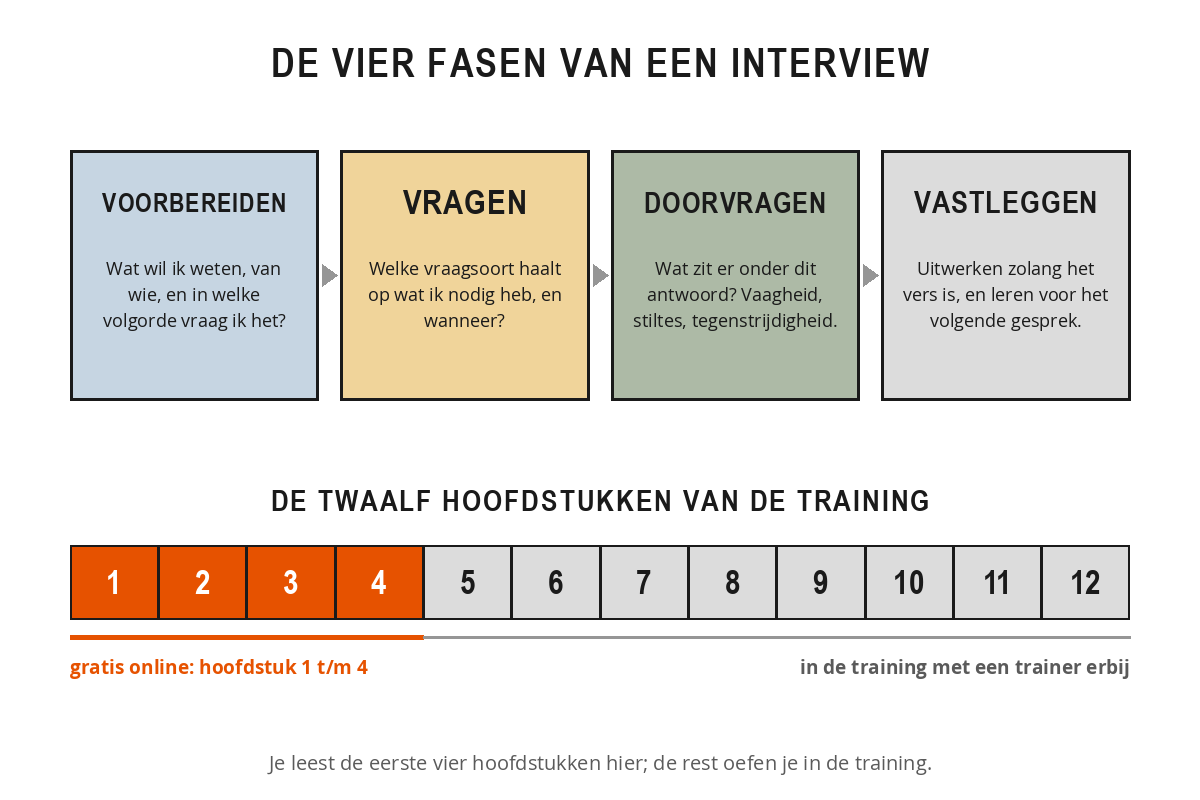
This free course contains the first four chapters: the orange part of the bar above. At the bottom of chapter 4 you will find the full course.
What you will learn
You start with the preparation, because that is where most is lost. You learn the difference between a subject and an information objective, and you build a guide that helps you during the interview instead of tying you down. After that you are given seven types of question, so that you don't keep asking the same question in a new guise. The third chapter is about what happens after the answer: probing through vagueness and contradiction until you can see the story in front of you. And in the fourth chapter you work the interview up, because an interview you don't process is, two weeks later, a notebook you can no longer read.
How the course is structured
The four chapters follow the four phases of an interview. You prepare: what do I want to know and from whom? You ask: which form elicits what I need? You probe: what lies beneath this answer? And you record: how do I keep it usable and what do I learn from it for the next interview? Together these four phases form a cycle: what you discover about yourself in the final phase changes how you prepare the next time. Each chapter contains theory, a model, worked examples and an exercise that you apply to an interview of your own.
Practical tips for use
- Choose one interview in advance that you will be conducting soon, and apply each chapter to it. A job interview, a client conversation, a user study, a story for the staff magazine: it doesn't matter which, as long as it is real.
- Don't read it all in one go. A chapter, then an interview, then the next chapter yields far more than an afternoon of reading straight through.
- Record an interview, with the other person's permission. Hearing yourself back is uncomfortable and it is by far the fastest way to improve.
- Practise probing outside work. At the kitchen table, on the train, at the coffee machine. You can train your ear for vague answers anywhere.
- Hold on to one learning point after every interview. Not five. One concrete intention that you can recognise in yourself the next time.
Each chapter ends with a short knowledge check of three questions: answer them correctly to mark the chapter as completed. Your progress is saved automatically in your browser.
Enjoy the read, and above all: enjoy the stories you will get to hear.