


1. Your preparation and the interview guide
Most interviews that fail do not fail in the room. They fail at your desk, a day earlier, at the moment you did not ask yourself out loud what it is you actually want to know. Those who do ask barely have to think about the route during the conversation. Only about what is being said, and that is exactly where your attention should be.
After this chapter:
- Do you know the difference between a topic and an information objective, and can you formulate the second.
- Assess in advance what interest the person you are speaking to has in the conversation and what that does to their answers.
- You can organise your preparation on three levels: strategy, tactics and technique.
- You recognise words in your own questions that provoke resistance, and you are able to replace them.
- you draw up a guide that acts as a memory aid and not as a script.
A topic is not yet an objective
"I am going to interview Karin about her new role." That sounds like preparation, but it is not. It is a topic: an area within which the conversation takes place. An objective sounds different. "I want to know which considerations led Karin to make the move, and what her first hundred days have taught her about the culture of her new organisation." That has direction. You now know which questions matter and, just as importantly, which do not.
The difference may look like word games, but it isn't. With a subject in mind, you ask questions that sit neatly within that area and spend an hour collecting material that is all somewhat relevant. With a goal in mind, you notice halfway through that you still don't know what considerations Karin weighed up, and you adjust. A goal gives you something to measure against while the conversation is under way.
A sharp information goal answers three questions for yourself. What do I want to know at the end that I don't know now? Which information, insights or quotes do I need to be able to produce my article, report or decision? Why is this particular person the source? What can she tell me that someone else cannot, because that determines where you slow down and probe further. And what am I going to do with it? The form of your end product determines which material you need. A profile calls for vivid anecdotes, a decision document for facts and figures. Asking that same question of the same person therefore produces two different interviews.
Tessa is carrying out user research for an insurer. Her brief reads: "investigate how users experience the app". She schedules eight one-hour conversations and in each one asks what people think of the app. Afterwards she has eight times "fine, just a bit unclear sometimes" and can tell her client nothing he did not already know.
Her colleague reformulates the brief before the second round: "I want to know at which point in the registration process people drop out while filling in their profile, and what they expected at that moment." Those same eight conversations now yield something. Six out of eight turn out to stop at the question about their citizen service number, and five of those six thought they had already finished. That is no longer an opinion, that is a place to look.
Who will be sitting opposite you
Besides your own aim, the other person's situation plays a role, and usually a bigger one than you expect beforehand. What is her interest in this conversation? Someone applying for a job wants to make a good impression. A whistleblower wants to be safe. A satisfied customer wants to be helped without spending much time on it. Every interest colours the answers you get, and anyone who doesn't see that interest reads the answers wrongly.
There are four questions you answer in advance. What does the other person already know about me and my aim? A short preliminary conversation prevents unnecessary explanation and distrust. What interest does the other person have in this? The greater the gap between your interest and theirs, the more attention you need to pay to atmosphere and trust before you get to the heart of the matter. What is their level of knowledge? You do not bore an expert with basic questions, and you do not ambush a layperson with jargon. And what sensitivities are at play? Topics that provoke emotion or resistance do not belong in the first five minutes.
Also collect the language your interviewee uses. Which words does she use herself, on LinkedIn, in publications, in earlier interviews? If you are interviewing a GP about workload, it helps to know that GPs talk about their patient population and not about customers, about consultations and not about appointments. Use the wrong word and the first response is a correction, which costs you both time and standing.
Before the interview, write down three to five technical terms your interviewee is likely to use, and work them into your questions. That shows you have prepared, without having to say so out loud.
Strategy, tactics and technique
Three levels help you to structure your preparation. They sound like a management model, but they are above all practical: they stop you spending hours formulating fine questions while you still do not know where the conversation should go.
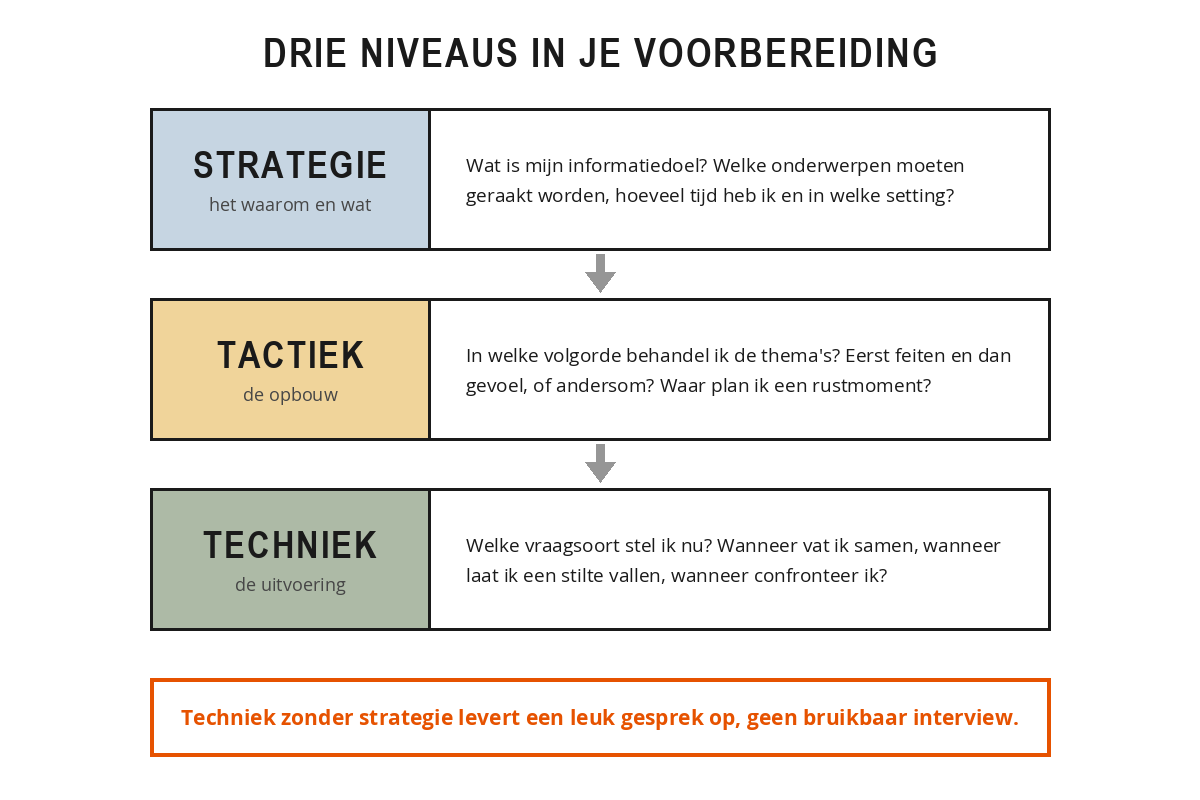
Strategy is about the why and the what. What is your information objective, which topics have to be covered, how much time do you have and in what setting does the interview take place? Tactics is about the structure. In what order do you cover the topics? Do you start with facts and build up to feelings, or the other way round? Where do you plan in a natural pause? Technique is about the execution, in the moment itself. Which type of question do you ask when, when do you summarise, when do you let a silence fall, when do you challenge?
The three layers interact. Good technique without a clear strategy produces a pleasant conversation but not a usable interview: you have probed beautifully into something you have no use for. A sharp strategy without controlled technique founders as soon as your interviewee strays from the path. And anyone who has thought through the first two layers in advance keeps mental space during the interview to really listen, instead of already formulating the next question while the other person is still talking.
The question you ask determines the answer you get
In your preparation you write down questions. Pay attention to the words you choose, because the wording does more than you think. Compare: "Why did the project fail?" and "What are, for you, the main reasons the project turned out differently than planned?" Both want to know the same thing. The first contains a judgement, failed, and puts your interviewee on the defensive. The second leaves room for nuance and invites reflection.
Words such as failure, mistake, problem and complaint provoke resistance, even when you mean them neutrally. More neutral variants give you the same information without the defensive reflex: what turned out differently, what did you run into, what would you have done differently in hindsight.
A researcher interviews school principals about an educational reform that never got off the ground. With the first principal she opens with: "Why didn't the implementation work?" The principal lists four causes that all lie outside his school, concludes with "it really wasn't down to us" and stays on that line for the rest of the conversation. Yield: twenty minutes of defence.
Two weeks later, with the next director, she starts differently: "Looking back on the implementation, at what moment did you first become unsure whether it was going to work out the way you had hoped?" The director thinks for a moment, mentions a team meeting in October, and then talks for twenty minutes about what was going on internally, who was not on board and why he did not intervene at the time. The same information need, a different way in, an entirely different conversation.
A guide is not a script
What you write down is a guide: a list of themes and key questions that helps you not to miss anything. It is not a questionnaire that you work through from top to bottom. During the interview you may skip questions, reverse them or phrase them differently. If the other person spontaneously raises a subject that appears further down your list, follow it up. If you get an unexpectedly interesting answer, let go of your planned route.
Mark in your interview guide which questions really must be answered and which have "if there's time" status. That way you know during the conversation where you can be flexible and where you can't. A two-page guide with everything in the same size doesn't help you: you end up searching instead of listening. One A4 with five themes, two or three key questions per theme and the must-haves circled works better.
After your preparation, ask yourself: if I am ill tomorrow morning and a colleague takes over this conversation, can she get to work with this guide? If the answer is no, your preparation still lacks sharpness.
The practical side
A well-prepared interview can still founder on poor organisation. Wrong address, too little time, no quiet place, no permission to record. There are five things to settle in advance. The aim and subject: you say what the conversation is about, not which questions you will ask, because then you get prepared answers. Time and place: agree a duration and allow an extra quarter of an hour for coffee, getting started and overrun. The recording: ask explicitly for permission and say what you will use it for: your own write-up, publication or the archive. Anonymity and publication: make clear whether the conversation will be used with names attached, and offer a quote check if that suits your situation. And who will be present: if a spokesperson, a colleague or an interpreter comes along, the dynamic changes and your interview guide adapts accordingly.
Confirm it straight away in a short email: date, time, place, duration, topic, recording or no recording, who will be present, and your telephone number in case anything goes wrong. Send that email immediately after making the appointment, not the day before. That way the person you are speaking to still has time to object to the recording or the topic, and you can prepare for the actual setting.
Finally, take what you need: a printed guide, a recorder with a full battery, a second recording on your phone as a back-up, pen and paper for loose notes, and a clock in view. It sounds excessive until the first time you discover after an hour that you have recorded nothing.
Take an interview you are about to conduct, or invent one. Write down in no more than three sentences:
- Aim: what do I want to know at the end that I don't know now?
- Source: why is this particular person the right person to talk to?
- Use: what am I going to do with the information afterwards?
Read it back. Are there topics in it instead of information? Rewrite until every sentence answers "what do I want to know" and not "what is it about". Then create a one-A4 guide: five themes, two key questions per theme, and circle the questions that really must be answered.
Summary
- A subject says what the conversation is about; an information goal says what you want to know. Only the second one steers your questions.
- A sharp objective answers three questions: what do I want to know, why is this person the source, and what will I do with the information?
- Estimate in advance what the other person already knows, what interest they have, what their level of knowledge is and which sensitivities are at play.
- Use your interviewee's professional language. The wrong word earns you a correction and costs you your position.
- Organise your preparation on three levels: strategy (what do I want to know), tactics (in what order) and technique (how do I phrase it).
- Words such as failed, mistake and problem provoke defensiveness. Ask what went differently or what someone ran into.
- Your guide is a one-page aide-memoire with themes and key questions, not a script to work through. Mark the things that really have to be answered.
- Agree in advance: purpose, time and place, recording, anonymity and who will be present. Confirm it in writing, straight away.
What is the difference between a topic and an information objective?
You ask a head teacher: "Why didn't the implementation work?" and get four external causes back. What is going wrong here?
According to this chapter, what belongs at the level of tactics?