


2. The seven question types
The question is the only tool you really have in your hands during an interview. The form you choose largely determines what you get back: a brief fact, a detailed story, an opinion or a layer that had not come out before. Most interviewers have two or three question forms that they use automatically and never use the rest. This chapter makes it seven, so that you have something to choose from at the moment a conversation stays on the surface.
After this chapter:
- You know seven question types and what information each of them yields.
- You know why an experience question yields something different from an opinion question.
- You understand why "why" often works against you in an interview, and what to replace it with.
- You recognise the three question forms you are better off avoiding: leading, multiple and seemingly open.
- You can deliberately steer the rhythm of exploring and verifying within a single conversation.
Why one question form is not enough
Suppose you only ask questions that call for facts. You get a tidy reconstruction: who, when, how much. But you still do not know what someone thought of it, what was going through their mind at the time or what they would do differently next time. If you only ask opinion questions, you get an hour of judgements without knowing what they are based on. A usable interview mixes question types, and you do that mixing deliberately.
Everyone knows the crude distinction between open and closed. A closed question steers the answer down a narrow path: yes, no, a number, a name. An open question gives the other person room to decide for themselves where to start and how far to go. In theory you know this; in practice, under time pressure and nerves, your questions slide back towards closed all by themselves. Within those two there is far more nuance, and that is what this chapter is about.
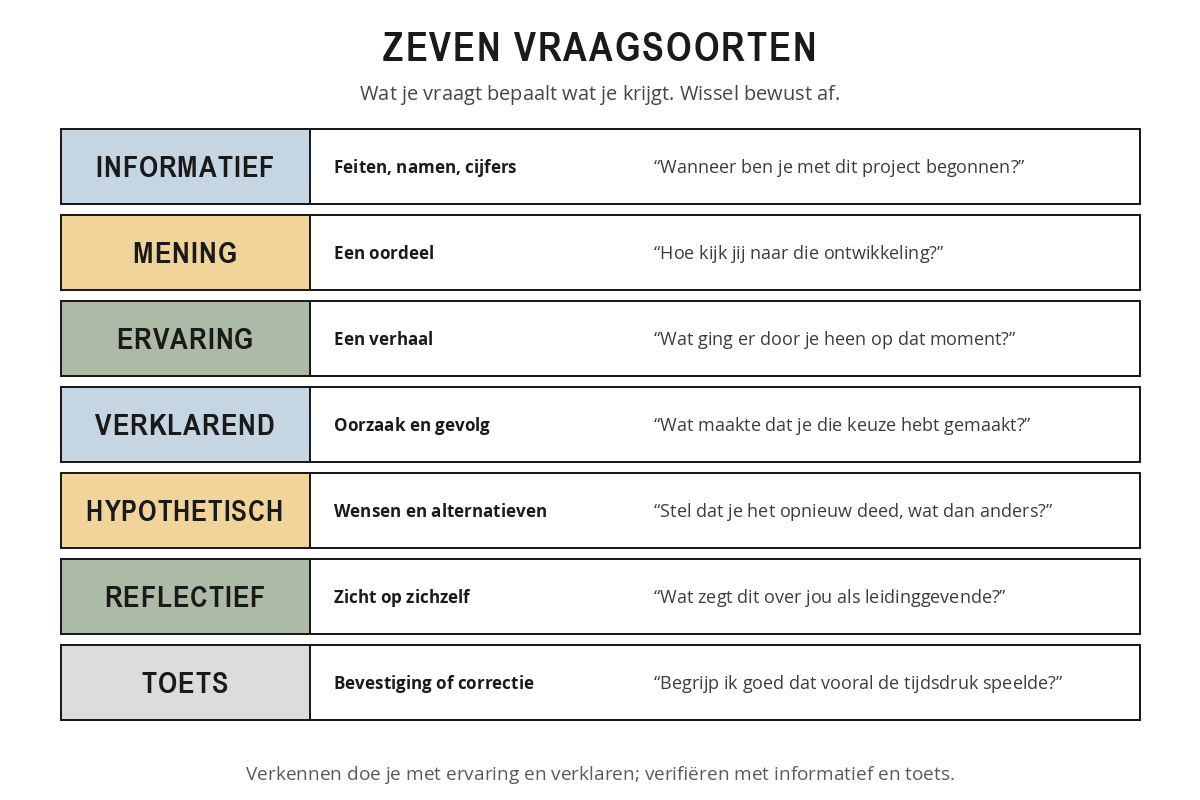
The seven at a glance
Informative questions gather facts: numbers, names, dates, sequence. "When did you start on this project?" "How many colleagues do you work with?" They are often closed or semi-open. You use them to get the factual basis in order before you go into the story. Too many in a row feels like an interrogation, so vary them.
Opinion questions ask for a judgement. "What do you think of the new way of working?" "How do you view that development?" Opinions are valuable because they show how someone interprets the world. Do keep the question genuinely open. As soon as you steer it ("Don't you agree that...?") you get a socially desirable answer that is of no use to you.
Experience questions are about what someone has experienced themselves and what that was like. "What was it like for you when you heard that?" "What was going through your mind at that moment?" The difference from an opinion question is small in wording and large in yield: with an opinion you get a judgement, with an experience you get a story. If you want something you can quote later, it almost always comes from an experience question.
Explanatory questions looking for cause and effect. "How did that come about?" "What caused that to change?" "What made you make that choice?" You will notice that the word why does not appear among them, and that is deliberate; we will come to that shortly.
Hypothetical questions invite the other person to think beyond the current situation. "Suppose you were to do it again, what would you do differently?" "What would it take to actually get this done?" They open the door to wishes, motives and alternatives that remain hidden in a factual question. Do not use them too early: if the facts are not yet clear, such a question hangs in the air and what you get back is just as vague.
Reflection questions are about the other person themselves, their own actions, their own role. "What does this say about you as a manager?" "What have you learned from this yourself?" They are powerful in in-depth interviews and coaching conversations, and they take thought. Allow time for that. A reflective question that you follow too quickly with another question yields nothing.
Verification questions checking whether you have understood correctly. "Is it right that you then decided to...?" "Do I understand you correctly that it was mainly the time pressure at play?" They are closed in nature, and that is precisely the intention: you give the other person the chance to correct your understanding. A good checking question is moreover a form of summarising. You show that you are listening, and that earns you credit for the trickier questions later on.
Write the seven types on a note and put it next to your interview guide. If you notice that the conversation stays on the surface or that you are getting stuck, look at your list and choose a type you have not used yet. Nine times out of ten that is where the opening lies that you overlooked, and usually it is the experience question or the reflective question.
The problem with why
Why is a powerful word and at the same time a sensitive one. Adults unconsciously associate it with parents, teachers and managers asking them to account for themselves. "Why did you do that?" rarely sounds like curiosity and often like an accusation, however kindly you put it.
You get the information you are after just as well with a different wording. "How did it come about that...", "What made it so that...", "What was behind..." The same question, without the defensive reflex. You will notice that the answer is not only more open but also longer: people who do not have to defend themselves tell you more.
A journalist interviews an entrepreneur about a project he has discontinued. She starts with closed questions, as many people do when they are nervous. "Was the project a disappointment?" "Yes." "Did it cost a lot of money?" "Quite a lot." "Will you try again?" "Maybe." Three questions, eleven words of answer, and nothing she can work with.
A colleague does the same interview again a week later, with the same three themes but in a different form. An experience question: "What went through your mind when you decided to stop?" That produces a story about doubt, about the pressure from his business partner and about the evening on which he made the decision. Then an open informative question: "What has this project cost you, apart from money?" That yields reflection on time, energy and two friendships. And finally a hypothetical one: "How do you look now at a possible new attempt?" What follows is a nuanced account of what he would do differently. The same entrepreneur, the same themes, an entirely different interview.
Three questions you are better off not asking
Some question forms seem harmless and work against you. Three of them come up most often, and they all creep in when you are in a hurry.
The leading question puts the answer in the question already. "You must have been pretty disappointed then, weren't you?" The other person can hardly do anything but agree, and afterwards you do not know whether it was true or whether you came up with it yourself. Better: "How was that for you?" The multi-part question crams two or three into one sentence. "How long have you worked here, what exactly do you do and do you enjoy it?" The other person picks the easiest one and the rest disappear, usually precisely the question you were after. Ask them one at a time. And the seemingly open question: "Can you tell me something about your work?" That sounds open but technically allows for a "no", and there are people who take that way out. Better: "Tell me about your work" or "What exactly do you do in your job?"
The rhythm of a conversation
A good interview is not a string of open questions. Too much openness makes a conversation shapeless and exhausting for the other person; they no longer know what you want from them. Too much closedness makes it superficial. The art lies in the rhythm: you open a theme with a broad question, you let the person talk, you go deeper with a follow-up question, you check a fact with a closed question, and you close off the theme with a checking question before moving on to the next.
A rule of thumb that helps: if you are in a exploratory phase, then open questions dominate, and experience questions and explanatory questions in particular. If you are in a verifying phase, then closed questions and check questions are exactly what you need. Deliberately switching between those two modes keeps your interview both rich and sharp. And it puts your interviewee at ease: they notice that the conversation is going somewhere.
Hakim conducts an exit interview with an employee who is leaving after three years. He has learned to do a full round per theme. He opens in exploratory mode with an experience question: "When did you first know you wanted to leave?" She mentions a moment in February. He probes with an explanatory question: "What made that moment stand out?" A story follows about a project that was given to someone else. Then he switches to verifying with an informative question: "How many such moments have there been since?" Three, she says. And he closes the theme with a checking question: "Do I understand correctly that this is mainly about how work is divided, and not about the workload itself?" She corrects him: it is both, but the division weighs more heavily. That correction is the most valuable answer in the entire conversation, and he would never have got it if he had not put his summary in the form of a question.
Take an interview you have recently conducted or are about to conduct and write down five questions you would ask. Then run through them:
- Which of the seven types is each question? Do you come across more than two types?
- Rewrite every closed question that was actually meant to be open.
- Rewrite every leading or multi-part question into a neutral, single-part version.
- Replace every 'why' with 'how come' or 'what made'.
- Add one experience question and one reflection question that you had not thought of yourself.
Read the new set aloud. Which questions sound different from what you are used to? Those are usually the most valuable.
Summary
- Seven types of question to choose from deliberately: informative, opinion, experience, explanatory, hypothetical, reflective and checking.
- An opinion question yields a judgement, an experience question yields a story. For quotations you need the second.
- Hypothetical questions only work once the facts are established; reflective questions only work if you give the other person time.
- A checking question is a summary in the form of a question. The correction you get in response is often the most valuable answer of all.
- Avoid why as an explanatory question. "How did it come about that" and "what made it so that" elicit the same information without prompting defensiveness.
- Three question forms work against you: the leading question, the multi-part question and the apparently open question that can also be answered with no.
- Deliberately alternate between exploring (open, experience, explanatory) and verifying (closed, informative, checking).
What is the difference between an opinion question and an experience question?
Why is it better to replace "why did you do that?" with "what made you do that?"
You have explored a theme and want to close it off before moving on to the next. Which question type best fits that, according to this chapter?