


3. Probing until you have the story
You have asked a good question. You get an answer. And that is when the work really starts, because the first answer is almost never the whole answer. People speak in generalities, in judgements and in shorthand that is perfectly clear inside their own head. "It actually went fairly smoothly." "We discussed that with the team." "That is a complex story, of course." It sounds like an answer and it contains no information. If you let those sentences pass, you walk out at the end of the conversation with a notebook full of fog.
After this chapter:
- Whether you know that an answer has layers, and that the facts lie just below the surface while the motives lie much deeper.
- You can recognise four types of vague answer by the words they come with.
- You know five ways to probe further, including the two that are not questions.
- You can use the image test to determine whether an answer is concrete enough.
- Whether you can point out a contradiction without it becoming a reproach.
- You know which three silences there are and what each of them yields.
An answer has layers
Think of a dipstick. The first answer is the top layer, the layer everyone talks at: the summarising judgement, the word with which someone covers the whole history in one go. Beneath it, just below the surface, lie the facts: what happened, when, who did what. You get those out with one or two follow-up questions. A layer deeper lie the feelings and motives: what was that like, what played a part, what weighed on you. And right at the bottom are the motivations and patterns: where this comes from, what someone keeps doing here. You will not reach that last layer in every conversation, and that is not necessary either.
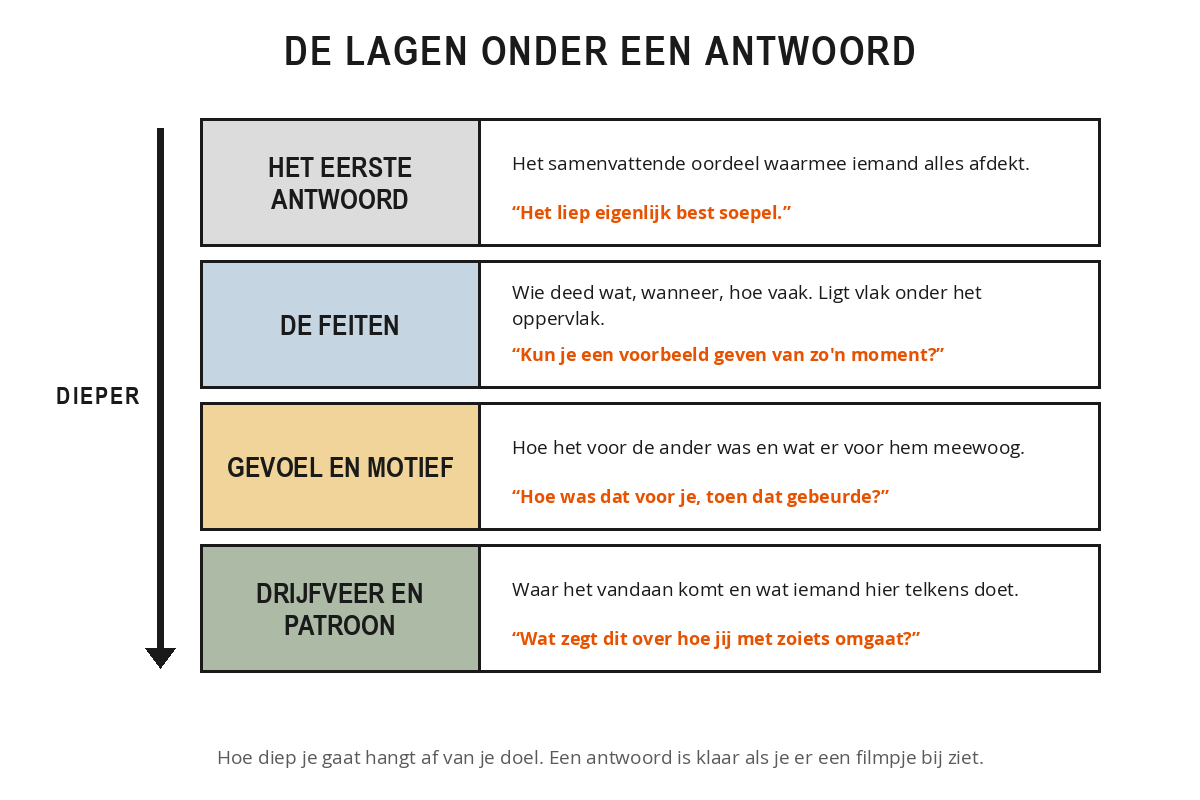
How deep you go depends on your information objective from chapter 1. In a survey interview you deliberately stay at the surface, because you want to ask a lot of people comparable questions and don't want to be three layers deeper with one than with another. In an in-depth interview, that descent is your whole job. What you should not do in either case is stay on the top layer by accident because you didn't notice.
Four types of vagueness
You recognise a vague answer by the words. Four types occur so often that after a while you pick them out automatically.
Generalisations are words such as always, everyone, never, one and we. They suggest a group or a pattern without saying who, when or how often. Your follow-up: "Who exactly do you mean by we?" or "How often is always?" Unnamed actions are verbs without content: align, look into, take along, pick up. They sound active and describe nothing. Your follow-up question: "What exactly do you do when you pick it up?" Blurred causes place the reason outside the speaker and make it abstract: because of the circumstances, because of the market, it was down to the communication. Your follow-up: "Which circumstances exactly?" or "Who failed to communicate what?" And labels without substance are judgement words that you get to fill in: difficult, challenging, a learning process, interesting. Your follow-up: "What made it difficult?" or "Can you give an example of such a moment?"
Besides these four there are two more you can add: comparative words without a reference point (better than what? less than when?) and hidden judgements ("he is just difficult"), where you ask about the behaviour on which the judgement rests.
Five ways to probe further
Probing is not a one-question trick, it is an attitude: you do not let go of a subject until you understand what the other person means. Five techniques help with this, and the last two are not questions at all.
Ask for an example. "Can you give an example of a moment when this came up?" This is by far the most powerful follow-up question there is. An example forces the other person to step out of the general and describe a concrete situation, and that description contains everything you need. Ask about the last time. "When did that last happen?" This makes it tangible and, in passing, exposes how often something really occurs; not infrequently "that happens constantly" turns out to refer to one occasion, in March. Zoom in on one word. Take a word from the answer and ask what the other person means by it. "You say tense. What did that tension look like?" The echo. Repeat the last important word with a questioning tone. "Not comfortable?" That is often enough to prompt the other person to clarify, and it costs you two words. And the silence. Sometimes the best follow-up is not a question at all.
A project manager is interviewed about a collaboration that ran into difficulties. He says: "Over the past few months we have suffered a great deal from miscommunication."
The weak follow-up question is: "Was that annoying?" At best that yields "yes, quite", and you are stuck again. The strong follow-up questions run as follows. "What do you mean by miscommunication in your situation?" (making a general word concrete) "Can you give an example of such a moment?" (asking for a situation) "When was the last time that happened?" (making it tangible) "What exactly happened then?" (getting the facts) "How did you know it was miscommunication and not something else?" (challenging the interpretation). Five questions later it turns out to be about two emails in June in which an assignment had been issued twice. That is something quite different from months of miscommunication, and only now do you know what the conversation is really about.
The picture test
A handy rule of thumb for deciding whether you are there: an answer is concrete enough if you can see it. If someone says "we approached it differently", try to run a film in your head of what happened. Who was in the room, who said what, what did the other person do then? If that film won't play, the answer is still too vague and you keep probing until it does.
That test is also your brake. As soon as you can picture the scene, you are done with this topic and can move on. Without such a brake you either dwell too long on something that was already clear, or you move on too quickly when all you have heard is a single word.
Naming contradictions
Sometimes someone says one thing at moment A and something different at moment B. You hear it, you sense the hesitation, and the temptation to move on is strong. Do not. Contradictions are places of discovery: where two accounts jar, the real story is usually to be found.
You name it factually, in a fixed pattern. You repeat both statements, you say that they do not fit together, and you invite an explanation. "A moment ago you said the team was fully behind the decision. Now I hear you say there was quite a bit of resistance. How does that fit?" No reproach, no sarcasm, no "yes, but". You do not say "that is contradictory" or "you are contradicting yourself"; you say: I am hearing two things, help me make sense of them. The confrontation lies in the content, not in your tone.
What often follows is the story underneath: that some people went along with it and others did not, that the resistance only came later, or that the decision was agreed on paper and never carried out in practice. That is exactly the nuance you held the conversation for.
During the conversation, put a small tick in the margin next to every statement you may want to use later. If you hear something that jars with an earlier tick, you have both sentences to hand at once and can quote them back word for word. Paraphrasing from memory makes a confrontation weaker, because the other person can then say that is not what they meant.
Three silences that work
Novice interviewers are afraid of silences. They experience a pause as a failure, as if the conversation is stalling and they have to fix it. The opposite is true. A silence at the right moment is one of the most powerful techniques you have, and it costs you nothing but self-control. There are three of them, and it helps enormously if you know during the interview which one you are letting fall.
The thinking silence falls after your question, before the other person answers. They have to formulate, and a good question takes formulation time. If you don't allow it, you get a quick and superficial answer, or worse: you repeat your question in different words and thereby make it smaller. Count to five in your head before you do anything. The follow-up silence comes after an answer, and in it you deliberately say nothing. Many people fill that space themselves with an addition, a qualification or an example they did not want to give at first. This is the most underrated technique in the whole field: you do nothing, and precisely because of that you get more. The confrontational silence comes after a sharp follow-up question or a contradiction you have named. Here you give the other person room to switch from their standard answer to something more honest. That switching time is two, three, sometimes five seconds. Do not fill it, do not soften it.
Why silences work: people experience a silence as social pressure. In an ordinary conversation you politely hand over the turn. If you do not take that turn when it is clearly coming your way, awkwardness arises, and that awkwardness is not a problem you need to solve. It is an invitation the other person feels to keep talking. The pitfall is that you feel that awkwardness too, and for the interviewer a silence lasts about twice as long as it does for the other person. Four seconds feel like ten to you. You have to sit it out.
A journalist interviews a councillor about a building project that has been halted. The first ten minutes are about the context, at a brisk pace, with short questions and short answers. Then comes the key question: "At what point did you know the project wasn't going to work?" She asks it, leans back and says nothing more. The councillor starts on a general answer about evolving insight, stops halfway through a sentence, looks out of the window. Seven seconds. Then he says: "Honestly, back in March." That is the sentence the whole piece opens with. Had she asked a helpful follow-up question after three seconds, she would have got the evolving insight and nothing else.
When friendly probing no longer helps
Sometimes someone gets stuck in a story they have already told a hundred times. Politicians, experienced managers, spokespeople. Your open question produces exactly the same answer that every previous interviewer got. That is the point at which you can go a step further and put down a prompt: not a contradiction, but a statement or a reversal of roles that the other person has to respond to.
An entrepreneur tells you for the third time that his employees are "the heart of the company". You can then say: "When I hear that, I think: every entrepreneur says that. What makes it different in your case from the company next door?" Or, more pointedly: "Suppose I speak to three of your employees tomorrow and ask whether they feel like the heart of the company. What would they say?"
An intervention like this only works if the relationship is strong enough. Do not try it in the first five minutes and not with someone who is emotionally vulnerable. Use it sparingly: an interview with three confrontations and two prompts is an interrogation, whereas one well-placed confrontation gets you the quote of the day. And never do it out of irritation, because the other person will sense it immediately.
Over the coming week, listen deliberately to conversations around you, at work or on the train, and pay attention to vague statements.
- Note down three generalisations, two unnamed actions and one label without content.
- For each statement, think of at least three different follow-up questions.
- Apply the image test: which statement made you see a film straight away, and which did not?
Then record one of your own conversations, with permission, and listen back to fifteen minutes of it. Find one contradiction you let pass and write down word for word the follow-up question you could have asked. By practising this outside an interview setting you train your ear, and in a real conversation you will then pick it up.
Summary
- Beneath the first answer lie the facts, below that the feelings and motives, and at the bottom the drivers and patterns. Your objective determines how deep you go.
- Four types of vagueness: generalisations (always, everyone), unnamed actions (pick up, align), obscured causes (due to circumstances) and labels without substance (difficult, challenging).
- The most powerful follow-up questions: ask for an example, ask about the last time, zoom in on a single word, use the echo and allow a silence.
- An answer is concrete enough if you can picture it as a video clip. If you can't, ask a follow-up question.
- Name a contradiction in three steps: repeat both statements, say that they do not sit well together, invite an explanation. Factual, without reproach.
- Three functional silences: the thinking silence after your question, the continuation silence after an answer, and the confrontation silence after a sharp follow-up question.
- A silence lasts roughly twice as long for you as it does for the other person. Count in your head and do not fill it.
- A prompt or confrontation only works within a solid relationship, used sparingly, and never out of irritation.
Someone says: "It was mainly down to the communication." Which type of vagueness is this?
What is the working-through silence?
Your conversation partner said earlier that the team was behind the decision and now says there was a great deal of resistance. How do you address that according to this chapter?