


Introduction
A customer who complains is a customer who still wants something from you. That sounds odd if you have just had an angry voice on the phone or are reading an email that starts in capital letters. Yet it is the starting point of this course: anyone who takes the trouble to complain is giving you information and a second chance. Most dissatisfied customers do not do that. They leave without saying anything, and you only hear that something was wrong once they have already gone.
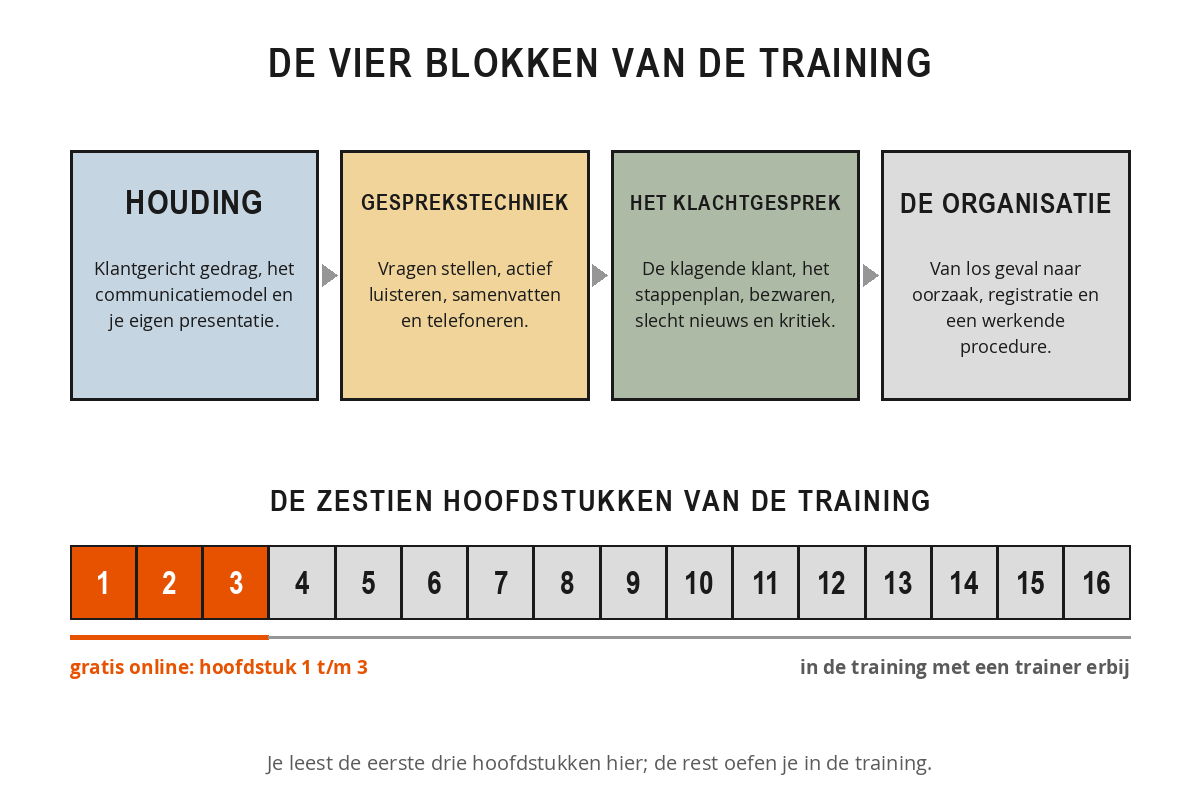
This free course contains the first three chapters: the orange part of the bar above. At the bottom of chapter 3 you will find the full course.
What you will learn
You learn to sort complaints, because a product complaint calls for something different from a complaint about the way someone has been treated. You learn why your explanation does not get through as long as emotions are running high, and what you do instead. After that you work through the complaint conversation step by step, from the first report to the feedback within your own organisation, with two models in hand: the eight-step plan and the scope for decision-making on which you position your offer. In the final chapter you zoom out. It is then no longer about this customer, but about the question of why the same complaint comes back every month.
How the course is structured
The full course runs from small to large, in four blocks. It starts with your posture: customer-focused behaviour and the way a message comes across. Then comes the conversation technique: asking questions, listening, summarising and telephoning. After that it becomes concrete with the complaint conversation itself, including the conversations that nobody enjoys: delivering bad news and receiving criticism. And it closes with the organisation: recording, analysis and a procedure that works. This free course takes the core out of each of the last two blocks.
Practical tips for use
- Choose one complaint you have handled yourself as a common thread, preferably one that did not go well. You hold each model up against it.
- Keep a notepad or a blank document to hand. The exercises only deliver something if you write down your own words, not those of the example.
- Do not read it all in one go. One chapter, then a week of holding conversations, then the next chapter.
- Write down what does not work in your situation. That is at least as interesting as what does work, and it is precisely the material you will be working with during the course.
- Start with a baseline measurement: describe your last complaint conversation in three sentences, note what went well and what mark you would give yourself. At the end you will look at it again.
Each chapter ends with a short knowledge check of three questions: answer them correctly to mark the chapter as completed. Your progress is saved automatically in your browser.
Enjoy reading. And the next angry customer: that is someone who still has something to tell you.