


1. The complaining customer
On the surface, complaints all look alike. Someone is dissatisfied and lets you know. What lies beneath differs greatly, and it is precisely that difference which determines what approach works. Anyone who comes straight out with a solution regularly solves something the customer was not losing sleep over. This chapter is about the question that precedes every solution: what is this complaint actually about?
After this chapter:
- You keep the four types of complaint apart and recognise which type you are dealing with.
- You know why emotion comes before substance and what that means for the order in which you work.
- You can tell from the customer himself when you can move on to the substance.
- You know that acknowledging is not the same as admitting fault, and how to put that into words.
- You track down the hidden complaint behind an apparently businesslike remark.
Four types of complaint
Anyone who sorts complaints responds faster and more precisely. The content of a complaint almost always falls into one of four categories.
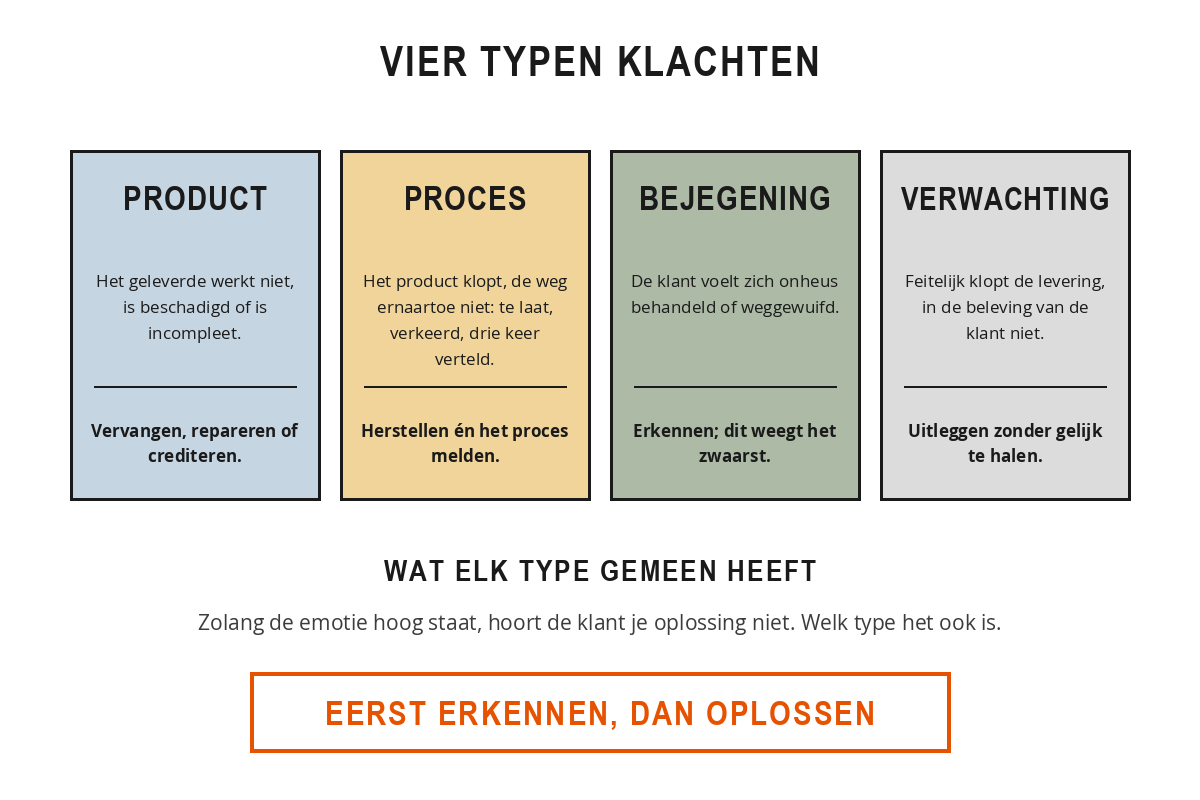
The product complaint is the most visible: what was delivered doesn't work, is damaged, is incomplete or doesn't do what was promised. There is a fact you can check, and the solution usually lies in replacing, repairing, crediting or delivering again.
With the process complaint the product is fine, but the route to it went wrong. The delivery arrived late, the invoice showed the wrong amount, the appointment wasn't in the system, or the customer had to tell his story three times. He is rarely angry about the product here; he is angry about the time he has lost.
With the treatment complaint the customer feels they have been treated unfairly. A colleague was curt, someone promised to call back and didn't, or the customer got the feeling they were being brushed aside. This type often only comes up when you ask about it, and it weighs more heavily than people themselves admit.
And then there is the expectation complaint: nothing has gone wrong, but the customer expected something different. The terms were unclear, the brochure suggested more, or the salesperson pitched it just a little too enthusiastically. Factually the delivery is correct, in the customer's experience it isn't. That is the trickiest category, because you are right and the customer feels hard done by.
Sometimes two types run together. The question is then which of the two bothers the customer most, because that is where your conversation begins.
A customer calls: "That printer I bought last week doesn't come with a cable." That looks like a product complaint. On further questioning it turns out the cable is sold separately and that this is stated on the packaging, so it is an expectation complaint. Probe a little further and something else emerges: "And when I called about it, your colleague said I should have looked more carefully." That's where the real pain is. The treatment weighs more heavily than that eight-euro cable, and anyone who only talks about the cable has lost that customer.
Emotion before substance
A complaint arrives in two layers at once. There is a substantive layer, about what has actually gone wrong, and an emotional layer, about what that has done to the customer. A customer running high on emotion does not hear your solution. Not because they do not want to, but because their attention is on their own story.
Emotion before substance means you address the emotional layer first and only then talk about the matter itself. That feels like a delay and it is the shortest route. The curve of a complaint conversation nearly always runs the same way. The customer starts telling their story and their emotion rises, because they hear their own irritation coming back at them. Around the peak comes the sharpest phrasing: "this is the last time I buy anything here." If you say at that moment what you can do, they start again from the beginning and you have had the conversation twice. If instead they are given acknowledgement, the curve drops, and below a certain point your answer lands first time.
In practice that means three things. You let the customer finish, even if you already know what it's about after two sentences. You say out loud what you are hearing. And you don't use "but" in the sentence in which you give acknowledgement, because the customer mentally deletes everything before that word.
Do you notice that your explanation fails to land three times over? That is almost never a sign that you are being unclear. It is a sign that you are on the substance too early. Stop explaining, summarise what the customer has been through and ask whether that is right.
Acknowledging is not admitting fault
Many employees hold back from acknowledging because they think that in doing so they have already admitted the complaint. Those are two different things. You acknowledge the customer's experience, not the legal substance of their accusation.
Mrs Dekker rings for the fourth time about a fault: "I've called three times and nobody is doing anything. Ridiculous." Karim, the employee who takes the call, can see in the system that something has in fact happened. There has been a ticket open since the twelfth.
If he says that straight away, Mrs Dekker hears that she is in the wrong. So he puts it differently: "Calling three times and still having no clarity is annoying. I understand you've had enough of it. I'm going to find out what was left undone." Only after that, once the urgency has gone out of her voice, does he explain what was recorded on the twelfth and why nothing was done with it. Karim hasn't admitted a mistake and hasn't made a single promise, but the customer hears that her story has got through.
How you can tell the emotion is subsiding
You do not have to guess when you can move on to the substance, because the customer signals it themselves. Their pace slows and they start leaving pauses again. Their volume returns to conversational level. They ask a question of their own, and "so what can you do about it now?" is your cue to answer. And they start saying "we": as soon as a customer talks about "let's have a look at it together", they are standing beside you instead of opposite you.
There is a pitfall at either end. Glossing over it, with "it's not that bad, surely", pushes the emotion up rather than down. Joining in the complaining about your own organisation, with "yes, it's always like that here", feels good for a moment but leaves you powerless in the customer's eyes. You acknowledge the customer's experience and stay away from the conclusion.
What lies beneath the complaint
The complaint a customer voices is rarely the whole complaint. What he mentions is the part that shows above the surface. Beneath it are three layers that determine whether your solution works: his experience, so what it did to him, his expectation, so what he thought would happen, and his interest, so which problem of his own needs to be solved here. Fix only the tip and the customer has formally been helped and still isn't satisfied. The late delivery is credited, but the feeling that a promise was broken remains. That customer will call again in three weeks, and then about something else.
A hidden complaint is the dissatisfaction the customer doesn't mention, but which does explain his behaviour. It doesn't disappear by itself, it accumulates: someone who swallows three small irritations leaves at the fourth without a complaint ever having been recorded. You recognise it from four signals. Disproportionate emotion over a small fact, because that anger doesn't match that amount, so there is a history underneath it. The sentence "and this isn't the first time", which is an invitation and not a subordinate clause. A vague complaint such as "things just aren't running very well at your end", which you can't do anything with without facts. And "yes, but" after a reasonable offer: if the customer doesn't bite, the problem you are solving isn't his problem.
A buyer at an installation company emails about an invoice for 340 euros which he says is incorrect. His tone is sharp for that kind of amount. The account manager rings and immediately offers to credit the amount. The buyer replies: "Yes, but that's not the point."
Only when you ask further does the rest come out. This is the third incorrect invoice in four months, and each time it holds up his own administration for two days. His interest is not those 340 euros, it is that he no longer has to explain internally why this supplier keeps invoicing incorrectly. The solution that works is not a credit note but a check on the invoicing and a short email he can forward to his own manager.
Getting to the bottom of what is going on
Probing only works if the customer understands why you're asking. You explain the reason for your question, you name the signal you picked up and you stick to one question at a time. If there's hesitation: "I'm hearing some doubt. Has something gone wrong before?" With a vague complaint: "To really do something about this, I want to understand one example properly. Which moment bothered you most?" And when an offer doesn't land: "I get the feeling I'm missing something. What is the most important thing for you that changes here?"
Take three customer contacts from the past two weeks and work out four points for each one:
- What did the customer say, in their own words?
- Which type of complaint was it: product, process, treatment or expectations?
- Was there a second type underneath the first, and which of the two bothered him most?
- Which solution matched that type, and did you actually provide it?
Then put your analysis alongside that of a colleague who assesses the same three contacts. Wherever the two of you disagree, further questioning would have been needed.
Summary
- Complaints fall into four types: product, process, treatment and expectations. Each type calls for a different solution.
- The expectation complaint is the trickiest one: factually the delivery is correct, but not in the customer's perception.
- As long as emotion is running high, your substance doesn't land. Acknowledge first, solve afterwards.
- Acknowledging someone's experience is not the same as admitting a mistake, and it should not be followed by a "but".
- The customer indicates themselves when the emotion subsides: slower pace, lower volume, a question of their own and the word "we".
- What the customer mentions is the tip. Experience, expectation and interest lie beneath it, and you bring them to the surface with well-reasoned questions.
A customer has received exactly what was ordered, but says the quotation suggested something completely different. Which type of complaint is this?
Why doesn't it work to tell an angry customer your solution straight away?
You make a reasonable offer and the customer responds with "yes, but that's not the point". According to this chapter, what does that mean?