


1. Your voice as your only tool
In a conversation at a desk, your whole body joins in. Your face shows that you sympathise, your posture invites, your hands underline what you say. On the phone all of that falls away. What is left is a narrow channel: your voice and the words you choose. This chapter is about what you can do with that narrow channel, and how to use it deliberately.
After this chapter:
- You know exactly what falls away when the client cannot see you, and what takes its place.
- You recognise the filling-in effect: the picture the customer forms of you, and the one you form of him.
- You know the five VITAS factors and can identify them in your own voice.
- You turn a negatively phrased sentence around into what you can do.
- You know which three things about your workplace are audible in your voice.
Two channels doing the work of three
Normally a message travels across three channels at once: your words, your voice and your body. On the phone the third channel disappears completely. There is no frown, no nod and no open gesture to catch an unfortunately worded sentence. That does not mean your words count for less, as the well-known percentages about body language suggest. The opposite is true: on the phone your choice of words and your intonation weigh more heavily than in a face-to-face conversation, because the two of them are doing all the work.
On top of that come a handful of characteristics that make telephone contact genuinely different. You have no visible reaction, so you do not know whether your explanation lands. A call starts without a warm-up: the first few seconds set the tone straight away. The attention span is shorter, because people are more impatient on the phone than they are across a table. There is noise on the line, both literally and figuratively. And there is no screen to look at together: everything you explain has to come across in words.
The filling-in effect works both ways
Because the customer cannot see you, his mind fills in the missing picture itself. If you sound rushed, he concludes that you have no time for him. If you sound flat, he thinks you are not interested. If you sound warm and engaged, the picture that emerges is of someone who genuinely helps. Your voice paints a portrait the customer never gets to see, but does remember.
And it works exactly the same way in the other direction. You also fill in how the customer is doing. Someone who responds curtly may be angry, but may just as easily be in a hurry because their train leaves in six minutes. The less you see, the faster you draw conclusions that are wrong. Noticing that you are filling in the gaps is the first step.
Mr De Vries calls the customer service department of an installation company. He opens with a short, sharp sentence: "Yes, De Vries here, I am calling about that invoice from last week." New colleague Tim fills in the blanks: angry customer. He sits up straight, talks faster and starts with "That is not my department, that is accounts." Now De Vries really does get angry. His colleague Wendy hears mainly tension in the same sentence. She answers calmly: "Good afternoon Mr De Vries, thank you for calling. Do tell me what the matter is." It turns out to be about 48 euros in call-out charges that De Vries had not expected. After three minutes he hangs up satisfied. Same customer, same invoice, different portrait.
The five VITAS factors
Your voice is not a fixed given. You can distinguish five dials on it, and those five together are called VITAS: Volume, Intonation, Tempo, Articulation and Sound.
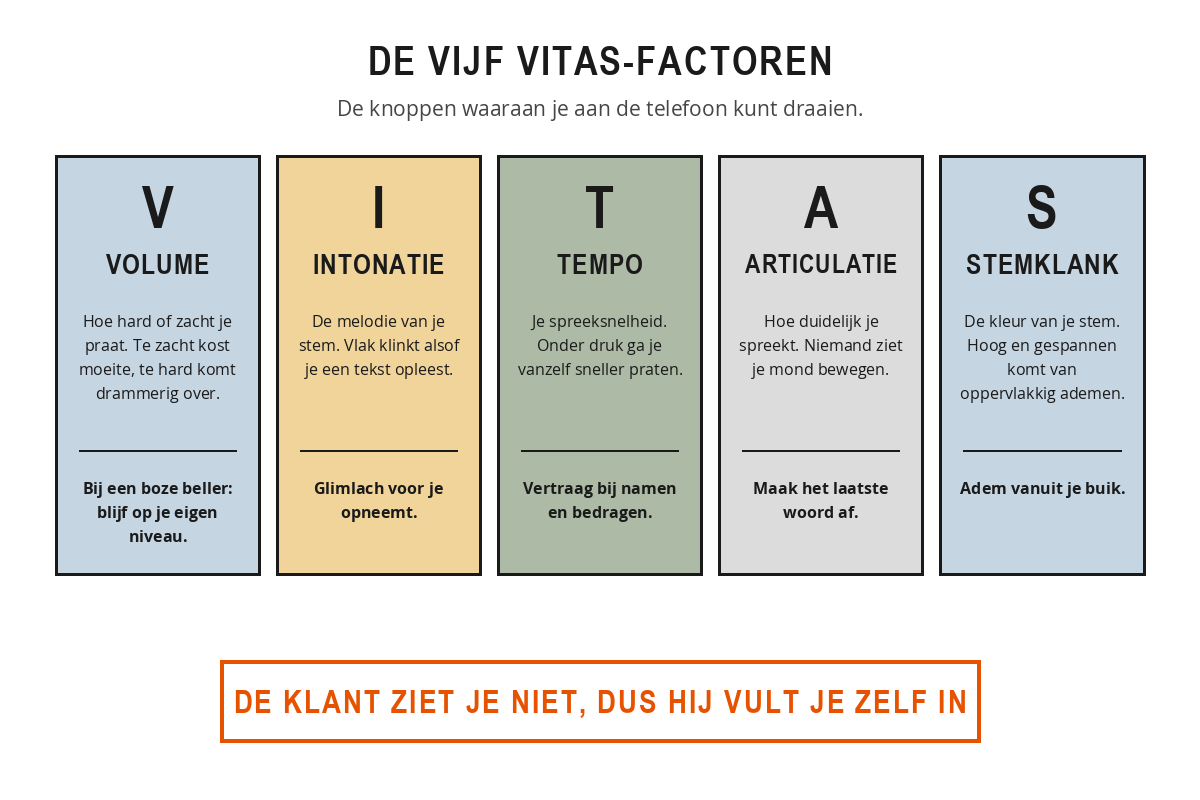
Volume is how loudly or softly you speak. Too soft and the customer has to strain to follow you, too loud and you come across as pushy. If the customer speaks softly, it usually works to speak a little more softly yourself. If he is shouting angrily into the receiver, you deliberately keep to your normal volume: that way you draw him back to your level instead of shouting along with him.
Intonation is the melody of your voice. A flat, monotone voice sounds as if you are reading a text out loud. With intonation you make clear what is important and you distinguish between a question and a statement. Try saying the sentence "So you would like to make an appointment for next week" with a question mark at the end, and then with a full stop. Same words, different meaning.
Pace is your speaking speed. Under pressure people almost always start talking faster, especially if they have already told the same story ten times that day. Always slow down for names, amounts, dates and telephone numbers, so the customer can write them down. Too slow does not work either, by the way: then the customer switches off.
Articulation is how clearly you pronounce your words. On the phone nobody can see your mouth moving, so swallowed endings hit twice as hard. Pay particular attention to the end of your sentences. That is usually where the conclusion or the agreement sits, and that is exactly where many people let their words trail off.
Sound is the colour of your voice: warm, cool, nasal, full or thin. It is largely something you are born with, but it is not fixed. A high, tense voice often comes from breathing shallowly from your chest. Breathe more deeply, from your abdomen, and your voice drops to a more natural level and sounds calmer.
Smile before you pick up. It sounds soft, but it is physics: the shape of your mouth cavity changes and your voice takes on a warmer tone. That is why call centres put a small mirror next to the phone. Three seconds' investment, audible effect.
Words that keep the door open
Customers rarely remember the literal sentence you spoke. What stays with them is the feeling: was I helped, or was I obstructed. A large part of that feeling lies in your wording. "I cannot do that for you" and "what I can do for you is ask a colleague to call you back today" contain the same message, but the second one makes clear that there is movement.
A few swaps that have an immediate effect. "You must..." sounds like an order; "the easiest thing is to..." does not. "That's not my department" sounds like pushing someone away; "my colleague knows more about that, I'll put you through" does not. "I don't know anything about that" sounds incompetent; "I'll find that out for you" does not. And the word problem carries a charge that you add yourself: question or situation does the same job without that charge.
Watch out for the little word "but" as well. It wipes out everything that came before it. "I understand your situation, but..." lands hard; "I understand your situation. At the same time..." lands softly. And choose deliberately between I and we: use I when you take something on personally ("I'll call you back tomorrow morning"), and we when you explain policy. Avoid they and one. "They decided it that way" means, to the customer: nobody here is responsible.
A customer calls because a delivery is two days late. Response 1: "Well, things have been rather busy here, so sometimes it runs over. You'll have to be patient, there's nothing I can do about it either." Response 2: "I understand this is annoying, you were counting on it. I'll find out for you where the shipment is now and call you back within half an hour with an update. Would that suit you?" The first contains blame directed at others, an order and not a single solution. The second contains acknowledgement, a personal commitment, a concrete action and a checking question. At that moment both employees know exactly the same amount about the shipment: nothing.
What your workplace gives away
Three things about your workspace are audible. Your posture: if you slump, your diaphragm is compressed and your voice becomes thinner, higher and faster. You start to sound as though you are in a hurry, even when you are not. For a call you are dreading, it helps to stand up; you breathe more deeply and think more clearly. Your headset: a handset clamped between shoulder and ear squeezes your larynx shut and keeps your hands occupied. And your background: the background chatter you are used to sounds to the customer like a market square and unintentionally tells him that he does not have your full attention.
Record your own opening line on your phone and listen back to it.
- Tempo: do you take your time over every word, or do you rattle on?
- Intonation: do people hear melody, or do you sound flat?
- Articulation: is the last word of the sentence still intact?
Then choose one of the five VITAS factors to pay attention to for a week. Ask a colleague to pay attention as well and to tell you what he hears.
Summary
- On the phone body language and facial expression fall away; your words and your voice together do the work of three channels.
- The customer fills in for himself how you are doing, and you fill in how he is doing. Both versions are often wrong.
- VITAS stands for Volume, Intonation, Tempo, Articulation and Sound: five dials you can turn consciously.
- Adjust your volume and tempo to the customer, but with an angry caller stay calm at your own level.
- Slow down for names, amounts and dates, and finish the last word of your sentence.
- Say what is possible instead of what is not, avoid "but", "they" and "one", and choose deliberately between I and we.
- Posture, headset and background noise are all three audible at the other end of the line.
Why do your words carry more weight on the phone than in a face-to-face conversation?
A customer is shouting angrily down the phone. What do you do with your volume?
Which sentence closes the conversation down instead of keeping it open?