


Introduction
The phone rings and you know nothing yet. Not who is calling, not what about, and not what mood they are in. You have no face to go on, no screen to look at together and not a second to prepare. Everything the caller picks up about you and your organisation travels through a handset in those few minutes. That makes telephoning a craft of its own, even for people who have no trouble at all in a face-to-face conversation.
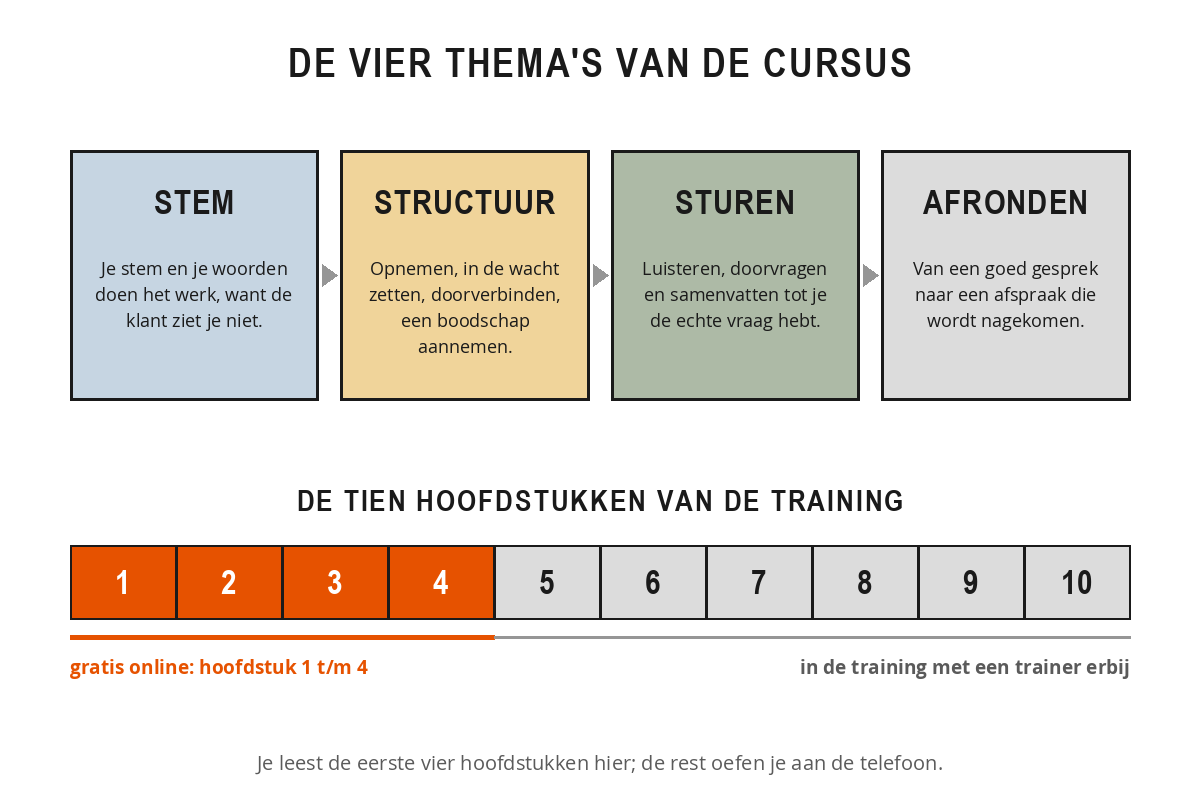
This free course contains the first four chapters: the orange part of the bar above. At the bottom of chapter 4 you will find the full course.
What you will learn
You learn exactly what is lost when the customer cannot see you, and what your voice does in that void. You are given the five VITAS factors, the dials you can turn on your own voice. After that comes the practice of the handset: answering, putting someone on hold politely, warm transferring and taking a message your colleague can actually work with. Next you learn how to steer a conversation you did not see coming, using active listening and the questioning funnel from open to closed. And you close as you should: with an arrangement that states who does what and when, rather than a well-meant "we'll look into it".
How the course is structured
The course follows four themes that build on one another. You start with your voice: the only tool you have on the phone. Then comes structure: answering, transferring, putting someone on hold, the things that happen dozens of times a day. After that send: listening, questioning and summarising, so that you get hold of the question behind the question. And you finish with Closing: from a conversation to an arrangement that is actually kept. Every chapter contains theory, a diagram, examples from practice and an exercise you apply to your own conversations.
Practical tips for use
- Record yourself once. Hearing your own voice played back is uncomfortable and teaches you more in five minutes than reading three chapters.
- Don't read it all in one go. One chapter a week, with time to try it out, delivers more than reading through it in an afternoon.
- For each chapter, choose one conversation from your own work to which you apply the content.
- Ask a colleague to listen in and tell you what they hear. On the phone, you are the only one who hears your own voice differently from the customer.
- Start small. Changing one thing at a time works better than doing everything differently from Monday onwards.
Each chapter ends with a short knowledge check of three questions: answer them correctly to mark the chapter as completed. Your progress is saved automatically in your browser.
Enjoy reading, and above all: enjoy the next conversation you did not know was coming.