


2. Answering and transferring calls
The first ten seconds of a phone call set the tone, and the ten seconds in which you transfer someone determine whether they feel helped or fobbed off. Both are short, both often happen on autopilot. This chapter stops to look at them.
After this chapter:
- You know the four parts of a good opening line and can check your own against them.
- You know what you do before the phone rings, and after how many rings you answer.
- You can put someone on hold without it feeling rude.
- You know the difference between a warm and a cold transfer, and you know when to use which.
- You take a message your colleague can act on straight away.
Before the phone rings
Preparation begins before the first ring. Pen and paper within reach, your systems open, your headset on and the background noise around you kept to a minimum. It sounds obvious, but the difference is audible: anyone who still has to go looking for a screen during the call starts talking and typing in a hurry, and the customer hears that.
Answer within three rings. Any quicker comes across as rushed, as if you were sitting there waiting for it; any later feels indifferent. For most callers, three rings is the natural rhythm to switch mentally. Use those few seconds yourself as well: breathe out calmly once, sit up straight and smile. The previous customer is done; this one starts with a clean slate.
The opening line in four parts
A professional opening contains four things, in this order. First the greeting: good morning, good afternoon or good evening. "Hello" is too informal for business contact. Then the name of your organisation, with your department added if useful, because the caller must know straight away that they have come through to the right place. Then your own name, clearly pronounced and not too fast: for you it is the hundredth time today, for them it is the first. And finally an offer of help, which hands the floor back to them.
Put together: "Good morning, De Vries customer service, Mariska speaking. How can I help you?" In a single sentence, the caller knows they have reached the right organisation, that they are speaking to a person with a name, and that this person is willing to help. The trick is to say it calmly. An opening that sounds like a droned-out mantra feels impersonal, even if all four parts are in there.
If you are making the call yourself, you reverse the order: greeting, your name, your organisation, the reason you are calling. Then ask whether it is a convenient moment. That brief check stops you from telling a whole story to someone whose mind is elsewhere.
The route of an incoming call
After the opening comes a fixed fork in the road: can you answer this question yourself or not? The rest of the conversation hangs on that.
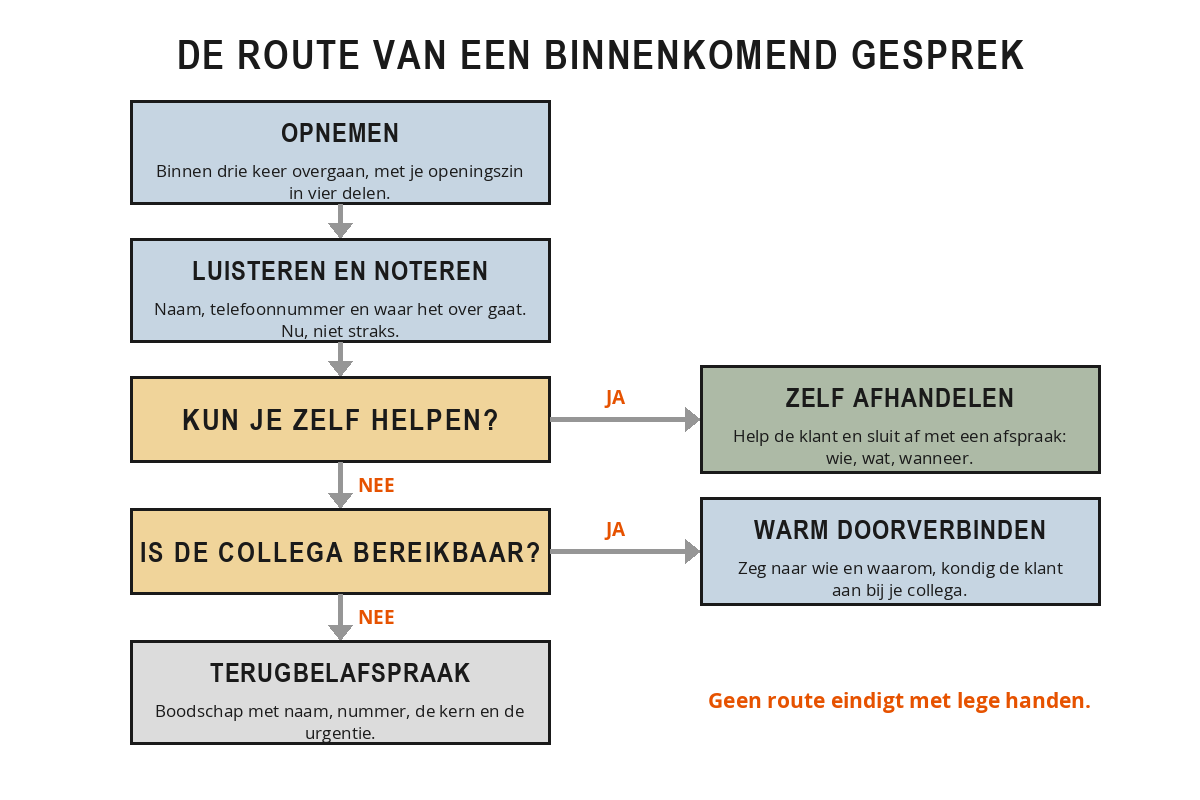
The route runs like this. You answers within three rings, with your opening line. You listens and makes notes: name, telephone number and what it is about, straight away, not later from memory. Then comes the first question: can you help them yourself? If the answer is yes, you deal with it yourself and end with an agreement. If it is no, the second question follows: is the colleague available? If so, you make a warm transfer. If not, you arrange a call-back and record the message. There is no route in this chart where the customer hangs up empty-handed.
Ask for the name and telephone number at the start, not at the end. If the connection drops halfway through, you can call back. If you do it at the end, the caller is gone and all you know is that someone was angry.
Putting someone on hold
Putting someone on hold is no problem, provided you do three things. You asks for the instead of announcing it: "May I put you on hold for just a moment?" You say why and how long: "I'll check it in our system, that will take me about a minute." And you comes back if it takes longer: after thirty or forty seconds, let them know you are still working on it. Silence feels endless on the phone.
When you come back, start by thanking them: "Thank you for holding." Not with "right, so...". The same goes for looking something up when you don't need to put the caller on hold: say out loud that you are checking something. Otherwise the customer hears a rattling keyboard and silence, and concludes that you are busy with something else. And keep your mouth empty. The microphone picks up every sip.
Warm and cold transfers
At cold transfer you press the button and the caller is gone. Your colleague gets a voice on the line without knowing who it is or what it is about, so the customer has to tell their story all over again. With a warm transfer you put the customer on hold, speak to your colleague first and pass on in two sentences who is calling and what they want. Only then do you put the call through. It costs you twenty seconds and it saves the customer the whole introduction.
This is how you transfer a call. Say to whom you transfer the call and why: "I'll put you through to Peter in accounts, he can open the invoice for you." Ask whether that is all right. Say what happens if it goes wrong: "If he doesn't answer, you'll come back to me." Announce the caller to your colleague by name and with their question. And only then transfer the call.
If your colleague does not pick up, go back to the customer. Say honestly that they are not available, and offer the alternative straight away: a call-back appointment, or a colleague who also knows the answer. What you never do is transfer the caller a second time to a third person. For most people, being transferred twice is the line between being helped and being passed around.
Mrs Bakker is calling about an order of 1,240 euros that has not been delivered. She gets Jeroen on the line, who handles the administration and not the logistics. Cold: "I'll put you through to planning, one moment." Click. Mrs Bakker tells her story again, is told there that she needs sales, and hangs up after the third time. Warm: "I'll put you through to Karin in planning, she can see where your order is. May I put you on hold for that? If she doesn't pick up, I'll come back to you." Jeroen calls Karin: "I have Mrs Bakker on the line, order number 88213, not delivered although the confirmation said Tuesday. Can you take her?" Karin opens with: "Mrs Bakker, I already have your order number in front of me." That saves two minutes and a lot of irritation.
A message that is usable
If nobody is available, your note becomes the entire conversation. A usable message contains five things: the name of the caller (and how to pronounce it), their telephone number plus when they can be reached, the core of their question in their own words, the urgency (why now, and what the deadline is) and what you have promised. Repeat the number back out loud, digit by digit; wrongly noted numbers are the most common reason a call-back is never made.
Only promise what you can deliver. "I'll make sure Karin calls you back today" is something you cannot deliver if you have not spoken to Karin. "I'll pass your question on to Karin now and ask her to call you back today. If you don't hear anything today, do feel free to call me" is. And write up your note immediately after the call, not after the next three calls; by then you will no longer remember exactly what was said.
Take your own opening line and set the four parts alongside it: greeting, organisation, your name, offer of help. Which part is usually missing in yours?
- Write your sentence down the way you want to say it tomorrow, and say it out loud three times.
- Then write down the sentence you will use to transfer the call: to whom, why, and what happens if nobody picks up.
- Finally, think about which three questions you routinely transfer. Could you learn to handle one of them yourself?
Summary
- Answer within three rings, with pen, system and headset ready.
- An opening line has four parts: greeting, organisation, your own name and an offer of help. If you are making the call yourself, you then ask whether it is a convenient moment.
- Ask for the name and telephone number at the start of the call, not at the end.
- Putting someone on hold is fine: ask permission, say why and for how long, check back in between and thank them for holding.
- A warm transfer means you first tell your colleague who is calling and what about. A cold transfer leaves the customer to tell their story all over again.
- Always say who you are transferring the caller to, why, and what happens if nobody picks up. Never transfer anyone twice.
- A usable message contains the name, the number, the gist, the urgency and what you have promised. Only promise what you can deliver yourself.
Which element is missing from the opening "Good afternoon, Sanne speaking, how can I help you?"
What is the difference between a warm and a cold transfer?
The colleague you wanted to transfer the call to does not answer. What do you do?