


2. The communication model
After the same conversation, two people each say something different about what was agreed, and both are acting in good faith. That is not because someone listened badly. It is because there are more steps between what you say and what the customer understands than you think.
After this chapter:
- You name the steps of the sender-receiver model and apply them to one of your own customer conversations.
- You can explain what encoding and decoding are and where in that process meaning is lost.
- You recognise how your frame of reference steers your interpretation of a customer's question.
- You can distinguish the three channels your message travels over and know what weight each carries.
- You can identify and limit external and internal noise in your own working environment.
From message to understanding
Every exchange with a customer follows the same pattern, including a forty-second phone call. You have an idea in your head. You convert it into words and tone, and that is called encoding. The customer picks it up and gives it his own meaning, and that is called decoding. Along the way there is noise in between that weakens or distorts the signal. Only once you get feedback session you know whether the meaning on the other side resembles what you intended.
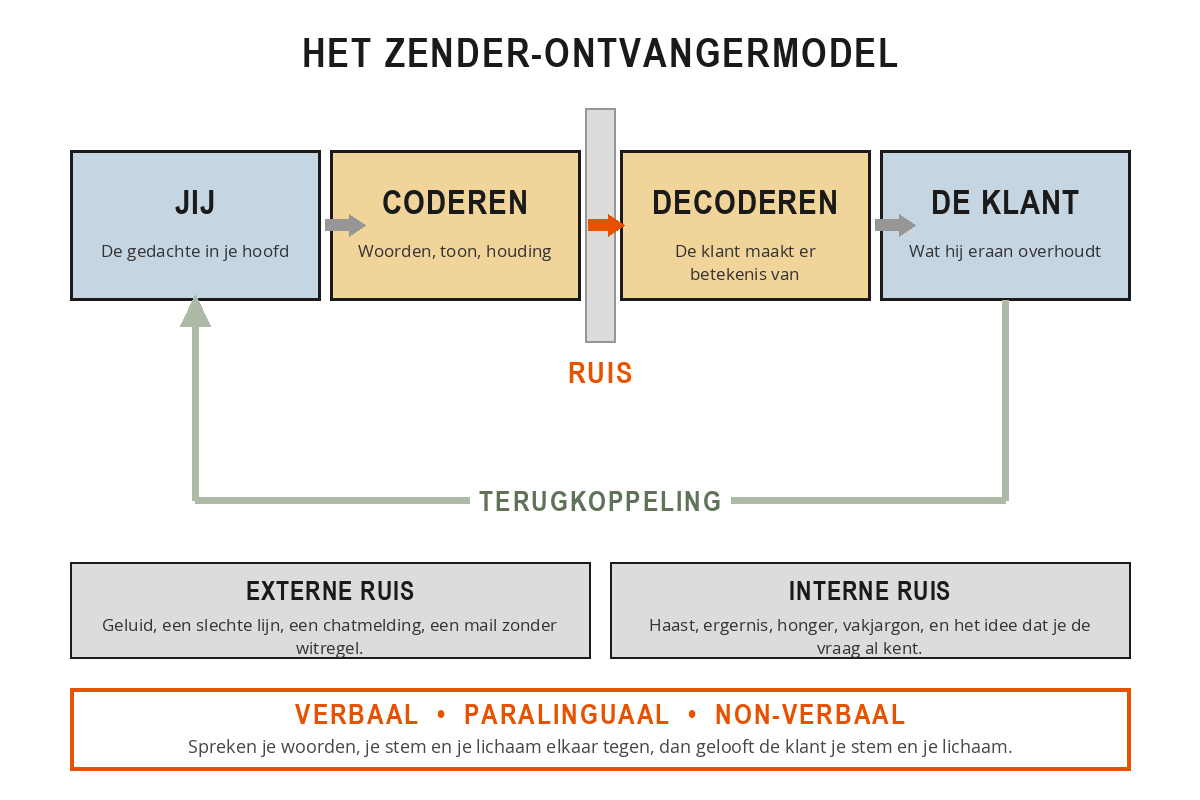
Those two translations are never identical, because you encode from your own knowledge and the customer decodes from his. As long as the customer gives you nothing back, you are guessing whether your message arrived the way you meant it. Feedback makes the decoding visible: you hear what the other person has made of it and you can adjust before things go wrong. You collect that feedback by asking a question, by summarising what you have agreed, or by having the customer retell what he has understood.
You tell a customer: "I'll put it in the schedule." What you encode is: it's on the list, and sometime this week a colleague will pick it up. The customer decodes: someone is coming today. The same six words produce two different agreements. Two days later you have a complaint that isn't about your work, but about your encoding.
External and internal noise
Noise is everything that comes between your encoding and the customer's decoding. It is rarely one big disturbance. More often it is three small things at once, so that half of your explanation does not get through.
External noise sits outside your head: the noise in the room, a connection that drops out, a conversation at the desk with three people listening in, a chat notification that pops up just as the customer is asking his key question. An email of five paragraphs without a blank line is external noise too, because the customer cannot find the agreement in it. Much of this you can remove before the conversation starts. Finding a quiet spot, switching off notifications and leaving your keyboard alone during the first minute costs you five seconds and gets you the full story.
Internal noise sits between your ears: haste, annoyance about the previous call, hunger, a deadline tugging at you, or the feeling that you already know this question. Your professional jargon belongs here too. Words such as backorder, escalate or second line are precise to you and empty to the customer. You do not solve internal noise by trying harder. You do solve it by naming it to yourself, pausing briefly between two conversations, and checking your explanation for jargon.
Do you notice halfway through that you're already thinking about your answer? That's internal noise. One brief summarising question brings you back into the conversation and gives the customer room to finish what he was saying.
The frame of reference
Everything you have experienced, learned and grown used to determines how you colour in your words. That baggage is called your frame of reference: your knowledge, your work experience, your jargon, your expectations and the interests you keep an eye on. The customer has a completely different frame, and yet you both use the same words. That is where a large part of the noise arises.
You say "shortly" and you mean two weeks, because you know the production schedule. The customer hears "shortly" and thinks tomorrow, because he is used to parcels landing on the doormat the next day. Nobody does anything wrong, and yet the agreement does not hold.
A customer with four branches calls and asks whether the fault is "known". Karim says yes, because there is a ticket open with the supplier. The customer concludes from this that someone is working on it and that he need do nothing further: he tells his staff it is being sorted out. Two days later he calls back angrily, because nothing has happened. In Karim's frame, "known" means that it has been registered. In the customer's frame, it means that someone is dealing with it. One word, two meanings, and a complaint that need never have happened.
You cannot guess the customer's frame, but you can find it out. You do that by making your words concrete (a date instead of "shortly", a name instead of "a colleague") and by having the customer retell what he has understood. Every time you probe further or give feedback, the overlap between your frames grows wider. That is exactly the behaviour from chapter 1, now with an explanation of why it works.
Verbal, paralinguistic, non-verbal
Your message travels over three channels at once, and you also send them independently of each other.
Verbal are the words themselves: your choice of words, your jargon, the order in which you explain things and how much information you give at once. This channel carries the facts. Paralinguistic is everything that happens in your voice: pace, volume, pitch, pauses, sighs, emphasis. This channel carries your attitude towards the customer. Non-verbal is your body language: posture, eye contact, facial expression, gestures, distance, and what you do with your hands while the other person is talking. This channel carries your involvement.
As long as all three say the same thing, nothing stands out. If they diverge, the customer follows your voice and your body, not your words. "Do take your time" delivered at a rattling pace sounds like haste, and then haste is the message that arrives.
On the phone your gestures fall away and the weight shifts to your voice. Sitting up straight before you pick up really does help: the other person hears it. If you're unsure how you came across, ask a colleague sitting next to you to pay attention only to your tone and not to the content. You barely notice that feedback in yourself.
What goes wrong in practice
Most communication errors are small and organisational. They only become costly once they start to add up with the same customer. Information gets stuck: you fail to pass an agreement on to the colleague who has to carry it out, or you do not record it anywhere. Vague agreements: "I'll get back to you" without a day, a time or a name, after which both parties wait for the other. Errors in the data: a wrong number or email address, so the feedback never arrives. Hearing what you expect: you recognise the problem as something familiar and stop listening before the customer has finished. Wrong recipient: the question ends up with a department that can do nothing with it, and the customer has to start all over again.
What these five have in common: all of them can be prevented with thirty seconds of extra work at the end of the conversation. A name, a date and a brief summary remove most of them.
Take a conversation from the past week in which a misunderstanding arose and lay the model over it.
- Write down what you meant to say: the thought before the encoding.
- Write down the exact words you used.
- Note down how the customer responded, and therefore what he made of it.
- Describe which part of his frame of reference you hadn't taken into account. Which word did the two of you colour differently?
- Note down one external and one internal disturbance you could have removed.
- Finally, formulate one sentence with which you would now encode the same message.
Summary
- A message goes from sender to receiver via encoding and decoding; along the way, noise distorts the signal.
- External noise is in your surroundings and internal noise is in your head. Both can largely be limited before the conversation begins.
- Your frame of reference determines how you colour words, and the customer's is different. Being specific and asking them to repeat it back in their own words increases the overlap.
- Your message travels verbally, paralinguistically and non-verbally. If those channels contradict each other, the customer believes your voice and your body.
- The five common errors are: information that gets stuck, vague agreements, incorrect details, hearing what you expect, and the wrong recipient.
- Thirty seconds at the end of the conversation, with a name, a date and a summary, prevents most of them.
You tell a customer "I'll put it in the schedule" and he then expects someone the same day. Where does the problem lie according to the model?
Which of these four is an example of internal noise?
You say "please take your time", but you speak quickly and sound rushed. What reaches the customer?