


1. Customer-focused behaviour
Every contact with a customer says something about the whole organisation. Not about the policy, the website or the brochure, but about you at that moment: your tone, your pace, and your willingness to look into something that isn't really your area. The customer doesn't know the organisation. The customer knows the person who answered the phone.
After this chapter:
- You can describe what customer-focused thinking and acting means in concrete behaviour.
- You explain why there is no such thing as a standard customer, and therefore no standard approach.
- Do you adjust your approach to the pace, level of knowledge and emotion of the person in front of you?
- You weigh up the customer's interest, the company's interest and the relationship.
- You identify the difference between an external and an internal customer.
The organisation's calling card
Words like service and optimal service provision sound fine in an annual report, but they are of no use to you in a conversation. Customer-focused thinking only becomes usable once you translate it into behaviour you can see and hear. One agreement you fail to keep weighs more heavily in the customer's experience than ten tidy emails from your department.
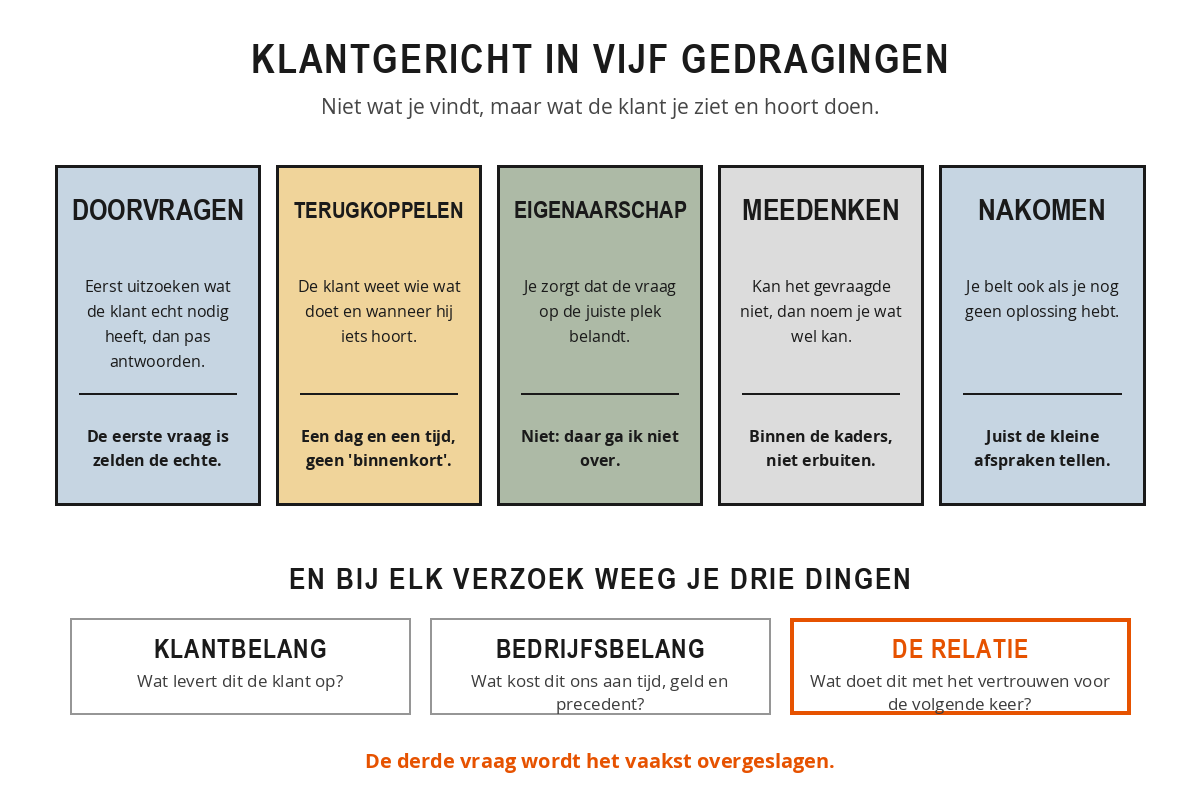
Five behaviours make the difference, and all five take hardly any extra time.
Asking follow-up questions before you answer. You first find out what the customer actually needs, instead of responding to the first question you hear. The first question is rarely the real question.
Reporting back on what you are going to do. After the conversation, the customer knows who is doing what and when they will hear back. Not "I'll get back to you", but "I'll ring you on Thursday before twelve, and if I still don't know by then I'll ring anyway".
Taking ownership. You don't pass people on with "that's not my area", but make sure the question ends up in the right place. The customer doesn't need to know how you've divided things up internally.
Thinking along within the boundaries. If what is asked isn't possible, you say what is possible. "That can't be done" is an answer; "that can't be done, but this can" is a conversation.
Keeping to agreements, including the small ones. If you promise something by Friday, you also ring on Friday if you don't yet have a solution. Especially then.
So the difference lies in attention, not in effort. And every contact produces two things: the result, meaning the question has been answered or the order is in place, and the impression the customer is left with of working with your organisation. Anyone who only watches the first of these closes conversations neatly and loses customers in the long run.
No standard customer, no standard approach
Two customers with exactly the same question may need something completely different. One wants an answer in three minutes and nothing more. The other wants to understand how it works before making a choice. You therefore adjust to three signals, and you usually pick these up within the first minute.
Pace. Does the customer speak briefly and quickly, or do they take their time? Match that rhythm instead of reeling off your own standard story. Level of knowledge. Does the customer know what it's about, or are they hearing the terms for the first time? That determines how much you explain and which words you choose. Emotion. Is there tension, anger or uncertainty beneath the question? Then acknowledgement comes first, because content only lands once someone feels heard.
These three signals do not determine what you can offer, but they do determine how you present it.
Two customers ring on the same morning about the same delayed delivery, both three days late. The first is a buyer at a construction firm who only wants a new date so he can update his planning: he gets the date in two sentences and a confirmation by email. Call finished in a minute and a half, and he is satisfied. The second is a sole trader who has already had to disappoint his own customer three times: he first needs acknowledgement, then the date, and then a suggestion about what he can tell his customer. That call takes seven minutes. The same information, two completely different conversations. Had you dealt with the second call in a minute and a half, you would have had a complaint about something that was factually correct.
If you're unsure what someone needs, an open check works: "Would you like me to keep it brief, or shall I take you through how it works?" The customer then chooses the format, and you're on the right track straight away.
Weighing up costs and benefits
Being customer-focused doesn't mean the customer always gets what they ask for. With every request you weigh up three things, and you do that with three questions.
What does this give the customer? Does your offer solve the real problem, or only the question as it was asked? What does this cost the organisation? Think about time, money, an exception to an agreement, and the effect on other customers who will ask for the same thing the moment they hear about it. What does this do to the relationship? Besides the outcome of this particular moment, the trust for next time is at stake.
That third question is the one most often skipped. Anyone who only looks at the end result of this one contact sometimes wins the argument and loses the customer. With competition on every corner, the relationship is part of your product.
Mariska works in the internal sales team. A customer asks for an urgent delivery that doesn't really fit the schedule. The costs: about two hours of extra work and a colleague in the warehouse who has to reschedule two other orders. The benefits: this customer is in the middle of relocating his shop and has been generating revenue for four years now, some forty thousand euros a year. Mariska arranges the urgent delivery, but says straight away that it is a one-off exception and why: next time her colleague would have to shift things around again. The customer is helped, the agreement stands, and the colleague knows what he did it for. Had she simply said yes, she would have had the same request a month later, with no argument for saying no.
The internal customer
A customer is not always someone outside the organisation. As soon as a colleague depends on your work, that colleague is your internal customer. The buyer waiting for your specification, the service desk that needs your file to answer the customer, the colleague who needs your time sheet in order to invoice.
Anyone who serves their internal customer poorly is only shifting the problem. The colleague further down the chain then has to repair it, usually with the external customer on the line. Four behaviours make the difference here: deliver complete work (you pass on what the next link in the chain needs, not what was enough for you), reporting back (you let people know that something has been picked up or is in fact still waiting, so nobody has to guess), asking what would be helpful (you check how your colleague wants it delivered instead of working that out yourself) and no hidden handovers (you don't quietly pass a problem on, but state what is still outstanding).
One question to the colleague who takes on a lot of your work often pays off immediately: "What do I hand over that gives you extra work?" The answer can usually be sorted out within a week.
Satisfaction as a business result
Customer satisfaction is not a prize for being nice; it is a business result. Only a satisfied customer stays a customer, and they bring in new customers as well. A dissatisfied customer often leaves without complaining, so you never even find out what went wrong. Keeping an existing customer usually costs far less than winning a new one, so every contact that goes well is an investment that pays for itself. And it is not only about what you deliver: understanding, speed and honesty about what is not possible weigh just as heavily.
Score yourself on the five behaviours from this chapter.
- Give yourself a score from 1 to 5 for each behaviour: asking follow-up questions, reporting back, taking ownership, thinking along within the boundaries, and keeping to agreements.
- For each score, note down a situation from last week that explains it. Without an example, the score is just a feeling.
- Take the lowest score and think of one change in behaviour you can carry out this week.
- Also note down three colleagues or departments that depend on your work, and write down for each person what they need from you.
- Pick one that regularly goes wrong and decide what you will change about it.
Summary
- Customer focus only becomes usable once you translate it into behaviour: asking follow-up questions, reporting back, taking ownership, thinking along within the boundaries and keeping to agreements.
- Every contact produces two things: the outcome of this conversation and the relationship you will still need afterwards.
- There is no such thing as a standard customer. You adjust to the pace, level of knowledge and emotion of the person in front of you.
- With every request you weigh up three questions: what it gains the customer, what it costs the organisation, and what it does to the relationship.
- A colleague who depends on your work is your internal customer. Poor internal work shows up externally.
- Satisfaction is a business result: keeping customers costs less than winning new ones, and a dissatisfied customer often leaves without complaining.
A customer asks something that is not your department's responsibility. What counts as customer-focused behaviour according to this chapter?
Which three signals do you adapt your approach to when there is no such thing as a standard customer?
Which of the three weighing-up questions is skipped most often, according to this chapter, and with what consequence?