


4. Conversation techniques for difficult behaviour
Knowing what is going on is one thing. Doing something useful with it in the conversation itself is another matter entirely. Two movements form the basis: asking questions until you understand the other person, and naming what you see happening.
After this chapter you can:
- Applying the three steps of LSD in a conversation with someone who reacts irritably, complains or closes off.
- Identifying the difference between a summary and your own conclusion.
- Formulating open questions that lead to the other person's behaviour and interests.
- Naming difficult behaviour using NIVEA, without putting the person you are talking to on the defensive.
- Setting a boundary in four steps, and responding to criticism that is either justified or not.
Listening, summarising, probing
LSD is not a trick for calming someone down, but a way of finding out what the other person really means before you form your own view. With difficult behaviour that is a real gain: someone who feels understood has no need to push harder.
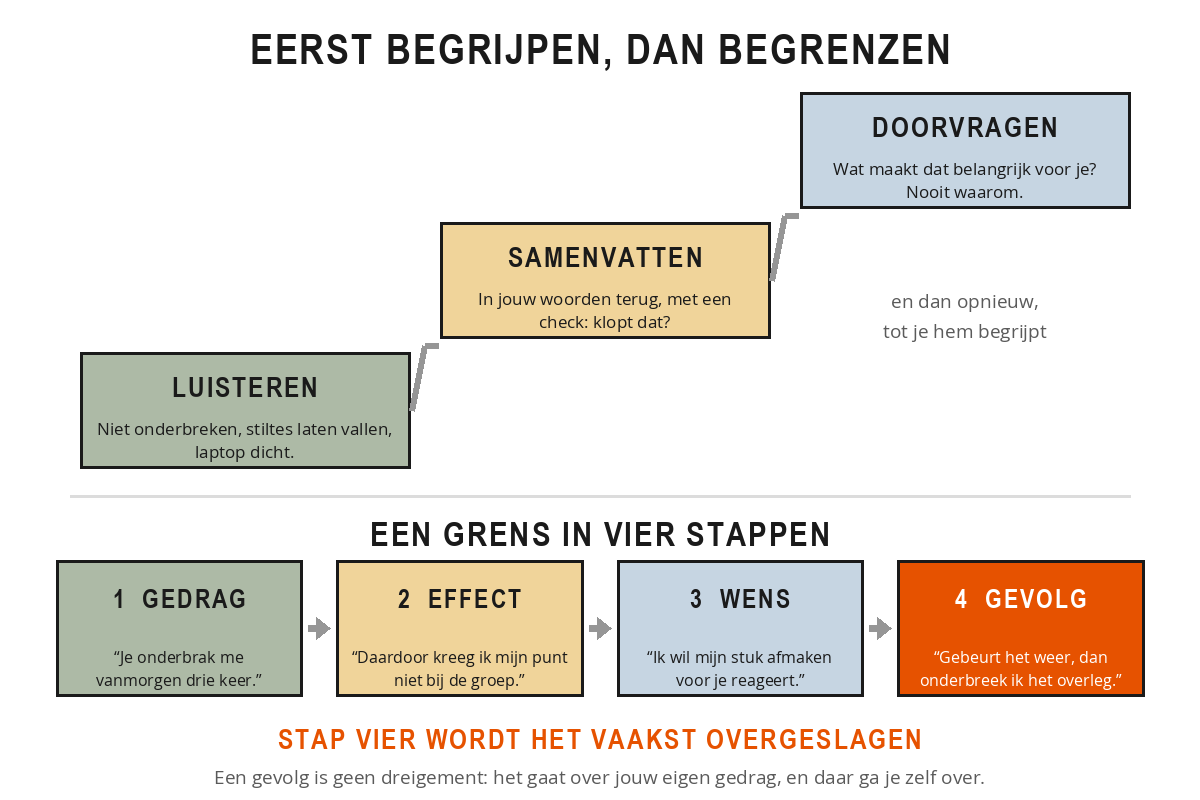
Listening means more here than keeping quiet while you prepare your answer. You direct your attention fully to the other person and hold back your own judgement for a moment. You pay attention to all three channels: the words, the tone and the posture. What is someone literally saying, how does it sound, and what is their body doing alongside it? In practice you can recognise good listening by a few things. You don't interrupt, you allow silences of two or three seconds, you nod or say "hm" to show that you are there, and you put your phone away and close your laptop. Half a channel of attention is read by the other person as no attention at all.
Summarising is a brief rendering of what the other person said, in your own words, followed by a check. "So if I understand you correctly, your main concern is next week's planning and not so much the report itself. Is that right?" That does three things at once: it proves that you have listened, it gives the other person the chance to correct you, and it slows the conversation down, which brings the temperature down. Do note the difference with a conclusion. "So you don't feel like doing this project" is not a summary, that is your interpretation dressed up as one.
Asking follow-up questions is the step most people skip, because after the summary they think they know. With an open question you go one layer deeper, to the behaviour, the situation or the interest underneath. Four questions do almost all the work. "What makes that important to you?" looks for the interest behind the objection. "What would that look like?" forces vagueness towards concrete behaviour. "Which situation exactly are you thinking of?" brings a label back to a single moment. And "what do you need in order to be able to support this?" is an invitation to think along rather than to grumble.
Why-questions are best left alone. "Why didn't you report that?" almost always sounds like a reproach, however kindly you say it. "What made you not report it at the time?" asks the same thing and produces an answer instead of a defence.
A colleague bursts in: "This is completely unworkable. You keep moving that deadline and I'm the one who has to sort it out again." Without LSD you say: "It's not that bad, we've only moved it twice." With LSD you first let him finish and say nothing about those two times. Then you summarise: "You've seen the deadline move twice and you feel the consequences land on your desk." After that you ask a follow-up question: "What does that mean for your week in practical terms?" He then tells you that he already has an audit scheduled for Friday. That is something you can talk about. Unworkable is not.
Summarise the moment you notice that you are formulating your own counterargument. That is exactly the point at which you stopped listening, and a summary brings you back into the conversation.
NIVEA: do not fill in the blanks for someone else
Listening and asking follow-up questions will take you a long way, but not indefinitely far. At some point something of yours has to go on the table: this is going too far, this is where I stop, this is not how I want it. A boundary you only draw internally is never noticed by the other person. And the first condition for such a boundary is that you set it without filling anything in.
NIVEA stands for niet invullen voor een ander: don't fill in the blanks for someone else. It is a reminder for the moment you notice that you have already come up with an explanation in your head for the other person's behaviour, and then discuss that explanation out loud as if it were a fact. As soon as you fill in the blanks, you say something like: "You simply don't feel like doing this project." That is a conclusion about someone's motives, and there is only one possible answer to it: denial. From that moment on, the conversation is about whether your interpretation is correct, and no longer about the behaviour that was bothering you.
NIVEA works in two directions. You do not fill in what the other person thinks, feels or means. And you also do not fill in what the other person can or cannot handle: "I'd better not say it, because it will only make her feel insecure" is just as much an assumption about an inside you cannot see.
Filling in the blanks: "You evidently don't consider this meeting important enough to arrive on time." Following NIVEA: "You came in twenty minutes late. As a result we had to go over the first agenda item again. What was going on?" The second version yields information. The first yields a discussion about what you think the other person thinks.
A boundary in four steps
A boundary that works consists of four parts, and you can see them in the bottom row of the diagram above.
- Behaviour. What you observe, in camera language: "You interrupted me three times this morning during my explanation."
- Effect. What that did, without filling in motives: "As a result I couldn't get my point across to the group, and that annoyed me."
- Wish. What you want instead: "I want to finish my point before you respond."
- Consequence. What you will do if the behaviour continues: "If it happens again, I'll interrupt the meeting and come back to it."
That fourth step is the one most often skipped, and that is precisely where the difference lies between a wish and a boundary. A wish can be ignored, a boundary cannot. And a consequence is not a threat: it is an announcement of your own behaviour, and therefore something you decide on yourself. That also contains the test of whether it is a workable consequence. If you cannot carry it out yourself, it is not a consequence but a hope.
Only state a consequence that you are actually going to carry out. A boundary you fail to enforce even once becomes, from that moment on, a suggestion in the other person's eyes.
Responding to criticism
Criticism rarely comes in a tidy form. Usually you get it in the corridor, in passing, or downright harshly during a meeting. Your first move determines how the rest of the conversation goes, and that first move is almost always to defend yourself. There is one question that governs everything before you say anything: is there something in it that is true? As long as you don't know that, you can't respond sensibly.
Asking further questions is not a delaying tactic here. "Where did you see that?" and "which situation are you thinking of?" break a label down until only behaviour remains. Only then can you judge whether there is any truth in it. If there is, even in part, acknowledgement is the quickest and strongest response: "You're right that that email should have gone out on Tuesday. I let that slip." You leave out the explanatory sentence that follows, because every "but" immediately undoes the acknowledgement.
Sometimes the criticism is simply wrong, or it is so vague and so often repeated that engaging with the substance no longer serves any purpose. For those situations there is the fogging technique. You behave like a fog bank: the other person can throw anything into it, but nothing comes back. No counterattack and no defence, so no material for another round either. You do this in three ways. You acknowledge what is true, and nothing else: "That's right, that report wasn't finished on Tuesday." You acknowledge that it could be the case, without adopting the conclusion: "It may well come across that way to you." Or you acknowledge in general terms: "There's probably something in what you say." Then you calmly repeat your own position, in the same words, no louder and no more elaborately. Someone who meets no resistance has nothing to push against.
Colleague: "You only ever think about your own department." You: "It may well come across that way. I am sticking to Wednesday as the deadline." Colleague: "Typical, always those deadlines of yours." You: "I hear that you find that annoying. Wednesday is still needed for the accountant." There is nothing to bite into, and the conversation then returns to the issue of its own accord.
The fogging technique is intended for criticism that makes no sense at all or is repeated endlessly. With justified criticism it works against you, because then it becomes evasion and the other person notices that straight away.
Choose one piece of criticism you have received over the past few months that still nags at you. Work it out in writing:
- The criticism in the other person's words.
- Your follow-up question to turn it into behaviour.
- What is factually correct about it, and your acknowledgement in a single sentence without a "but".
- What is wrong with it, and your fogging-technique sentence plus your own position.
Then read the two responses aloud. Do you notice that the acknowledgement is shorter than the explanation you would normally give? That is exactly the point.
Summary
- Listening, summarising and asking follow-up questions bring out the information you need before you form a view of your own.
- A summary stays close to what was said and ends with a check. A conclusion about someone's motives is not a summary.
- You ask follow-up questions using what and how. Why questions sound like an accusation and produce a defence.
- NIVEA keeps you from making assumptions about the other person's motives and feelings, and about what they can or cannot handle.
- A boundary consists of behaviour, effect, wish and consequence. The consequence concerns your own actions and is therefore not a threat.
- A consequence you do not carry out turns your boundary into a suggestion.
- If the criticism is justified, you acknowledge it without explaining. If it is not, you use the fogging technique to take away the resistance and calmly repeat your position.
Which of these responses is a summary and not a conclusion of your own?
You state the behaviour, the effect and the request, but leave out the fourth step. What is the consequence of that?
When does the fogging technique work against you?
Ready for the next step?
You have completed the free starter of Dealing with Difficult People. The next chapter in the full course is The communication model: Sending and receiving, the three channels of a message, the laws of communication and the formula E = K x A.
Take the 2-day course →From €1250,- excl. VAT · with an experienced trainer included