


3. Five classic difficult types
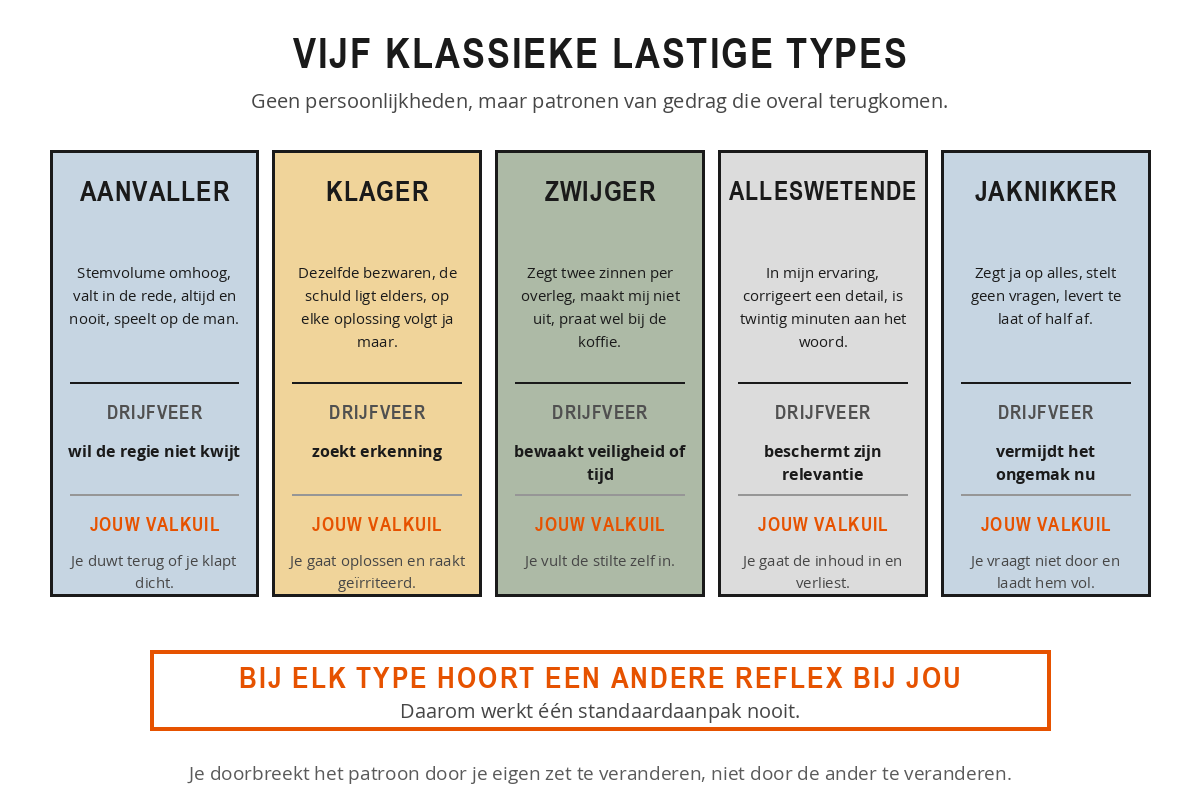
Five behavioural patterns keep coming back in work situations. If you recognise them, you see more quickly what lies beneath them and, just as importantly, which reflex they trigger in you.
After this chapter:
- You recognise five classic patterns of difficult behaviour by concrete signals.
- Name the driver that lies beneath each pattern.
- You know which reaction each type provokes in you and why that makes matters worse.
- You choose an approach for each type that breaks the pattern.
Patterns, not personalities
A typology of difficult behaviour is a set of recognisable behavioural patterns, not a classification of people. So you look at behaviour and not at the person, exactly as in chapter 1. A type describes what someone does in a particular situation, towards a particular person, under a particular pressure. The same colleague who attacks in the project meeting can be calmness itself at the coffee machine. As soon as you think "he is just a complainer", you have stopped looking.
Every pattern has two layers. The first is the driver: the recurring motive that feeds the behaviour. Someone who attacks wants to achieve or protect something, even if he chooses a form that rubs you up the wrong way. The second layer lies with you. The pitfall in your own reaction is the reflex this behaviour triggers in you and that keeps the pattern going. Each type comes with a different pitfall, and that is precisely why one standard approach never works.
The attacker
You hear a voice getting louder and a pace that picks up. He interrupts you, uses absolute words like always and never, and shifts from the issue to the person: "Your department is structurally late with deliveries." This often happens with an audience present, which raises the pressure further.
His driver is almost always the wish not to lose control. Someone feels cornered, is being held responsible for something he has no influence over, or is afraid of losing face. Attacking is then the quickest way to get back in the driving seat. The volume says something about the pressure he is under, not about the size of your mistake.
Your pitfall is one of two reflexes, and both confirm the pattern. You push back in kind, after which you both turn up the volume together. Or you shut down and say "fine", after which he notices that talking louder works.
The approach: first notice your own alarm system, because hot ears and a clenched jaw are the signal to breathe out once before you say anything. Then acknowledge the emotional charge without conceding the content: "I can hear this matters a great deal to you." Next, name the form in an I-message: "That is the third time you have interrupted me, and it means I cannot finish my point." Set a boundary and offer an alternative alongside it: "I want to talk this through further, but then we take turns." And move the conversation to a room without an audience as soon as the tension does not subside.
During the monthly meeting Erik says loudly: "That planning of yours is complete nonsense, we'll never make it." Rachid does not defend his planning. He says: "You're clearly not comfortable with it. Which part do you think will go wrong?" It turns out Erik is afraid the delay will land on his plate. That is the conversation they then have, and it takes five minutes instead of half a meeting.
The complainer
Complaining behaviour is less loud than an attack, but in the long run it drains you more. The same objections come back time and again, often in almost the same words. The cause always lies with others: management, the system, the previous project leader. Every solution you offer is met with "yes, but". And the complaining happens more often alongside the meeting than in it.
His driver is not a solution but acknowledgement. Someone who complains is looking for confirmation that he feels powerless. As long as that acknowledgement is missing, he has to keep repeating the problem, because that is his only way of being heard. Any solution you offer before the acknowledgement is there sounds like "don't make such a fuss".
Your pitfall is to solve it. You list three options, he shoots down all three and you become irritated. The second reflex is to go along with it until you snap: you nod along pleasantly until the day you avoid him in the corridor.
The approach: first acknowledge the feeling without confirming the content, for example with "I understand it's frustrating when you keep having to chase it up". Then ask about one concrete example instead of the general story. Next, shift the question to his own influence: "What could you do about this yourself?" Make an agreement with a name and a date, however small. And set a time limit if it keeps recurring: "I have ten minutes for this, and then I want to know what you are going to do."
With a complainer, the question "what have you already tried?" works better than "what are you going to do?". The first question acknowledges his effort, the second can sound like a reproach.
The silent type
Of all the types, the silent one is the easiest to overlook. He disrupts nothing and claims nothing, and precisely for that reason it often takes months before you notice that something is off. In an hour-long meeting he says two sentences, both in answer to a direct question. Asked what he thinks of it, the answer is "I don't mind either way". At the coffee machine, ten minutes later, it turns out he does have a very definite opinion on exactly the point you were just discussing. That last part is the signal that this is not shyness: someone with nothing to say is silent everywhere, someone who is silent only in the group is making a choice.
His driver is one of three things. The first is the experience that contributing gets you nowhere. The second is safety: he expects criticism or loss of face as soon as he speaks up. The third is pace: he needs more processing time than the rhythm of the conversation allows, and by the time his thought is complete, the subject has moved on. With the first you help with influence, with the second with safety, with the third with time.
Your pitfall is to fill the silence yourself. You repeat your question and then answer it yourself. You talk longer and faster, taking over what he should be doing. The second pitfall is reading his silence as agreement. That is an interpretation, not an observation, and the more often you make it, the greater the chance that you only discover at the implementation stage that he was never on board.
The approach: ask in advance, not on the spot, because letting him know a day earlier that you want to hear his view on point three gives him the processing time the meeting itself does not offer. Then let the silence stand and count to seven in your head after your question; most people cannot hold out for three seconds, and it is precisely those seconds that create the space he steps into. Ask a question that cannot be answered with yes or no, because "what do you see that we are missing?" yields more than "can you go along with this?". Check your assumption out loud: "You are quiet today. Does that mean you agree, or that you are still thinking it over?" And speak to him separately if the group setting does not work.
When a silent type finally says something, the first minute afterwards is decisive. Anyone whose contribution is immediately met with a counter-argument will opt for silence again next time. Ask follow-up questions first, respond only after that.
The know-it-all
With this type the difficulty rarely lies in what someone knows, because the content is often largely correct. It is the way the knowledge is deployed that closes down the conversation. He interrupts halfway through your sentence with "that is not going to work", starts sentences with "in my experience", corrects a detail that does not matter and uses that correction to set aside your entire proposal. In an hour-long meeting he is speaking for twenty minutes. When contradicted, he does not get louder, but slower and more explanatory.
His driver is not being proved right but relevance: the certainty that he still matters. Knowledge is where his position rests, and as soon as someone comes along with a newer story, that position starts to shift. That explains why he plays it harder the more people are present. There is often a core quality underneath it that has been taken too far: craftsmanship and experience turn into dogmatism in too large a dose.
Your pitfall is to get drawn into the content. You bring in figures and prove that it can be done, and in doing so you play exactly the game he is better at. The rest of the table watches two people fight over who is right. The opposite pitfall also exists: you stay silent and let him finish, after which his verdict lingers as the decision.
The approach: acknowledge the experience before you bring in anything else, for example with "you've seen this system change three times, so you know where it goes wrong". Acknowledgement is not agreement and costs you nothing. Then turn his knowledge into an assignment: "What do you see as the three biggest risks, and which of those can you cover?" Someone who takes ownership no longer needs to prove that he knows. Separate fact from opinion, visibly limit airtime with "five minutes per person", and have the real confrontation one to one.
The yes-man
The yes-man is the friendliest of the list and for that reason causes the most delay. The problem only becomes apparent at the deadline, and by then it is too late to adjust. He says yes to everything: every deadline is feasible, every request still fits. He asks no questions and raises no objections. The work then comes in half-finished, late or not at all, and when you ask why, you hear that something came up. In the meeting "fine" is said in a flat tone and without eye contact: his words and his tone tell two different stories.
His driver is avoiding the discomfort of the moment. Saying no creates tension straight away, saying yes creates calm straight away, and the problem this causes lies safely in the future. Underneath there is usually the wish to be liked, or the fear that contradicting someone will cost him his position.
Your pitfall is failing to probe further. His yes feels pleasant, so the next time round you ask him again, because at least he does not say no. That way you keep loading him up until it goes wrong, and then you react more sharply than the situation warrants. To him that outburst comes out of nowhere, which confirms his conviction that being honest is dangerous.
The approach: actively invite the objection with "what could get in the way here?", because that gives him permission to have doubts. Avoid closed questions: "can you manage that?" always produces a yes, whereas "what do you need to get this finished by Friday?" produces information. Have him play it back with "what will you do first on Monday?", because anyone who cannot formulate his own plan does not have one. Keep the agreement small and concrete: one step, one date, one check-in. And reward bad news, because if he does once indicate that it is not going to work, your reaction determines what happens next time.
Choose the type that costs you the most and work out:
- Why this particular type gets to you. Set it alongside your quadrant from chapter 2.
- A specific situation from the past month, in three sentences that pass the camera test.
- What you literally did or said at that moment, and what that triggered in the other person.
- Which of the five steps for this type you have never tried.
- The one sentence you will use to open it next time.
Summary
- The five types are not personalities but patterns of behaviour, which you recognise by observable signals.
- The attacker is protecting his control. You push back or shut down; acknowledge the charge and set limits on the form.
- The complainer is looking for recognition, not a solution. You start solving; acknowledge the feeling first and then shift to his own influence.
- The silent type is protecting his safety or his time. You fill in the silence; ask in advance, let the silence stand and check your assumption out loud.
- The know-it-all is protecting his relevance. You get drawn into the content; acknowledge his experience and turn his knowledge into an assignment.
- The yes-man avoids the discomfort of the moment. You fail to probe; invite the objection and have him repeat it back to you.
- Each type triggers a different reflex in you, and that reflex keeps the pattern going. You break it by changing your own move.
A colleague has been raising the same complaint about the system for months and shoots down every solution with "yes, but". According to this chapter, what drives him?
Someone says "I don't mind either way" in every meeting, but has an outspoken opinion on the same point at the coffee machine. What does that tell you?
Why is getting drawn into the content the wrong move with the know-it-all?