


2. Deferred tax assets and liabilities
The same coin has two sides. A temporary difference leads either to a future tax liability or to a future tax benefit. Which way it goes determines whether a deferred tax liability or a deferred tax asset appears on the balance sheet, and thus whether the item lands on the credit side or the debit side. In chapter 1 you found the difference; here you give it a direction.
After this chapter you can:
- Identify when a temporary difference leads to a deferred tax liability and when it leads to a deferred tax asset.
- Deducing the direction of a deferred tax position from the comparison between the carrying amount for financial reporting purposes and the tax base.
- Recognising the most common causes of deferred tax liabilities in a balance sheet.
- Calculating the size of a deferred tax position on the basis of the temporary difference and the applicable rate.
What a deferred tax liability is
A deferred tax liability is an obligation on the balance sheet for tax that you have already become economically liable for, but which you only pay in a later financial year. The profit in the financial accounts is then higher than the taxable profit, or the carrying amount of an asset in the financial accounts is higher than its tax base. Either you have already had a deduction for tax purposes that is still to come in the financial accounts, or you have already recognised profit in the financial accounts on which the tax authorities will come calling later. That claim sits on the credit side, usually under provisions, under the name provision for deferred tax liabilities or provision for taxation.
The term liability therefore refers to the place on the balance sheet, not to the degree of certainty. Such a deferred tax position follows automatically from the balance sheet approach in chapter 1, applied to the item concerned: you multiply the taxable difference by the rate at which it is expected to be settled.
Where deferred tax liabilities come from
Practice shows a limited number of recurring causes. Four of them you will come across in virtually every financial statements file.
Depreciation differences. For tax purposes you depreciate faster than commercially, for example through a shorter useful life or a lower residual value. The tax book value falls more steeply, and the difference is taxable. Revaluation of property or other assets. You value a property commercially at current value while the tax authorities continue to follow historical cost; the unrealised increase in value gives rise to a taxable temporary difference. Capitalisation of development costs. For accounting purposes you capitalise the costs and depreciate them over several years; for tax purposes they are charged to the result in one go. Tax reserves. The best-known example is the reinvestment reserve: for tax purposes you defer the book profit by setting it off against a replacement investment, while commercially you simply take that profit to the result.
A manufacturing company buys a machine on 1 January for 500,000 euros. Commercially the company depreciates it on a straight-line basis over ten years with no residual value, so 50,000 euros a year. For tax purposes the machine may be depreciated over five years, so 100,000 euros a year.
At the end of the first financial year the picture looks like this. The accounting carrying amount is 500,000 minus 50,000 is 450,000 euros. The tax carrying amount is 500,000 minus 100,000 is 400,000 euros. The taxable temporary difference is therefore 50,000 euros, and at 25.8 per cent that comes with a deferred tax liability of 12,900 euros.
The tax authorities have allowed 50,000 euros more deduction this year than the company recognises commercially as an expense. That advantage is temporary: from year six the machine is fully depreciated for tax purposes and commercially there are still four years of depreciation charges to come. The difference then falls back to zero and the deferred tax is released step by step.
Calculating and tracking the deferred tax
The calculation itself is simple once the difference has been established. For each balance sheet item you determine the commercial book value at the balance sheet date. You look up the tax book value of that same item in the tax balance sheet or the tax return. You deduct the tax book value from the commercial book value; if the outcome for an asset is positive, you have a taxable temporary difference. You multiply the difference by the tax rate expected to apply at the time of settlement. And then comes the step that is most often skipped in practice: you compare the outcome with the balance of the deferred tax at the start of the year, and you post that difference through the tax charge in the profit and loss account.
A deferred tax balance is not an amount that you determine once and then leave alone. At each balance sheet date you recalculate the position, and the movement runs through your effective tax burden. How to book that movement is covered in chapter 4.
A reconciliation schedule per item with three columns (carrying amount for financial reporting purposes, tax base and the difference) takes you ten minutes and immediately makes visible during the audit where the deferred tax comes from. Without that schedule, a year later you will have forgotten why the amount is what it is.
Determining the direction of the difference
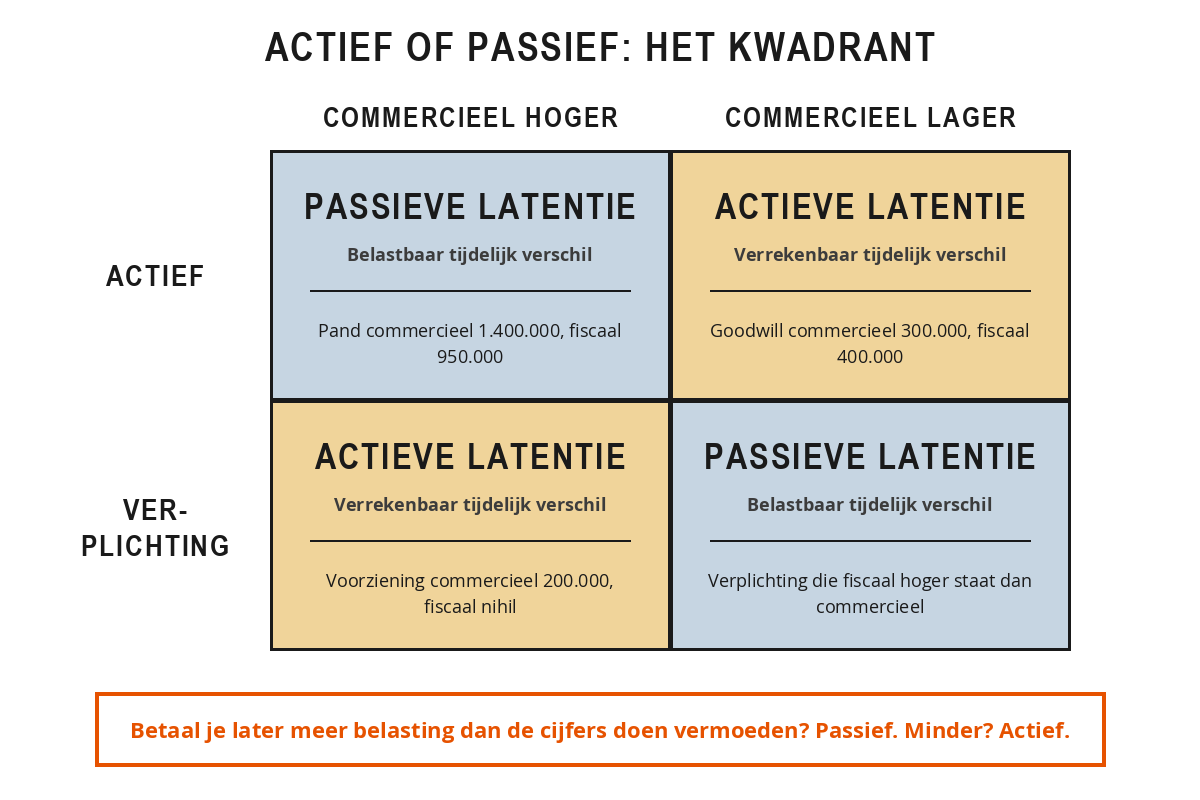
Two questions together determine the direction: is the item on the assets side or on the liabilities side, and which carrying amount is the higher? Once you have those two answers, the type of deferred tax follows automatically. The quadrant shows that the outcome is mirrored diagonally: for a liability the logic works exactly the other way round compared with an asset.
The four boxes from the diagram, written out in full. A asset whose commercial carrying amount is higher than the tax value produces a taxable temporary difference and therefore a deferred tax liability; the example is a property carried at 1.400.000 euros in the financial accounts and at 950.000 euros for tax purposes. A asset whose commercial book value is lower gives a deductible temporary difference and therefore a deferred tax asset; think of goodwill carried at 300.000 euros in the financial accounts and at 400.000 euros for tax purposes. A liability whose commercial book value is higher than the tax value likewise gives a deductible difference and therefore a deferred tax asset; the textbook example is a provision amounting to 200.000 euros commercially and nil for tax purposes. And a liability whose tax carrying amount is higher than the commercial one gives a taxable difference and therefore a deferred tax liability.
Why the direction reverses for liabilities
For an asset the reasoning is straightforward. If the property is carried commercially at 1,400,000 euros and for tax purposes at 950,000 euros, there is 450,000 euros of value in the books that still has to be settled with the tax authorities. That is a future tax burden, and therefore a deferred tax liability.
With a provision it works the other way round. A major maintenance provision of 200,000 euros that is not recognised for tax purposes has a tax book value of zero. Commercially you have already taken the expense; for tax purposes that deduction only comes when the maintenance is carried out. So you still have deduction potential outstanding, and that gives rise to a deferred tax asset.
This is how you work through an item. You identify the item and pick one at a time, for example the business premises, the goodwill or the provision for major maintenance. You determines the nature: is it an asset or a liability? This steers the direction of the outcome. You places both carrying amounts side by side, commercial and tax, as at the same date. You calculates the difference, commercial minus tax, including the sign. You reads off the direction by combining nature and sign in the quadrant. And you multiply by the rate that applies at the moment the difference is expected to reverse.
Unsure which way it goes? Then the cash question helps: will this item in future lead to you paying more or less tax than you would expect on the basis of the commercial figures? Paying more means a liability, paying less means an asset. That question works for every item, even when the quadrant briefly escapes you.
A private limited company bought goodwill in 2019 for 500,000 euros. For financial reporting purposes it amortises over ten years, so 50,000 euros per year. For tax purposes the amortisation is limited to 10 per cent per year of the acquisition value, which comes out at the same amount. Both routes therefore arrive at 50,000 euros per year, the difference remains nil and there is no deferred tax. A difference in rules does not always lead to a difference in figures.
If the goodwill is amortised over five years for financial reporting purposes, so 100,000 euros per year, the picture changes. After two years the goodwill stands at 300,000 euros for financial reporting purposes and 400,000 euros for tax purposes. The carrying amount for financial reporting purposes is lower than the tax base and it concerns an asset, so you are in the top right of the quadrant: a deductible temporary difference of 100,000 euros, and with that a deferred tax asset of 25,800 euros at a rate of 25.8 per cent.
The cash question gives the same answer. For tax purposes there is still 400.000 euros to be depreciated after two years, and commercially only 300.000 euros. In the years to come the taxable profit will therefore be lower than the commercial profit, and the bv will pay less tax than the commercial figures suggest. Paying less means an asset.
Deferred tax in SME practice
In a medium-sized private limited company you will rarely come across dozens of deferred tax positions. Usually it comes down to a handful of items that keep recurring, and those are precisely the items worth recording in your file every year. Both types of deferred tax can sit side by side on one balance sheet perfectly well: they relate to different items and follow their own terms. Whether you may combine them into a single line is covered in the full course, under presentation in the financial statements.
Four situations account for the lion's share of deferred taxes in SMEs. Revaluation of property: if you value a property commercially at current value, the tax book value immediately diverges from it, and the related deferred tax liability runs through the revaluation reserve. Differing depreciation periods: goodwill, machinery and refurbishments often have different periods or restrictions for tax purposes than commercially, and over the term the difference runs back to zero. Provisions that do not count for tax purposes: major maintenance, reorganisation and anniversary payments are permitted for accounting purposes but only deductible for tax purposes at the moment of payment, which invariably produces a deferred tax asset. And carry-forward losses: a carry-forward loss gives future scope for deduction, but whether you recognise a deferred tax asset for it depends on a separate test that is covered in the full course.
Small legal entities may publish abridged financial statements, but that does not mean deferred tax positions may be left out. The obligation to determine and account for them is independent of the size of the company. What you publish is limited, what you calculate is not.
For each situation, determine whether it concerns a deferred tax asset or a deferred tax liability, and note in one sentence why. Then calculate the deferred tax amount at a rate of 25.8 per cent and indicate on which side of the balance sheet the amount ends up.
- Situation A: a machine is carried at 80.000 euros commercially and at 45.000 euros for tax purposes after arbitrary depreciation.
- Situation B: the inventory has been written down commercially to a lower net realisable value; 130.000 euros commercially, 160.000 euros for tax purposes.
- Situation C: a reorganisation provision of 75,000 euros has been formed which is not yet deductible for tax purposes.
- Situation D: on the sale of a property, a reinvestment reserve of 300,000 euros has been formed for tax purposes; commercially, the book profit has been recognised in full in the result.
Then do a second exercise on a file of your own. A company measures a business property at current value for financial reporting purposes. At 31 December the property is carried at 1,400,000 euros for financial reporting purposes and 950,000 euros for tax purposes, the applicable rate is 25.8 per cent and the deferred tax liability stood at 90,000 euros at 1 January. How large is the temporary difference at the balance sheet date? What amount should be recognised as a deferred tax liability on the balance sheet at 31 December? How large is the movement compared with the opening balance? And why is this a taxable and not a deductible temporary difference?
Summary
- A deferred tax liability is a tax obligation that you already owe economically but only pay later; it sits on the credit side, usually under provisions.
- A deferred tax asset is future deductible potential and sits on the debit side.
- The direction follows from two questions: is it an asset or a liability, and which carrying amount is the higher? For a liability the logic is reversed compared with an asset.
- An asset with the commercial value higher gives a liability; an asset with the commercial value lower gives an asset; a liability with the commercial value higher gives an asset; a liability with the commercial value lower gives a liability.
- The cash question is the check: if you pay more tax later than the commercial figures suggest, the deferred tax is a liability; if you pay less, it is an asset.
- Deferred tax liabilities mainly arise from depreciation differences, revaluation, capitalised development costs and tax-deductible reserves. Deferred tax assets mainly from provisions that are only deductible for tax purposes on payment.
- You determine the deferred tax position afresh each year; only the movement relative to the opening balance goes to the tax charge.
A private limited company has a provision for major maintenance of 200,000 euros that is only deductible for tax purposes when the work is carried out. Which deferred tax position goes with this and why?
A machine costing 500.000 euros is depreciated commercially over ten years and over five years for tax purposes. What is the deferred tax position after the first financial year at a rate of 25,8 per cent?
You are unsure for a particular item whether the deferred tax position is an asset or a liability. According to this chapter, which check settles the matter, even without the quadrant?