


3. Calculating deferred tax
Calculating deferred taxes is nothing more than adding up structured differences. You determine the difference for each item, apply the correct rate to it and finally explain the movement compared with last year. The two previous chapters gave you the difference and the direction; this chapter turns it into an amount you can account for.
After this chapter you can:
- Determining the temporary difference for each balance sheet item and recording it in a differences matrix.
- Determining which tax rate to apply to a difference, including when the rate changes in the future.
- Reconciling the deferred tax position from opening balance to closing balance in a movement schedule.
- Explaining why a difference matrix is the basis for your file and your notes.
The differences matrix by balance sheet item
The difference matrix is the worksheet in which you set out all the temporary differences of a financial year side by side. Each row is a balance sheet item, each column a step in the calculation. If you work with the balance sheet approach from chapter 1, this matrix is simply the written-out form of it. The advantage is that you forget nothing: every item on the commercial balance sheet appears in the matrix, even if the difference is nil.
You build it up in five steps. You take the commercial balance sheet as the starting point and work through all assets and liabilities, from intangible fixed assets to provisions and debts; each item gets its own line. You enter the tax carrying amount alongside it, from the tax-based statement of assets and liabilities or from the most recently filed return, updated to the balance sheet date. You calculates the difference: commercial carrying amount minus tax carrying amount. A positive figure for an asset indicates a taxable difference, a negative figure a deductible difference; for liabilities that logic is reversed. You eliminates the permanent differences: items that never lead to settlement receive no deferred tax, but you do note them down, together with the reason. And you converts the remaining difference into a deferred tax position by multiplying by the applicable rate.
A company bought a commercial property in 2019 for 1,500,000 euros, of which 400,000 euros was land. Commercially, the company depreciates the building over 40 years to a residual value of 100,000 euros, so 25,000 euros per year. For tax purposes, accelerated depreciation was applied in 2022 and the floor value has since been reached, so tax depreciation has come to a standstill.
As at 31 December, the property is carried at 1,200,000 euros in the commercial accounts and at 900,000 euros for tax purposes. The difference is 300,000 euros. The commercial carrying amount is higher, so more has already been depreciated for tax purposes than commercially. On sale or on further depreciation, the company will still pay tax on that amount. At 25.8 per cent this gives a deferred tax liability of 77,400 euros.
Three places where it goes wrong
The matrix is quickly drawn up, but there are three places where things go wrong in practice.
The first is the land under a building. Commercially you do not depreciate it, nor do you for tax purposes, so the difference is usually nil. You do split out land and buildings separately, otherwise you are comparing two items with different depreciation histories on a single line.
The second is the reinvestment reserve. You use the tax carrying amount after writing off the reserve, otherwise you count the difference twice.
The third is the loss available for carry-forward. You will not find that difference in a balance sheet item, but in the tax return. It gets a separate line at the bottom of the matrix, with a reference to the loss assessment.
The easiest way to build the matrix is in a spreadsheet with a fixed column structure, saved per financial year. Next year you only fill in the column with the new carrying amounts. The comparison with last year then rolls out automatically, which saves you the discussion about where the movement came from.
Choosing the applicable rate
The applicable tax rate is the rate that is expected to apply at the moment the temporary difference reverses. So it is not automatically the rate for the current financial year. If a difference only reverses in seven years' time, and a rate change has since been enacted in law, you calculate using the new rate.
Two conditions determine your choice. The first is that the rate must be enacted in legislation or effectively certain at the balance sheet date: an announcement in a coalition agreement does not count, an adopted bill does. The second is that you look at the year of reversal, not the year in which the difference arises.
The 25,8 per cent used in the calculations below is the percentage our syllabus uses in its examples, not a rate we are establishing here for your situation. Which rate applies in your case depends on the year of reversal and on the law as it stands at the balance sheet date. This course is not tax advice and not accounting advice.
Worked example with a commercial property
A commercial property is the classic example of a depreciation difference, because at a certain point the floor value brings tax depreciation to a halt. Take this case. On 1 January 2019, a private limited company buys a commercial property for 1,200,000 euros, of which 400,000 euros is land and 800,000 euros is the building. For reporting purposes, the company depreciates the building to zero over 40 years, so 20,000 euros per year. For tax purposes the same amount applies, but depreciation stops as soon as the tax book value reaches the WOZ value of 1,000,000 euros. That moment falls at the end of 2028, because by then ten times 20,000 euros has been depreciated. The applicable rate is 25.8 per cent.
This is how you arrive at the amount of the deferred tax position at the balance sheet date of 31 December 2031. You determines the commercial book value: from 2019 up to and including 2031, thirteen annual depreciation charges have been taken, so 1,200,000 minus thirteen times 20,000 is 940,000 euros. You determines the tax book value: tax depreciation stopped at the floor value at the end of 2028, so that remains 1,000,000 euros. You calculates the difference: 940,000 minus 1,000,000 is minus 60,000 euros, so the commercial carrying amount is lower than the tax book value. You determines the nature of the difference: with an asset, a lower commercial book value means there is still deductible potential for tax purposes, so this is a deductible temporary difference. And you multiplied by the applicable rate: 60.000 times 25,8 per cent is a deferred tax asset of 15.480 euros.
The difference reverses at the moment the property is sold or demolished. The taxable book profit will then be 60,000 euros lower than the commercial one, so the private limited company pays less tax for that year than the commercial figures would suggest. It is precisely that future benefit that is now recognised as an asset on the balance sheet. That is also what the cash question from chapter 2 comes down to: paying less means an asset.
The matrix for this financial year
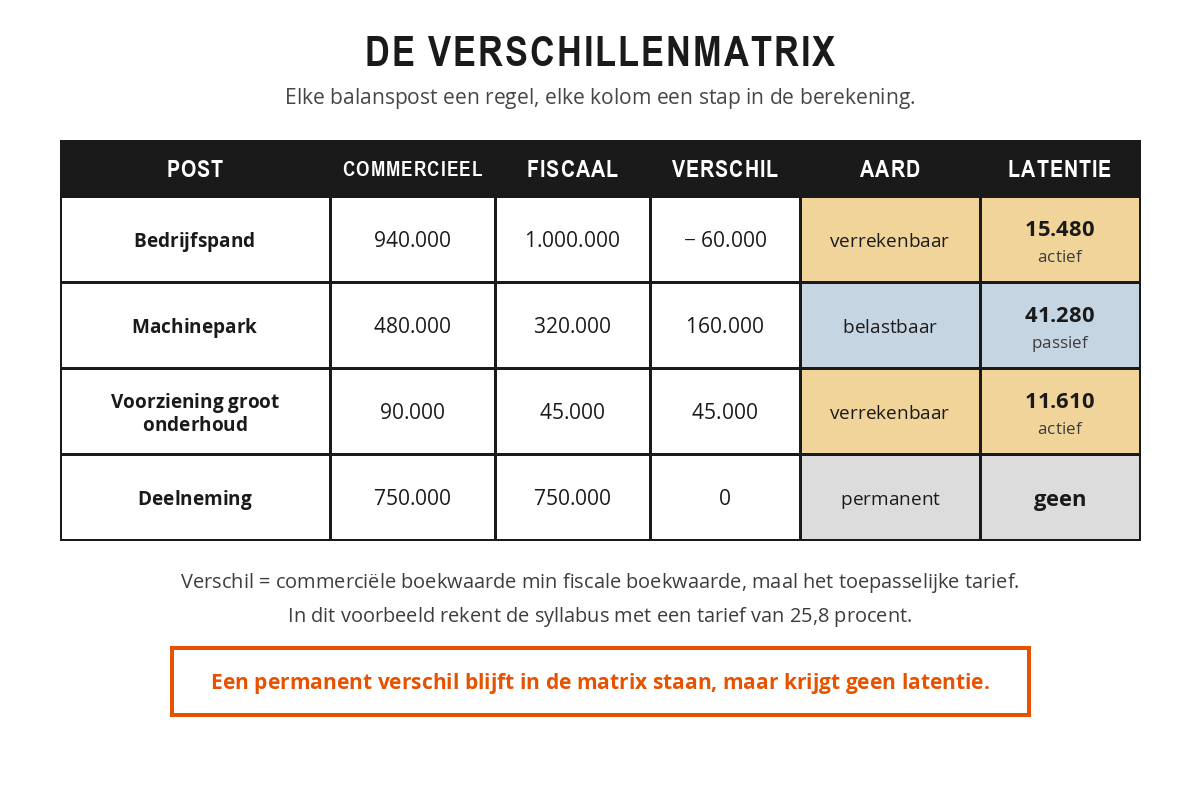
If you set that outcome alongside the other items of the same private limited company, you get the overview with which you will later justify your calculation. Line by line:
- Business premises: commercially 940,000, for tax purposes 1,000,000, difference minus 60,000. Deductible, giving a deferred tax asset of 15,480 euros at 25.8 per cent.
- Machinery: commercial 480,000, tax 320,000, difference 160,000. Taxable, giving a deferred tax liability of 41,280 euros at 25.8 per cent.
- Provision for major maintenance: commercial 90.000, tax 45.000, difference 45.000. Deductible, because with a liability the logic is reversed; at 25,8 per cent a deferred tax asset of 11.610 euro.
- Participating interest: commercially 750,000, for tax purposes 750,000, difference nil. Permanent, so no rate and no deferred tax.
Note the last line. That item receives no deferred tax, but it does remain in the matrix, together with the reason. That way, a year later you can show that you looked at it and deliberately skipped it, rather than that it was forgotten.
Your matrix should always include an extra column for the year of reversal. For a building, that moment may be fifteen years away; for a provision for major maintenance, often only two. That column helps you choose the applicable rate and makes your file verifiable.
Movements between two balance sheet dates
The balance sheet shows a position, but your result is determined by the movement between two positions. Anyone who only calculates the closing position still does not know how much deferred tax charge or credit belongs in the profit and loss account.
The movement schedule of deferred taxes is the reconciliation between the opening and closing balance of each deferred tax, broken down by the cause of each movement. For the building in the worked example, that reconciliation looks as follows. The deferred tax asset stood at 10.320 euros as at 31 December 2030, being a difference of 40.000 euros times 25,8 per cent. As at 31 December 2031 it is 15.480 euros. The increase of 5.160 euros is the result of one extra year of commercial depreciation without a tax counterpart, and is taken to the result as a deferred tax benefit.
If the rate changes, you recalculate the entire opening balance at the new rate. Suppose that at the balance sheet date you have a deferred tax liability of 38,700 euros on a reinvestment reserve of 150,000 euros, and that the rate for the year of reversal has been reduced to 24 per cent. The new balance becomes 150,000 times 24 per cent, which is 36,000 euros. The difference of 2,700 euros is released to the tax charge.
You present that effect as a separate line in your movement schedule. This keeps it visible which part of your tax charge results from differences arising or reversing, and which part is purely the consequence of changed legislation. That saves discussion during the audit and makes the note on the effective tax rate considerably easier.
Movements that do not run through profit or loss
Not every movement passes through the profit and loss account. The main rule is that the deferred tax follows the underlying item. If you revalue the machinery in the commercial accounts by 300,000 euros and post that revaluation directly to the revaluation reserve, you also post the associated deferred tax liability of 77,400 euros directly against equity. Nothing of it appears in the result.
The same applies to deferred tax positions arising on an acquisition. These form part of the initial measurement of the assets and liabilities acquired and therefore do not run through the tax charge for the year. In chapter 4 you will see how to record these movements.
A private limited company buys a machine on 1 January 2028 for 250.000 euros. Commercially, it is depreciated on a straight-line basis to nil over ten years. For tax purposes, accelerated depreciation applies: in 2028, 100.000 euros may be charged against the result, and 25.000 euros per year thereafter. The applicable rate is 25,8 per cent. Calculate and record:
- The accounting carrying amount as at 31 December 2028.
- The tax carrying amount as at 31 December 2028.
- The difference and its nature: taxable or deductible.
- The deferred tax as at 31 December 2028: the amount, and whether it is an asset or a liability.
- The deferred tax position as at 31 December 2029, with both carrying amounts recalculated.
- The movement over 2029: the amount, and whether it is a charge or a credit.
Then discuss with a colleague in which year the difference has fully reversed. Also take out your own worksheet from chapter 1 and convert the five items you scanned there into matrix rows, with difference, nature, rate and deferred tax.
Summary
- You calculate a deferred tax in five steps: commercial carrying amount, tax carrying amount, difference, nature of the difference and rate.
- The differences matrix is the worksheet in which you record this per item. Items without a difference and permanent differences also remain in it, together with the reason.
- Three places where things go wrong: land and buildings on one line, the reinvestment reserve counted twice, and the loss available for carry-forward that sits in the tax return and not in a balance sheet item.
- The applicable rate is the rate for the year of reversal, provided it has been enacted in legislation at the balance sheet date or is substantively certain.
- With a business property, the floor value often gives rise to a deductible difference and therefore a deferred tax asset, even though the item itself is an asset.
- The movement schedule links the opening balance and the closing balance and breaks down the movement into movements through profit or loss, movements through equity and the effect of a change in rate.
- In the event of a rate change, you recalculate the entire opening balance and show that effect on a separate line.
A difference on business premises is not expected to reverse for another seven years. At the balance sheet date, a rate reduction effective from next year has been laid down in law. Which rate do you calculate with?
Business premises are carried at 940.000 euro commercially and 1.000.000 euro for tax purposes, because tax depreciation has stopped at the floor value. What follows from that at 25,8 per cent?
A participating interest is stated at 750,000 euros for both accounting and tax purposes and falls under the participation exemption. What do you do with that line in the differences matrix?