


4. Journal entries for deferred tax
A tax expense in the profit and loss account is rarely a single amount. Part of it is settled with the tax authorities this year, and part of it only falls due for payment later. You make that split visible in your journal entries. You already have the amounts: they are in the movement schedule you drew up in chapter 3.
By the end of this chapter you can:
- Split the total tax expense into a current and a deferred part.
- Draw up the corresponding journal entries from your deferred tax movement schedule.
- The entries for a deferred tax liability and a deferred tax asset on recognition, addition and release.
- Checking whether your entries tie in with the corporate income tax return.
Splitting the tax expense
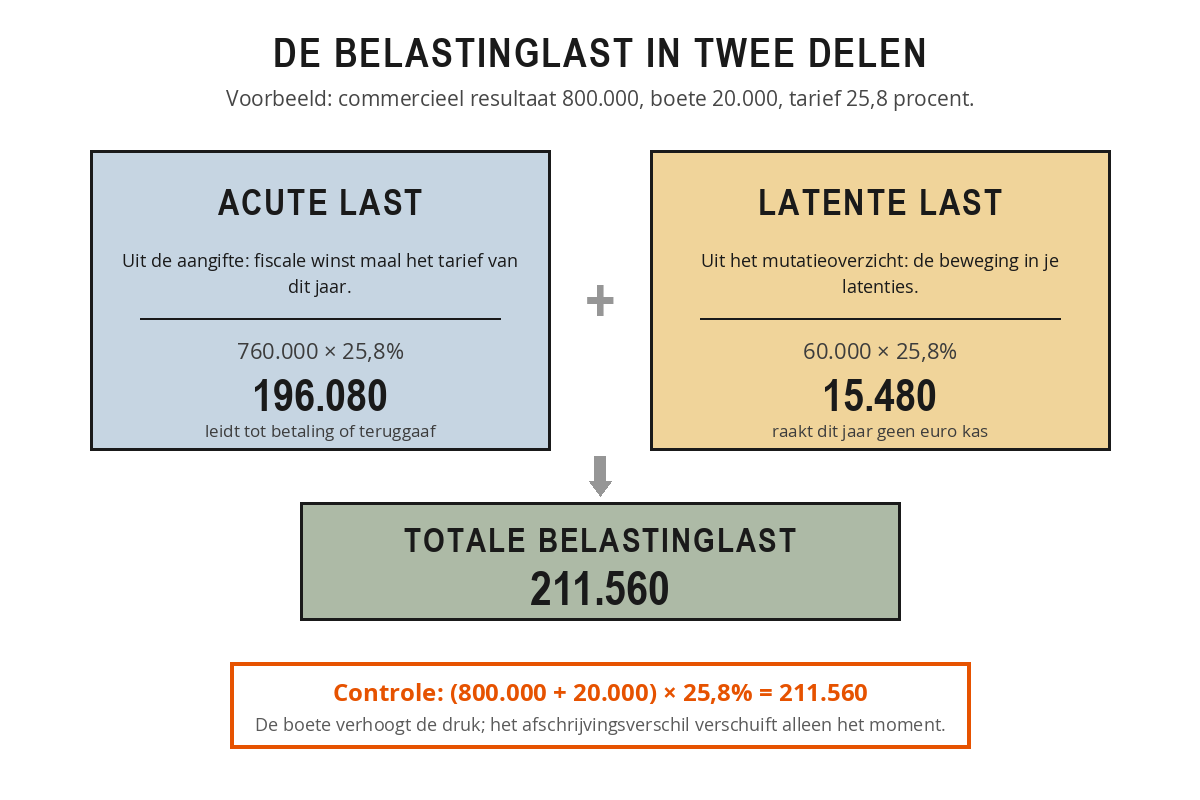
The current tax expense is the amount that follows directly from the corporate income tax return for the financial year: taxable profit multiplied by the rate applicable in that year. This expense belongs to the current year and leads to a payment or a refund within the foreseeable future. The contra account is therefore not a provision, but a receivable from or a payable to the tax authorities.
The deferred tax expense is the amount that follows from the movement in your deferred tax items during the financial year. If the taxable temporary differences increase, the deferred tax liability grows and the deferred tax expense rises. If differences reverse, part of the deferred tax item is released and this produces deferred tax income. This expense does not involve a single euro of cash in the current year; settlement lies in the future.
Together the two make up the total tax expense in the profit and loss account. That total expense should match the accounting profit, adjusted for permanent differences. If it does not, there is an error somewhere in your differences matrix or in your tax return.
From movement schedule to journal entry
You take the entry straight from your deferred tax movement schedule: the movement is the amount you post, and the nature of the movement determines the contra account. You determines the current tax expense by multiplying the taxable profit from the tax return by the applicable rate. You determines the deferred tax charge per item by taking, for each deferred tax item, the difference between the closing balance and the opening balance from the movement schedule. You separates out the rate effects: a remeasurement of the opening balance at a new rate is posted on a separate line, so that you can explain later where the amount comes from. And you posts both parts to the tax expense: this goes to the same general ledger account, but with a separate sub-account for current and deferred, so that the notes can be completed later without any puzzling.
Bouwbedrijf Verhoef BV has an accounting result before tax of 800.000 euros for 2024. That result includes a non-deductible fine of 20.000 euros. For tax purposes, 60.000 euros more is depreciated on the machinery line than for accounting purposes. The rate is 25,8 per cent.
The taxable profit is 800.000 plus 20.000 minus 60.000, which is 760.000 euros. The current tax expense is 760.000 times 25,8 per cent, which is 196.080 euros. The increase in the taxable temporary difference is 60.000 euros, so the deferred tax expense is 60.000 times 25,8 per cent, which is 15.480 euros. Together that gives a total tax expense of 211.560 euros.
The check: 800.000 plus 20.000 multiplied by 25,8 per cent is likewise 211.560 euros. The fine increases the effective rate, because those 20.000 euros are never deductible. The depreciation difference only shifts the moment of payment and therefore does not affect the total expense.
A current tax expense that is exactly equal to the accounting result multiplied by the rate is almost always a sign that there is no tax return behind it but an estimate. In that case you ask for the return or the tax profit computation before you approve the item.
Entries for a deferred tax liability
With a deferred tax liability, the entry always runs through profit or loss, unless the difference arose in equity. The pattern has three moments. At the initial recognition you debit the deferred tax expense and credit the provision for deferred tax liabilities. If the taxable temporary difference grows in a subsequent year, you post the addition in the same way. If the difference reverses, for example because the tax depreciation advantage has been used up, then part of the provision is released: provision debit, tax expense credit.
In all three cases only the movement goes into the general ledger, never the full balance. That is the most commonly made mistake: posting the closing balance again instead of the difference with the opening balance, which causes the deferred tax item to double in the books.
Entries for a deferred tax asset
A deferred tax asset is posted on the debit side of the balance sheet, and the contra entry in principle reduces the tax expense. The pattern is therefore the mirror image of the deferred tax liability: when the difference arises the expense decreases, and when the difference reverses the expense increases again.
This is how you deal with it in three steps in your general ledger. You determine the difference by setting the carrying amount of the item alongside the tax base and establishing that there is still deductible potential for tax purposes. You measure the deferred tax position by multiplying the deductible temporary difference by the applicable rate, and you compare that outcome with the opening balance of the deferred tax position. And you post the movement: only the difference between the opening and closing balance goes into the general ledger, with the tax expense in the profit and loss account as the contra account.
Techniek Vermeer BV recognises a reorganisation provision of 200,000 euros at the end of 2024. The costs are not actually incurred until 2025 and 2026, so for tax purposes nothing is deductible yet in 2024. The carrying amount of the liability for accounting purposes is 200,000 euros, the tax base is nil. At a rate of 25.8 per cent, this gives a deferred tax asset of 51,600 euros. The entry in 2024 is therefore: deferred tax asset 51,600 debit, tax expense 51,600 credit.
In 2025, 120,000 euros of the provision is used and deducted for tax purposes. The deductible temporary difference falls to 80,000 euros and the deferred tax asset to 20,640 euros. You record the release of 30,960 euros as tax expense debit and deferred tax asset credit. Note that you post that 30,960 euros and not the new balance of 20,640 euros: only the movement goes into the general ledger.
The measurement test before you post
A deferred tax asset always raises an additional question: is there sufficient future taxable profit to use the deductible amount? That question is particularly pressing for a deferred tax asset arising from loss carry-forwards. If the expected profit proves insufficient, you do not recognise the deferred tax asset, or you recognise it only in part, and so you do not post the unrecognised portion either. If that expectation changes in a later year, you account for the change as a movement in the tax expense for that year.
Keep the recognition of the deferred tax position and the measurement test on two separate lines of your movement schedule. In an audit you want to be able to show that the deferred tax position works out at 51.600 euros and that you have deliberately written 15.000 euros off it. A single combined line of 36.600 euros only raises questions.
Movements outside profit or loss
Not every movement in a deferred tax item runs through the tax expense. The main rule is that the tax follows the item in which the underlying difference arose. If the difference arises in the profit and loss account, the deferred tax also goes through the profit and loss account. If the difference arises directly in equity, you also post the related deferred tax directly in equity.
Three situations in which the movement is recognised outside profit or loss are the ones you come across most often in practice. In the case of revaluation of an asset the upward revaluation goes to the revaluation reserve, and so does the related deferred tax liability. In the case of a a change in accounting policy or correction of an error you adjust equity at the start of the financial year retrospectively, and the tax effect of that adjustment belongs in the same movement in equity. And in the case of deferred tax in an acquisition you account for the deferred tax positions recognised on initial measurement of an acquired business within the purchase price allocation; they affect goodwill, not the tax expense for the year of acquisition.
Once the deferred tax position has been recognised, subsequent movements do in principle run through profit or loss. A revaluation-related deferred tax liability that is released annually through depreciation is therefore credited to the tax expense, whereas initial recognition affected equity. That split regularly leads to discussion during audits, so record in your file which part of the deferred tax position comes from where.
Reconciliation with the tax return
The reconciliation between the financial statements and the tax return is the final check on your entries: the current portion from the taxable amount and the deferred portion from the movement in all deferred tax positions combined should match the accounting profit after adjustment for permanent differences.
If the reconciliation does not add up, in nearly all cases one of these three causes is behind it. A a temporary difference has been treated as permanent, or the other way round: the difference does adjust the taxable amount, but there is no deferred tax item to match it. A rate effect is not shown separately: in the event of a rate change you recalculate the opening balance, and that effect falls outside the movement for the current year. Or a an assessment correction has ended up in the deferred tax position: a correction relating to a prior year belongs to the current tax position, not to deferred tax.
As soon as the final assessment for a previous financial year comes in, you check two things: is the current tax liability you recognised correct, and does anything change in the tax base figures you use in your deferred tax calculation? If the inspector adjusts a depreciation charge, for example, the temporary difference on that asset shifts along with it.
For 2025 Vermeer BV has an accounting profit before tax of 620.000 euros. This includes a non-deductible fine of 15.000 euros. The reorganisation provision falls from 200.000 to 80.000 euros, and the taxable temporary difference on the machinery grows from 60.000 to 95.000 euros. The rate is 25,8 per cent. Calculate and note down:
- The taxable amount.
- The current tax expense.
- The movement in the deferred tax asset.
- The movement in the deferred tax liability.
- The deferred tax expense as the balance of those two.
- The total tax expense.
- The check: accounting profit plus the permanent difference, times the rate.
Then write out the full journal entry for the total tax expense, including all the general ledger accounts you use. Do the same exercise again for a second BV: a profit before tax for accounting purposes of 450,000 euros that includes 30,000 euros of exempt participation income, and a taxable temporary difference on the business premises that grows from 100,000 to 140,000 euros, at the same rate.
Summary
- The total tax expense consists of a current part from the tax return and a deferred part from the movement in the deferred tax items.
- The current tax expense leads to a payment or a refund and has a receivable from or a liability to the tax authorities as its contra account; the deferred tax expense does not touch a single euro of cash this year.
- A deferred tax liability increases the tax expense on recognition and addition and reduces it on release; for a deferred tax asset it works exactly the other way round.
- You always post only the movement between the opening and closing balance, never the full balance.
- A deferred tax asset always calls for a measurement test: is there sufficient future taxable profit? Keep that test on a separate line of your movement schedule.
- The tax follows the transaction: differences that arise in equity have their deferred tax recognised in equity as well. That applies to revaluation, to a change in accounting policy or error correction, and to an acquisition.
- The total expense ties in with the accounting profit after adjustment for permanent differences. If it does not add up, look for a difference that has been classified incorrectly, a rate effect that has not been shown separately, or an assessment correction that has ended up in deferred tax.
A bv has an accounting result before tax of 800.000 euros including a non-deductible fine of 20.000 euros, and depreciates 60.000 euros more for tax purposes than for accounting purposes. At 25,8 per cent, what is the total tax expense?
A deferred tax asset stood at 51.600 euros at the start of the year and ends the year at 20.640 euros. What do you post?
A building is revalued for accounting purposes and the upward revaluation goes directly to the revaluation reserve. Where does the related deferred tax liability end up?
Ready for the next step?
You have completed the free starter of Deferred Taxes. The next chapter in the full course is The company's tax position: Current and deferred tax side by side on the balance sheet, and the risks that incorrect treatment brings for equity, financing and the tax return.
Take the 1-day training course →From €625,- excl. VAT · with an experienced trainer alongside you