


Introduction
Welcome to Leadership: The Foundation. A title with a reason: leadership is not a trick you perform on the side, but a foundation you stand on every day. And as with a building, the same applies: the sturdier the base, the more you can build on it. Whether you have just moved up into a leadership role, have been at it for a while, or mainly notice that you keep getting stuck on recurring themes, this syllabus helps you to examine, strengthen and concretely apply your own foundation.
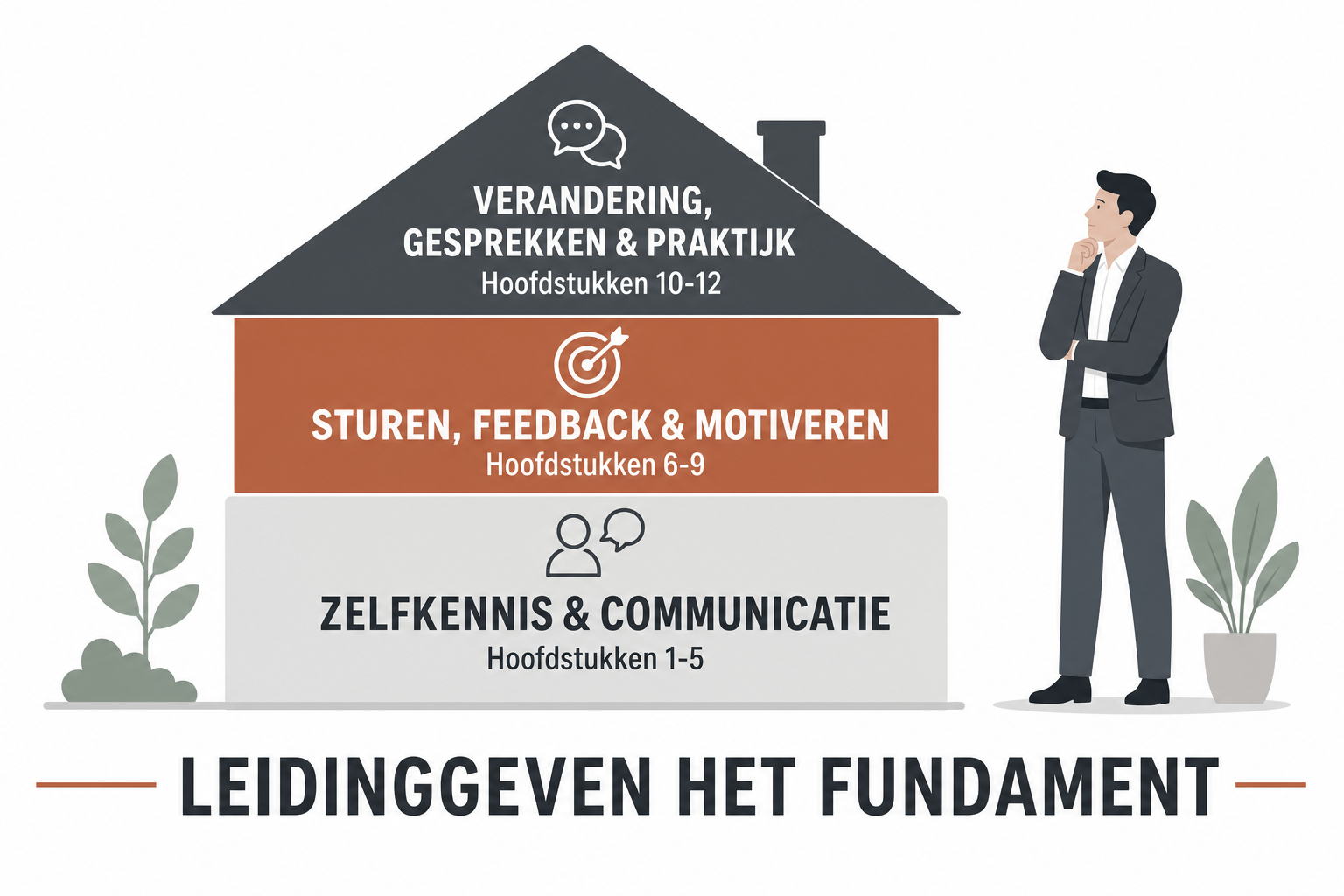
This free course contains the first three chapters: the lower, grey part of the house above. Would you like to continue with the rest? At the bottom of chapter 3 you will find the complete course.
What you will learn
You gain insight into the role and position of the manager, into your own style and pitfalls, and into the conversation skills you need to make genuine contact. You learn to steer on behaviour as well as results, to give feedback that lands, and to hold difficult conversations without slumping into your chair afterwards. In addition, motivating, delegating, dealing with change, negotiating and time management are covered. The common thread: self-knowledge, communication and conscious choices in your behaviour.
How the syllabus is structured
The twelve chapters follow a logical line. You start with the basics (role, communication, self-image), then move on to behaviour and conversation skills (Leary Rose, active listening), and build up towards directing, feedback and motivating. The final chapters bring everything together in concrete practical situations. Each chapter contains theory, models, examples and exercises, so that you can immediately test what you have learned against your own work.
Practical tips for use
- Keep a notebook or digital document to hand. The exercises only work if you actually complete them.
- Don't read it all in one go. One chapter a week, with time to try things out, yields more than a marathon session.
- For each chapter, choose one concrete situation from your own practice to which you apply the content.
- Share your insights with a colleague or sparring partner. Talking about leadership out loud makes it tangible.
- Come back to earlier chapters. Many insights only really sink in on a second reading.
Each chapter ends with a short knowledge check of three questions: answer them correctly to mark the chapter as completed. Your progress is saved automatically in your browser.
Enjoy reading, and above all: enjoy learning in practice.