


1. The role and position of the leader
Managing is about setting direction, defining boundaries and getting people moving. It asks something different from doing your own work well: you are judged on what your team does, no longer only on your own performance.
After this chapter:
- You know what managing people involves and what responsibility comes with it.
- You recognise the different roles you fulfil as a manager.
- You understand what the transition from colleague to manager does to your position.
- You can think more consciously about the example you set within the team.
Leadership as a profession
Leadership is not something you do on the side. It is a profession in its own right. Many people become managers because they are strong on content: the best salesperson becomes sales manager, the senior developer becomes team lead, the experienced nurse becomes team coach. But subject-matter expertise does not automatically make you a good manager. Your role shifts fundamentally.
Where you used to be paid for what you produced yourself, you are now paid for what your team produces. That may seem a small difference, but it changes everything. Your time, your attention and your responsibility lie somewhere else. Your work is people, no longer (only) the content.
Four responsibilities that come with your role
However you fill in the role, as a manager you carry four core responsibilities. They come back in every organisation and every team.
- Providing direction: you translate the organisation's objectives into what they mean for your team. You make clear what you are working towards and why that matters.
- Setting boundariesyou determine the agreements, standards and boundaries within which the work takes place. What do you expect from people, and what can they expect from you?
- Developing peopleyou make sure employees grow in their work. That means giving feedback, offering scope and paying attention to what someone needs in order to improve.
- Monitoring results: you keep sight of progress and adjust where necessary. Not in order to check up on people, but to make sure that agreements are kept and goals are met.
These four responsibilities call for different behaviour. Sometimes you are directive, sometimes supportive, sometimes mainly present and listening. That brings you to something important: managing people is not a fixed style but a repertoire of roles.
From colleague to manager
The step from colleague to manager is one of the most difficult transitions in a working life. You often work with the same people, in the same space, with the same history. But your task has changed. Where you used to join in, you now give direction. Where you previously complained about a decision, you now have to explain and defend it.
That transition often feels uncomfortable, for you and for your former colleagues. People are not quite sure how to relate to you. Is joking still allowed? Does your loyalty change now that you "belong to management"? These kinds of questions are alive, even if nobody asks them out loud.
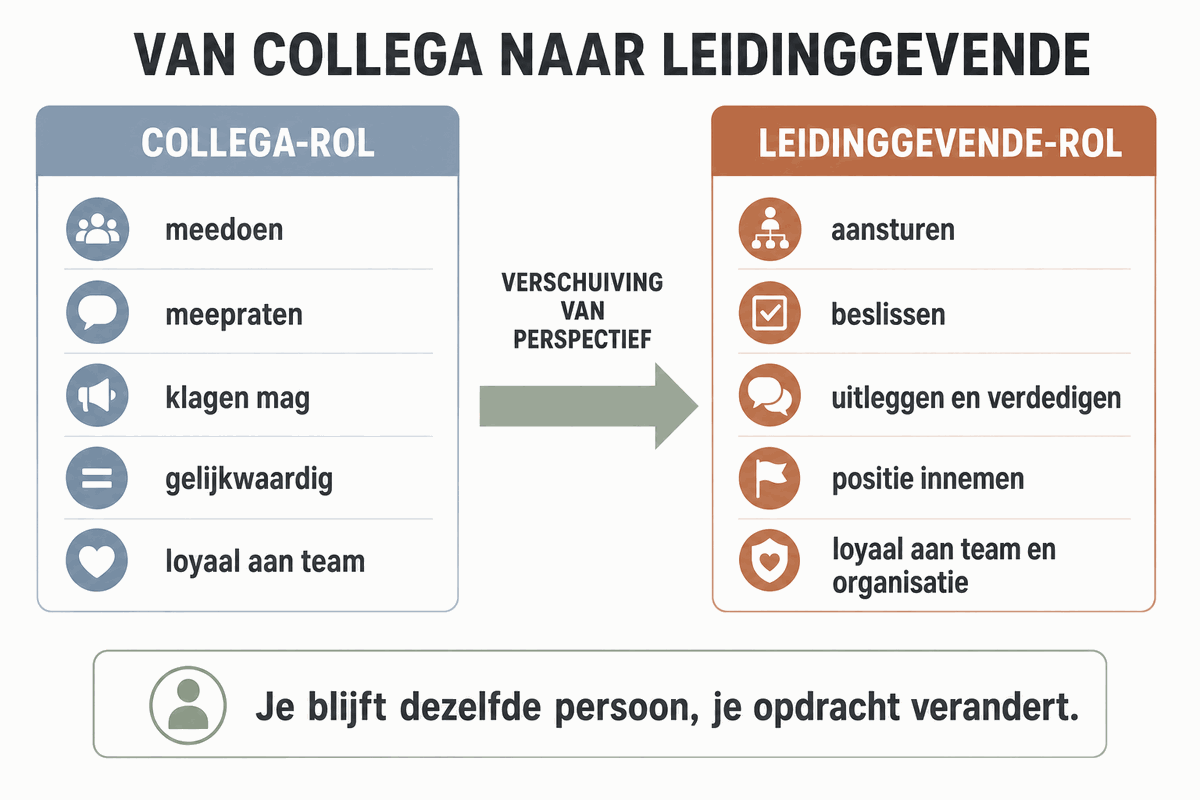
Three things shift the moment you become a manager:
- Your access to information: you receive information that others do not, about reorganisations, appraisals, salaries and strategic choices. You can no longer share everything you hear, not even with people you trust.
- Your loyalty: as a colleague, you were above all loyal to your team. As a manager you serve two interests: that of your team and that of the organisation. Sometimes they coincide, sometimes they clash.
- Your behaviour is under scrutiny: what you do and say has more impact than before. A casual remark from you is remembered. Whether you want to or not, you send out a signal.
Sanne worked in a team of six for four years before she became team leader. In her first week she scheduled a half-hour conversation with each team member. Not an appraisal, no agenda, just a conversation. She asked three questions: what should I keep doing the way I did it, what do you now expect me to do differently, and what are you worried about? The answers were valuable: one colleague said he would find it difficult if Sanne still joined in complaining about management; another asked whether she would not be keeping too much distance. Afterwards Sanne knew better what to look out for, and her team knew she was taking it seriously.
A common mistake at this stage is that new managers either stay too friendly (so as not to damage the relationship) or become overly distant (to enforce authority). Both are counterproductive. Staying too friendly weakens your position: people stop taking you seriously as soon as you have to say something difficult. Becoming too distant makes you unapproachable and feeds an us-and-them feeling.
Be alert to the "old mate". There is often a colleague you used to be especially close to. That person sometimes unconsciously expects preferential treatment: information sooner, more leeway, less criticism. If you go along with that, you undermine your position with the rest of the team. An honest conversation with that person about what is changing is almost always necessary.
Switching between five roles
Managing people is not a fixed position in which you do the same thing every day. You switch between roles continuously, sometimes within a single conversation. The question is not which role suits you, but which role is the most helpful at this moment, for this person, in this situation. The five roles you will encounter most often:
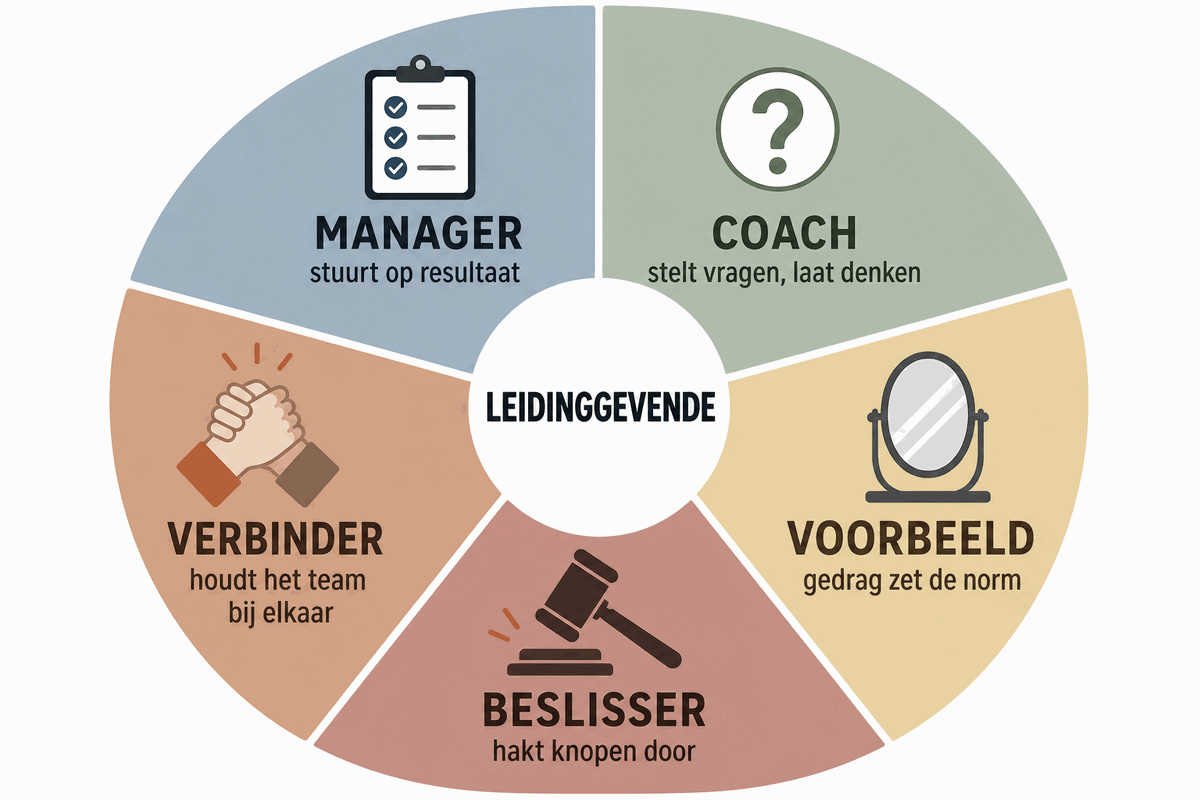
- Manager: you divide up the work, monitor progress and steer on agreements and results. Without this role, the team gets bogged down in scattered initiatives without direction.
- Coach: you help people move forward by asking questions, giving them space and letting them think. You don't have the answer ready straight away. Powerful when someone can and wants to learn.
- Example: your behaviour sets the standard, whether you want it to or not. The way you deal with mistakes, deadlines and conflicts is copied. This role is always active.
- Decision-maker: sometimes a decision has to be made. Not everything is a dialogue. If you get stuck in this role, your team will not feel heard; if you avoid it, everything stays up in the air.
- Connector: you keep the team together as a whole and connected to the wider organisation. You mediate when there is friction and keep unnecessary noise away from your team.
There is no formula for which role to use when, but there are patterns. With an experienced employee facing a complex problem, you often work as a coach. With an inexperienced employee facing a deadline, the manager role makes more sense. In the event of a conflict within the team, you shift to connector. In a deadlock, you make the call as decision-maker. And the role-model role runs through everything, whether you are in a meeting or replying to an email.
Sanne has been the team leader of a customer service team for three months. On Monday morning she discusses the planning (manager). In the afternoon she has a one-to-one with an employee who is stuck; she asks questions and does not provide a solution (coach). On Tuesday she decides that a new working method will be introduced, despite objections from two team members (decision-maker). On Wednesday she sits in the management team meeting and argues for extra capacity for her team (connector). And all week her behaviour is visible: how she deals with complaints, how she discusses mistakes, what time she starts and finishes (role model). Five days, five roles, one person.
A common pitfall is that you get stuck in one role because it suits your character best. One manager is a natural coach and keeps asking questions endlessly, even when someone simply needs a decision. Another is a doer and takes charge too quickly, where a question would have been better. Being able to switch consciously between roles is one of the most important skills in this job.
Take a week from your diary and look back at each conversation or meeting: which role did I actually play here?
- Write down one of the five roles for each moment.
- Which role do you choose most often?
- Which role do you avoid?
- In which situation would a different role have been a better fit, and what stopped you from using it more often?
Discuss your findings with a fellow manager or in the course group.
Summary
- Managing people is a profession in its own right: subject expertise does not automatically make you a good manager.
- You carry four core responsibilities: providing direction, setting frameworks, developing people and monitoring results.
- The move from colleague to manager changes three things: your information position, your loyalty and the impact of your behaviour.
- Make that transition an explicit topic of discussion instead of hoping it will sort itself out.
- As a leader, you consciously switch between five roles: manager, coach, role model, decision-maker and connector.
According to this chapter, which three things shift as soon as you become a manager?
What is the main difference between the Manager role and the Coach role?
An experienced employee is stuck on a complex problem, but has the knowledge to work it out themselves with the right questions. Which role fits best here?