


3. Self-knowledge and self-image
Anyone who wants to lead others cannot avoid looking at themselves first. How you react under pressure, what you believe about yourself and which qualities you draw on all help determine how you come across to your team.
After this chapter:
- You understand how the Johari window works and what a blind spot means for you as a manager.
- Can you describe the difference between strong and weak self-worth, and do you recognise the signs of both.
- You can apply the basic idea of RET (Rational Emotive Therapy) to your own thought patterns.
- You work with Ofman's core quadrant to get a clearer picture of your strengths and pitfalls.
The Johari window
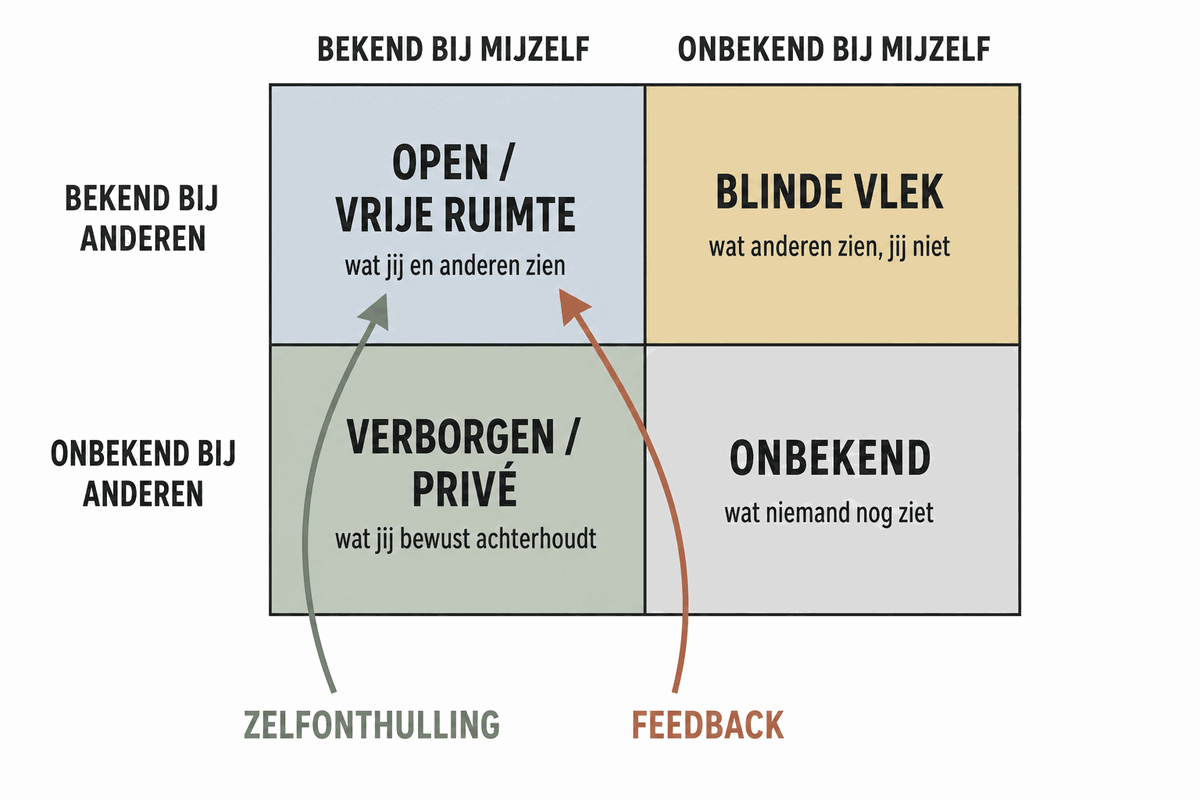
The Johari window is a model developed by the psychologists Joseph Luft and Harry Ingham in the 1950s. The name comes from their first names: Jo and Hari. The model divides your personality into four parts, based on two questions: what do you know about yourself, and what do others know about you?
- The open area: what you know about yourself and what others know about you too. Your name, your role, your visible behaviour. The larger this area, the more smoothly collaboration runs.
- The blind spot: what others do see in you, but you do not see yourself. Think of an irritating habit during meetings, or a talent you overlook yourself.
- The hidden area: what you know about yourself but deliberately do not share with others. Insecurities, ambitions, an opinion you would rather keep to yourself.
- The unknown: what nobody sees, not even you. Talents that have not yet been called upon, reactions you only discover in a new situation.
In your role as a manager (see chapter 1), your blind spot is the most interesting quadrant. After all, your behaviour has an effect on others, whether you see it or not. A team leader who thinks he comes across as calm, while the team experiences him as tense, is unintentionally steering towards tension instead of calm.
The only way to reduce the blind spot is to ask others what they see. You reduce the hidden area by sharing something of yourself: a manager who says out loud that he finds something daunting gives the team permission to do the same. That enlarges the open area on both sides.
Ask three people who know you well what they see as your biggest pitfall. Not to debate it, but to listen. What they mention largely sits in your blind spot. Write it down without reacting or defending yourself straight away.
Self-image and self-worth
Besides what others see, something else plays a part: what you believe about yourself. We call this your self-image: the whole of the views, judgements and convictions you have built up about yourself. It has been formed by years of experiences and reactions from others, and it is not an innate characteristic. A self-image is also not the same as the truth: it is an interpretation, and interpretations can be examined, adjusted and changed.
Self-worth is the emotional part of your self-image: how you value yourself, regardless of your achievements. Someone with strong self-worth fundamentally believes that he or she matters, even in the face of setbacks. Someone with little self-worth constantly makes their worth dependent on what others think.
You recognise strong self-worth by behaviour such as: calmly taking your own position even when others disagree, being able to admit a mistake without immediately becoming defensive, accepting compliments without brushing them aside, and saying no without feeling guilty about it for long. Low self-worth shows in: constantly seeking confirmation, difficulty with mild criticism, putting yourself last to keep the relationship comfortable; or exactly the opposite: reacting harshly outwards to cover up your own vulnerability.
For you as a manager this is relevant in two directions: your own self-worth determines how you approach difficult conversations (anyone whose sense of worth depends on whether employees like them will be less inclined to correct behaviour), and you will recognise the same signals in your team members.
Thinking and behaviour: RET
Your self-image and self-esteem lie not only in what you feel, but also in what you think, often at lightning speed and without you noticing. RET (Rational Emotive Therapy, developed by the American psychologist Albert Ellis) helps you make those thoughts visible. The core idea: it is not the situation itself that determines how you feel or behave, but the thought you have about that situation.
REBT works with the ABC model:
- A: Activating event. What actually happened? For example: an employee responds curtly in a meeting.
- B: Belief, the thought. What do you think about that? For example: "He doesn't think I'm a good manager."
- C: Consequence. What do you feel and what do you do? For example: you feel insecure and do not raise it with him.
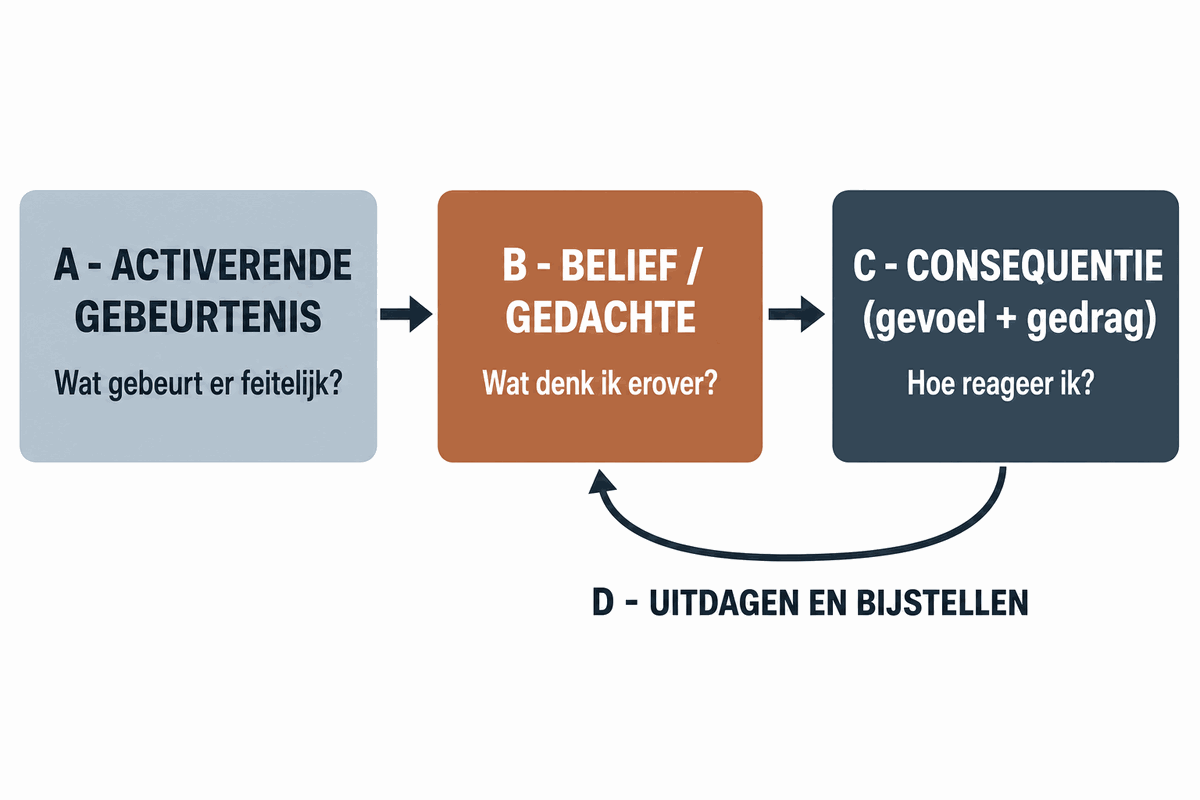
Most people think that A leads directly to C. RET shows that B sits in between, and that B is often coloured by beliefs you do not consciously choose. For leaders, these kinds of irrational beliefs come up regularly: "Everyone in my team has to like me", "I must have everything under control", "If I make a mistake, I am not a good leader", "My staff should understand what I mean without me having to spell it out." They sound reasonable as long as you do not say them out loud, but they set an impossible standard.
You can challenge and adjust such a thought with a few simple questions: is this thought factually correct? What is another, equally logical explanation? Does this thought help me, or does it work against me? What would I say to a colleague who thinks this way?
A team leader is dreading a one-to-one with an experienced member of staff. A: the one-to-one is scheduled for tomorrow. B: "He has more experience than I do and will think my questions are stupid." C: she puts off preparing, goes into the conversation unsure of herself and steers less than she would like to. When challenging this: is it true that he thinks her questions are stupid? No, he has never said so. New B: "I have a different role from his. Asking questions is part of steering, not a sign of weakness." New C: she prepares for the conversation calmly and holds it without making herself small.
RET is not a trick for wiping away unpleasant feelings. Sometimes your feeling is justified and something really is wrong. It is a tool for checking whether your reaction fits the facts, or whether a stubborn conviction is getting in your way.
Core qualities and pitfalls
Another useful model for self-knowledge is that of core qualities, developed by Daniel Ofman. It shows that your strengths and weaknesses lie closer together than you think: they come from the same source.
A core quality is a characteristic that typifies you, something you are naturally good at (think of decisiveness, patience, care or commitment). If you take a core quality too far, it becomes a pitfall: too much of a good thing works against you. Opposite your pitfall lies a challenge: the characteristic you lack and that would help you stay in balance. Opposite that in turn is your allergy: behaviour in others that irritates you especially, precisely because it sits too far in the other direction. Together, these four form the core quadrant.
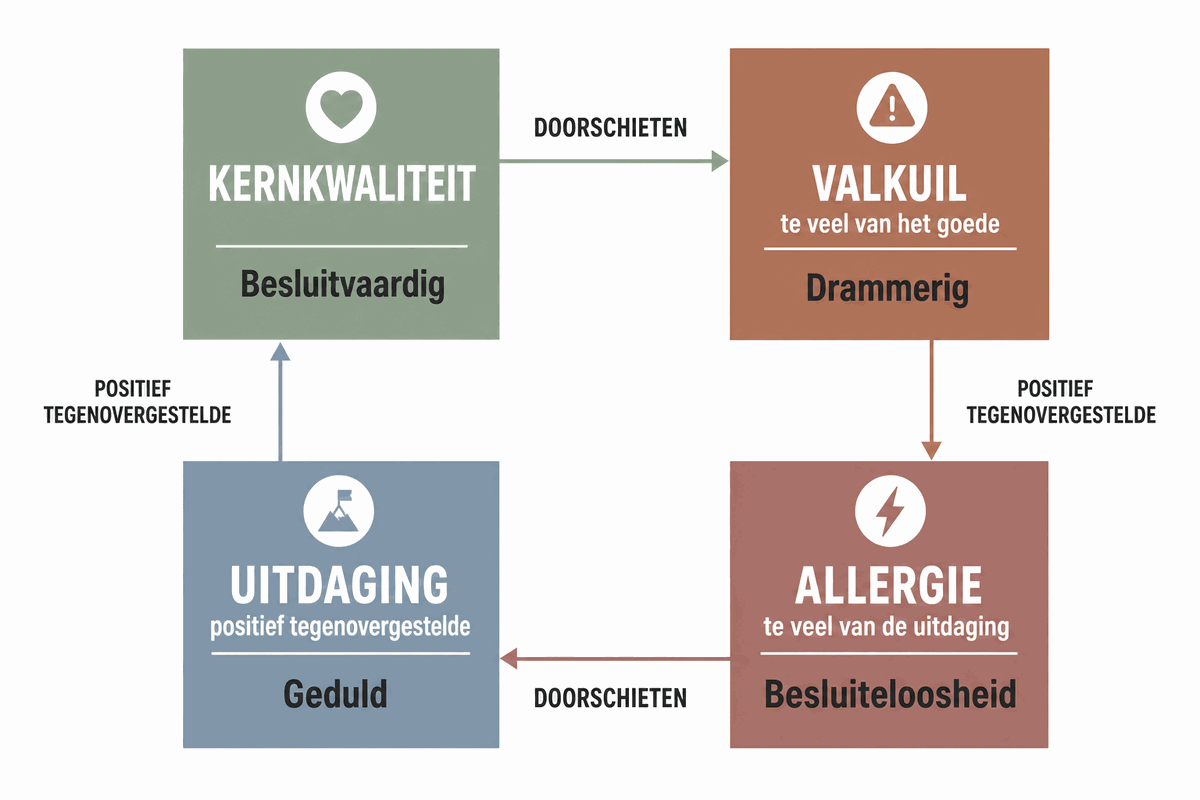
An example makes it concrete: core quality decisive, pitfall pushy (too much decisiveness), challenge patience, allergy indecisiveness. Or: core quality involved, pitfall meddlesome, challenge letting go, allergy indifference.
The core quadrant gives you three insights. First, you learn to recognise your own pitfalls as a quality taken too far, not as a character flaw; that saves embarrassment and creates room to adjust. Second, you understand why certain employees irritate you more than others: often that is where your allergy lies, and it is the mirror image of your own quality. Third, it shows that a team benefits from differences: your challenge is often precisely someone else's core quality.
Take a trait you often receive compliments about: that is probably one of your core qualities. Work it into the quadrant:
- My core quality: ...
- My pitfall (what others say when I overdo it): ...
- My challenge (what I need in order to stay in balance): ...
- My allergy (behaviour in others that particularly irritates me): ...
Then consider: which employee in your team triggers your allergy? And which core quality might lie beneath it?
Summary
- Self-knowledge is not a luxury but a tool: the better you know what you do and why, the more calmly you lead.
- The Johari window shows that part of you is visible to others but not to you. Asking for feedback reduces that blind spot.
- Your self-image and self-esteem determine how you deal with difficult situations.
- RET makes visible that your thoughts (B) sit between the situation (A) and the reaction (C). By challenging beliefs, you gain a grip on your own reaction.
- Ofman's core quadrant shows how quality, pitfall, challenge and allergy are connected.
During meetings, your colleagues see that you regularly come across as impatient, but it comes as a surprise to you when someone mentions it. Which quadrant of the Johari window does this fall into?
In the ABC model of RET: which letter stands for the thought you have about an event, rather than for the event itself or for your reaction to it?
A colleague is always careful and prefers to check details three times, but as a result it takes him a great deal of time to make decisions. Which two elements of the core quadrant can you see most clearly here?
Ready for the next step?
You have completed the free starter of Leadership Basics. The next chapter in the full course is Styles and behaviour patterns: Leary's Rose: The Leary Rose explained, your own preferred style and how to deal with classic difficult types.
Take the 2-day course →From €1300,- excl. VAT · with an experienced trainer included