


2. Communication as the foundation of leadership
As a manager, your work stands or falls by the way you convey and receive messages. What you mean is not automatically what the other person hears.
After this chapter:
- Understand how the communication model works and where misunderstandings arise.
- Whether you know what effective communication involves and how to apply that formula in practice.
- You can recognise the three laws of communication and the effect of each of them.
- Whether you are aware of your own frame of reference and that of your staff.
The communication model
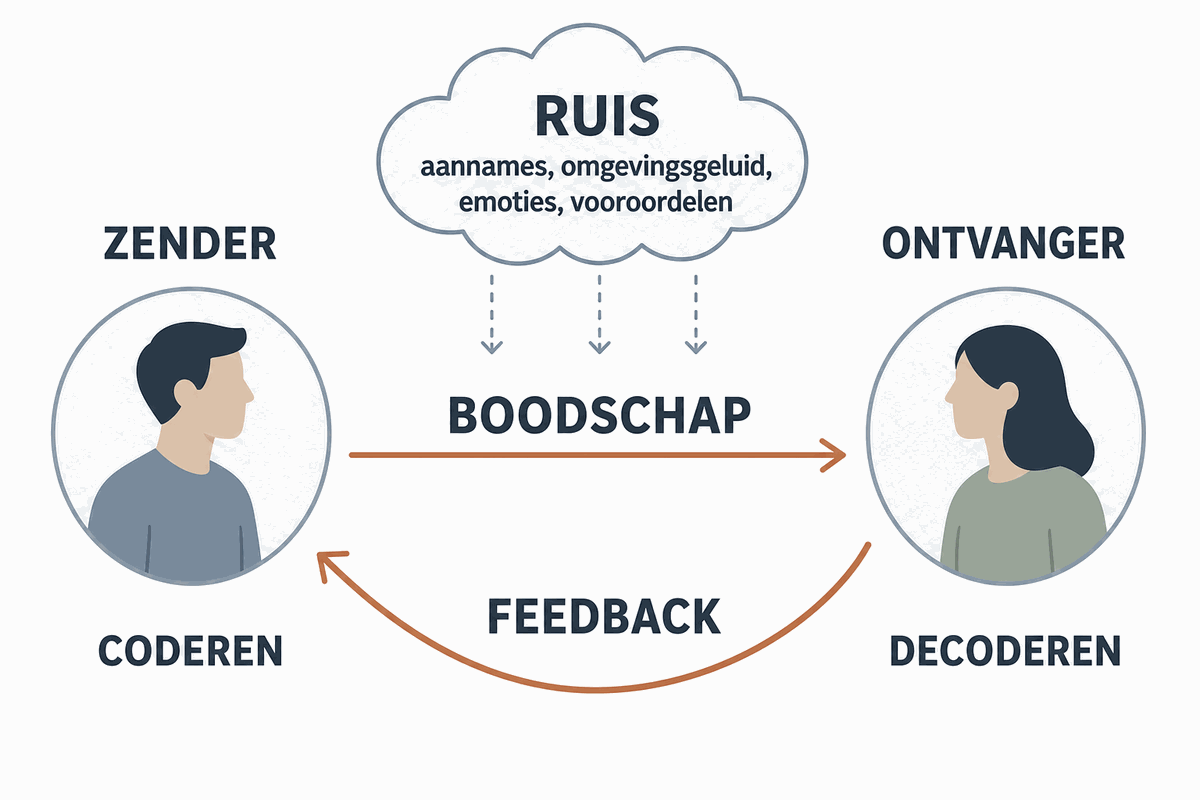
Communication seems simple: you say something, the other person hears it, done. In practice it rarely runs that smoothly. What you have in your head first has to be translated into words, tone and posture. That message then travels through a layer of noise: ambient sound, emotions, assumptions and previous experiences. At the other end sits a receiver who translates the message back into meaning, in his or her own way.
The communication model shows that communication always consists of two movements: a message out and a response back. We call that response feedback, in the broad sense: everything the receiver shows, asks or does as a result of your message. Only through that feedback do you know whether you have been understood: a nod, a question, a look, an action.
Effective communication: E = Q × A
When is your communication really effective? Not when you have said it, and not when the other person nods either. Effective communication means that you can answer two questions with "yes":
- Does the other person understand my message? This is the Quality. Does what I mean come across?
- Does the other person draw the conclusions from it that I want? This is Acceptance. Does the other person actually do anything with it?
Together, these two elements form a multiplication: E = Q × A. Effectiveness is the product of Quality and Acceptance. The word "product" matters here: if either of the two is zero, the result is zero as well. A crystal-clear instruction that the employee does not commit to produces nothing. The reverse applies just as much: a motivated employee who does not understand what exactly is expected of them will not deliver results either.
You say to Sander: "It would be good if you could pick up that report soon." Sander nods. Two weeks later, nothing has happened. What went wrong? Quality: what is "quickly"? Today, this week, before the end of the quarter? Acceptance: has Sander committed to anything, or did he just nod because it was socially convenient? A more effective version: "Sander, I want the draft report in my mailbox on Friday. Can you manage that?" Now the quality is high (concrete, measurable) and you check acceptance straight away.
Your frame of reference, their frame of reference
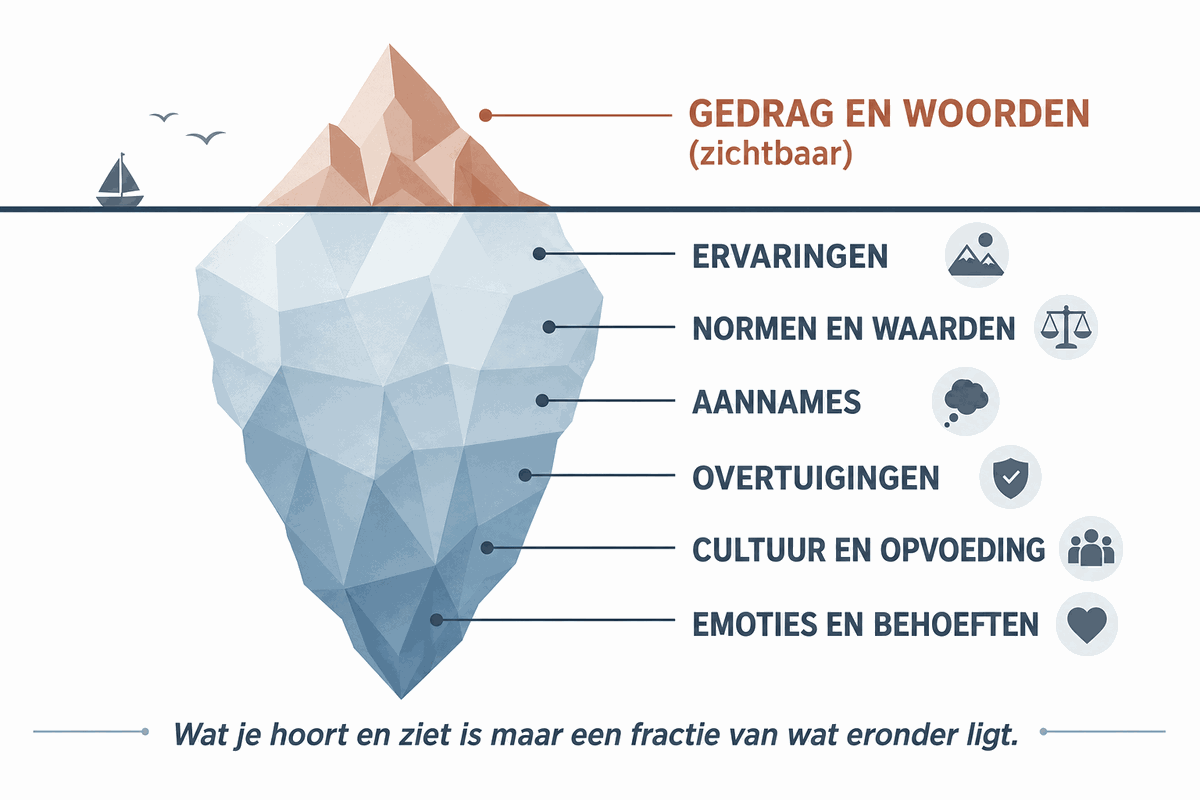
Your brain constantly takes in far more stimuli than you can consciously process. If you registered everything consciously, your head would explode. That is why you filter continuously, usually without noticing it. That filtering is based on what you know, what you have experienced, what you have learned and what you consider important: your frame of reference.
For you as a manager, this has two consequences. The first: what you take for granted is not what they take for granted. What you see as "of course this is part of the job" may come as a surprise to your employee. The second: you cannot guess what is going on in someone's head, and they cannot guess what is going on in yours. That is why you make explicit what you think, want and expect. The other person fills in the silence themselves, based on their own frame of reference, and rarely in the way you intended.
Three laws of communication
There are three principles that always apply, whether you are holding an appraisal interview or sending an email on a Friday afternoon.
1. You cannot not communicate. Silence is a message too. If you say nothing in a meeting while a colleague puts forward a proposal, others will fill in the blanks themselves: "she disagrees", "she has no opinion", "she finds it uninteresting". Everything communicates: your facial expression, your posture, how quickly you reply to a text message.
After a difficult moment, ask yourself: what did I say without saying anything? A short sigh, a glance at the clock or a quick "okay, next point" can have more impact than you realise.
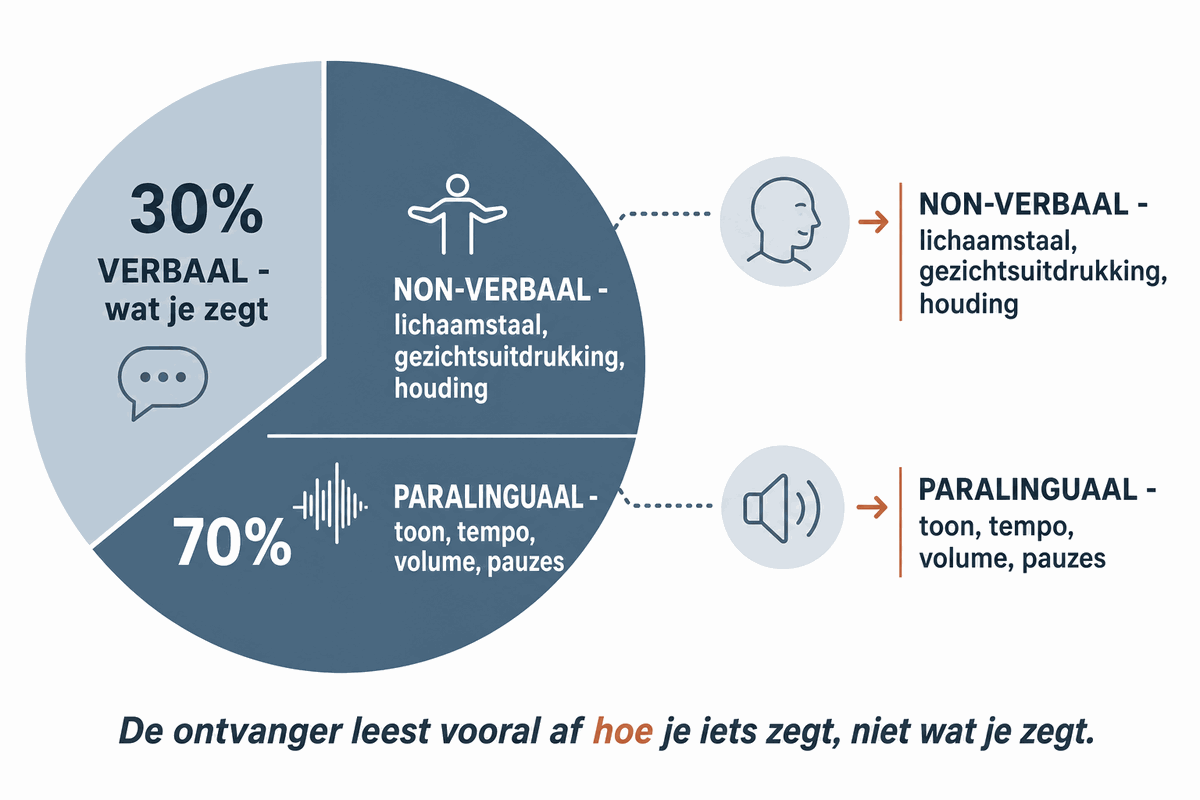
2. Words are only a small part. Research shows that the content of your words carries roughly 30% of the message. The remaining 70% lies in your body language and your use of voice: tone, pace, volume, pauses, eye contact, posture. If you say "well done" while keeping half an eye on your screen, the message "I'm busy with something else" lands harder than the compliment.
3. Everyone has their own frame of reference. What you perceive and what your member of staff perceives are never exactly the same. So never assume that the other person has the same picture as you. Check it, with questions such as "How do you read this situation?" or "What do you hear me saying?".
You tell your team: "This quarter we are going to manage more closely on quality." To you that means: fewer errors in what we deliver. To your senior member of staff it means: "She no longer trusts our work." To your junior it means: "I have to double-check everything." Three people, three stories, one sentence from you.
Clear communication: direct versus indirect
When misunderstandings arise, most people automatically think: the other person was not clear. Sometimes that is true. But anyone who wants clarity starts with themselves, and that is harder than it seems, because speaking unclearly is often a habit.
Why we speak unclearly
You are rarely indirect on purpose. It creeps in out of politeness, embarrassment, caution or fear of confrontation. Four common patterns:
- Vague pronouns: you say "we" or "one" when you mean "I". "We would like the reports to be on time" usually means: "I want your report to be on time."
- Hedging: you put "maybe", "a bit", "possibly" in front of your request. "Could you maybe have a look at whether it is feasible to..." What you mean is: "Do it before Thursday."
- Indirect questions: you dress up an instruction as a question. "Would it be an idea to pick this up?" Your employee hears a question and thinks he has a choice.
- Absent expression of intent: you describe a situation and hope the other person will draw the conclusion themselves. "The deadline is tomorrow." What you are not saying: "I want you to finish it today."
Direct is not the same as harsh
Many managers are afraid that speaking directly comes across as blunt or tactless. There is a misunderstanding behind this. Tact is about how you say something and which words you choose. Directness is about whether you get your message across at all. You can be very direct and friendly at the same time. Compare:
- Indirect: "We would actually rather like a bit more attention to be given to the planning."
- Direct and blunt: "Your planning isn't right."
- Direct and friendly: "I want you to adjust your planning, and I think we can make it stronger together. I would like to see a new version next Thursday."
The third variant is both clear and respectful. The other person knows what you want, when you want it and that it comes from you.
Take an email you sent to a member of staff this week. Underline every word or phrase in which you hide yourself: "we", "one", "maybe", "possibly", "could you", "is it an idea to". Rewrite the email in the first person with direct statements of what you want. Read both versions aloud. Which version leaves your member of staff no room for misunderstanding?
Not everything has to be direct. In a brainstorming session, with sensitive personal subjects, or with someone who has just had bad news, indirectness is sometimes more appropriate. The question to ask yourself is: who am I sparing by beating about the bush? If you are mainly sparing the other person, it is tact. If you are mainly sparing yourself, it is avoidance. For most work situations the rule is: choose direct.
Summary
- You cannot not communicate: silence, posture and gaze also send a message.
- Effective communication is Quality × Acceptance: if either of the two is zero, the result is zero as well.
- Only 30% of your message is in the words; the rest is in tone, pace and body language.
- Everyone filters reality through their own frame of reference: always check whether the other person has the same picture in mind.
- Speaking indirectly (vague pronouns, hedging, indirect questions, no stated intention) leads to misunderstandings.
- Direct is not the same as harsh: speak in the first person and make concrete what you want.
According to the formula E = Q × A: what happens when Acceptance is zero, even if the Quality of your message is perfect?
According to this chapter, which part of your message is conveyed by your words alone?
An employee emails you: "Could you maybe have a look at the report sometime, if you get the chance?" Which pattern of indirect communication do you mainly recognise here?