


Introduction
Before you have spoken a single sentence, the person you are talking to already knows how you are doing. Your posture, your expression and the speed at which you walk in provide information that nobody asked for and that everyone processes anyway. Body language is therefore not a side issue alongside the conversation, but a considerable part of the conversation itself.
At the same time, a great deal is claimed about this subject that simply is not true. Crossed arms do not automatically mean resistance. Looking away is no proof of a lie. Anyone who thinks they can read people is usually mainly reading their own assumptions. This course is therefore not about deciphering others, but about looking more carefully, asking better questions, and getting a grip on what you yourself convey.
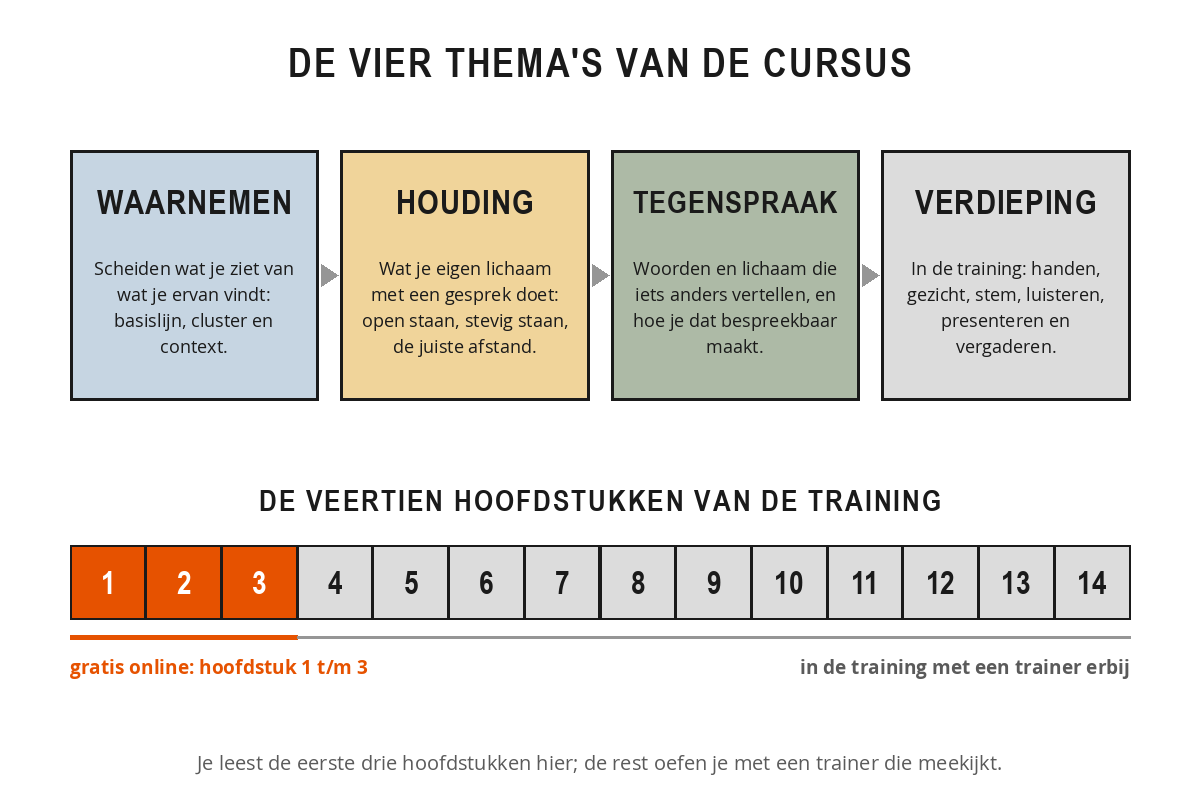
The diagram above divides the course into four themes. The first is observing: separating what you see from what you think of it, using a baseline, a cluster of signals and the context. The second is posture: what your own body does to a conversation, from being open and standing firmly to the distance you choose. The third is contradiction: what happens when words and body tell a different story, and how to raise that for discussion. The fourth theme is going deeper and is part of the full course: the hands, the face, the voice, listening, presenting and meetings. Below those four themes is a bar showing the fourteen chapters of the course. The first three are orange: those are the chapters you can read here free of charge.
What you will learn
You learn to observe before you interpret, and you learn to keep the difference between the two clear even when you have an opinion about it. You build up a baseline of the people you talk to, so you know what is normal for them. You work with clusters of signals instead of isolated gestures, and you take the context into account before drawing a conclusion. After that you look at your own side: open versus closed, standing firmly, taking up space, the four distance zones and mirroring. And you finish with the hardest part: someone says yes while their body says no, and you have to do something with that without the conversation shutting down.
The common thread is caution. A single signal rarely means anything. Only when several signals from different channels point in the same direction, and the context fits, do you have something worth asking about. Not a conclusion: a question.
How the course is structured
Each chapter begins with learning objectives and ends with a summary and a three-question knowledge check. In between are worked examples from ordinary work situations, a diagram that illustrates the model, and an exercise you apply to your own week. The chapters build on one another: the tools from chapter 1 are used again in chapters 2 and 3.
Practical tips for use
- Keep a notepad or a note in your phone to hand. Signals you do not write down fade within an hour.
- Don't read it all in one go. One chapter a week, with time to try it out, delivers more than reading through it in an afternoon.
- Practise first where you have nothing at stake: on the train, in a waiting room, while watching part of a talk show. There you can afford to miss things.
- Start with yourself. You can change your own posture today; observing others takes weeks.
- Do not draw conclusions about people. If something strikes you, ask a question about it.
Before you start chapter 1, map out your starting point. Think of a recent conversation in which you noticed that the words and the impression did not match, and note down four things:
- Situation: who, where, and what was it about?
- Signal: which non-verbal detail gave you that feeling?
- Response: what did you do at the time, or deliberately not do?
- Learning question: which single question do you want answered by the end of this course?
Keep that sheet of paper. At the end of chapter 3 you will look at it again.
Each chapter ends with a short knowledge check of three questions: answer them correctly to mark the chapter as completed. Your progress is saved automatically in your browser.
Enjoy the reading, and above all: enjoy the conversations that go differently afterwards.