


1. Observing body language
A furrowed brow can mean concentration, or irritation, or simply a lamp shining too brightly. The difference lies not in the gesture, but in how carefully you look before forming a view. This chapter is about that looking. Not about reading people, because nobody can do that, but about a way of observing that will catch you out less often.
After this chapter:
- You separate what you factually observe from the meaning you give to it.
- Establish someone's baseline and recognise a deviation from it.
- Work with clusters of signals rather than isolated gestures.
- You weigh up four layers of context before drawing a conclusion.
- You turn your interpretation into a checking question that the other person can answer.
Observing before you interpret
Most misunderstandings about body language arise not because people observe badly, but because they form an opinion too quickly about what they see. Your brain supplies an explanation within a fraction of a second, and that explanation feels like observation. You think you saw that someone was irritated. What you saw was an eyebrow.
The distinction is easy to make with a single question: could you film it? An observation you can film. The arms fold, the gaze moves to the window, the speaking pace halves, the chair turns a quarter away. An interpretation you cannot film. He isn't keen on it, her mind is elsewhere, he has doubts, she is holding something back. Interpretations are not wrong or forbidden, because without meaning you get nowhere. They only become usable once they rest on precise observations, and once you treat them as a hypothesis rather than a fact.
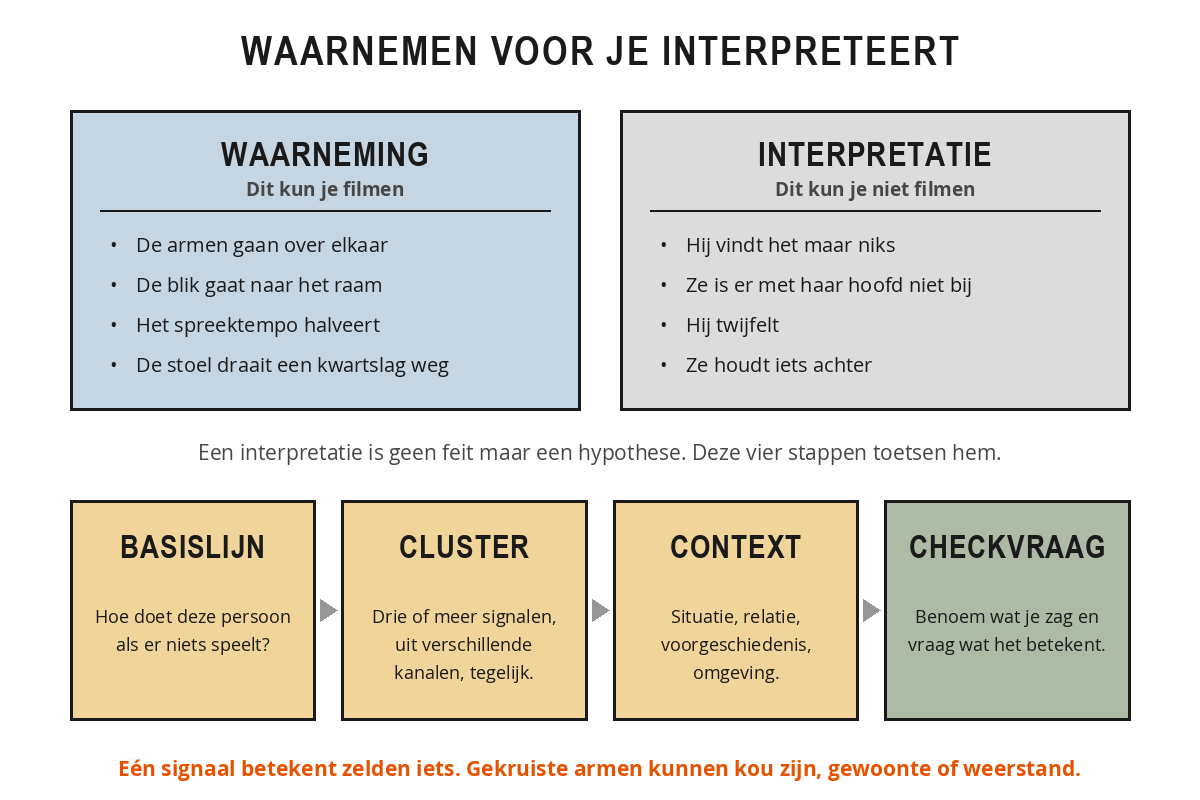
In the diagram above, those two columns stand side by side. On the left the observations, on the right the interpretations that in real life usually follow immediately. Below them are four steps that test your hypothesis: first the baseline of this person, then the cluster of signals, then the context, and only then the checking question. That order is the core of this chapter.
Formulating observations precisely
A good observation is concrete, visible and free of judgement. You train that in four ways. You describe the body part and the movement: "his shoulders rise" instead of "he is startled". You add the moment: "when the word deadline came up" makes the connection visible without you filling it in already. You add the duration, because looking away for two seconds is something other than looking away for half a minute. And you leave out the adjective: "fidgeting nervously" already contains a conclusion, "turns the pen between thumb and forefinger" does not.
Do you notice yourself mentally using a word such as tense, uninterested or arrogant? That is your signal that you have switched to interpreting. Rewind and look for the behaviour that led you to that word. Often you will find less than you thought.
A person's baseline
The baseline is the behaviour someone shows when nothing in particular is going on. His normal speaking pace, his usual amount of eye contact, the way he habitually sits, how much he does with his hands. That baseline varies enormously from person to person. One person naturally speaks quickly and moves a lot, another sits almost still and leaves long pauses. Without a baseline you interpret someone's normal behaviour as a signal, and then you are consistently wrong about half of your colleagues.
You build up a baseline in the first few minutes of contact, during the small-talk phase. That is precisely when there is little tension and you see relaxed behaviour. Pay attention to four things. Pace and volume: how fast and how loudly does this person speak when the conversation is not yet about anything in particular? Eye contact: does he look at you almost continuously, or does he regularly avert his gaze? Posture: does he normally sit slouched, upright, or leaning forward? Hands: do they rest still, or is there always movement?
A deviation from the baseline still does not tell you why someone is deviating. It only tells you that something changed, and when. That moment is the valuable part, because it links the change to what was just said.
Signals in clusters
Even with a baseline in mind, one striking gesture will not get you there. Crossed arms are the best-known example of a hasty conclusion. Someone may cross their arms because they are cold, because the chair has no armrests, because they always do it, or simply because it is comfortable. Exactly the same applies to looking away, leaning back and a brief frown. Each of those signals has at least five innocent explanations, and the chance that you pick the right one is small.
Meaning only arises with a cluster: a group of three or more signals that occur at the same time, come from different channels and point in the same direction. In doing so you pay attention to three things. The number: the more signals pointing in the same direction, the firmer your hypothesis. The simultaneity: signals that occur within a few seconds of each other probably belong together, signals that are minutes apart do not. And the channels, and that is the most important condition: a cluster of hand gestures alone is weaker than a cluster in which posture, face and voice show something together.
During a project meeting Anna proposes bringing the deadline forward by two weeks. Her colleague Wouter says: "Fine, that should be doable."
What Anna observes in the three seconds beforehand: his chair turns a quarter turn away from the table, he draws an audible breath before answering, his speaking pace halves compared with the rest of the meeting, and his gaze goes to his laptop instead of to her.
Four signals, three channels, all of them a deviation from his baseline of five minutes earlier. That is a cluster. What it means, Anna does not yet know. What she does know is that "fine" is probably not the whole story, and that a follow-up question is in order here.
The role of context
The context rule is this: a signal only takes its meaning from the situation in which it occurs. Folded arms in a cold meeting room say something about the temperature. The same folded arms at the moment you mention a price increase may say something else. Cultural norms count too, because the rules for eye contact, touch and personal space vary considerably from country to country.
There are four layers of context that you take into account. The situation: an appraisal interview, a first meeting and a routine team meeting each produce a different level of tension. Signs of nerves in a job interview are normal and therefore tell you little. The relationship: who has something to gain or lose here? Someone who needs your approval behaves differently from someone who needs nothing from you. The history: what has happened before in this case or between these people? A short, tense reaction to an innocent question often has a history. And the physical environment: temperature, noise, furniture, time pressure. A hard chair produces shifting that has nothing to do with the conversation.
Karin is holding an intake meeting with a new client. After ten minutes she notices that the man opposite her leans back three times and taps his pen as soon as she brings up the schedule. Her first thought: he does not believe in it.
She works through the four layers. The situation: a first meeting, so some tension is normal. The relationship: he will shortly have to justify internally why he is choosing this agency. The history: in the first minute he mentioned that the previous project overran by six months. The environment: it is warm and the meeting has already been going for forty minutes.
With those four layers added, "he doesn't believe in it" sounds a good deal less likely than "schedules are a sensitive subject here". Karin says: "I notice we're dwelling a bit longer on the planning. What went wrong last time?" After that they talk for another twenty minutes about exactly the subject that mattered.
From observation to checking question
Interpreting always remains a hypothesis, and the only way to test it is to put it to the other person: in plain language and without accusation. You name what you saw and you ask what it means. "I notice you hesitating over that date. What's going on?" The answer produces new observations, and with that the cycle starts again.
A checking question only works if you name the signal neutrally. "You look irritated" is an interpretation and provokes resistance. "You've gone quieter than at the start of this conversation, is that right?" is an observation and gets you an answer.
Watch five minutes of a conversation in which you have no part: a clip from a talk show, an interview, or a meeting where you are an observer. Make notes in two columns:
- Observation: only what you could film, at least eight lines.
- Interpretation: what meaning you attached to it, and at what moment that occurred to you.
Then cross out every observation that secretly still contains a judgement. Count how many remain and reformulate the crossed-out lines, this time without judgement.
Then choose three conversations from your coming working week in which you build up a baseline. For each conversation, note the pace, the eye contact, the seated posture and the hands in the first two minutes, the moment at which you saw a deviation, which signals occurred at the same time and from which channels, which layer of context played a part, and the checking question you asked or wish you had asked afterwards.
Summary
- Observing and interpreting are two separate acts. An observation can be filmed, an interpretation cannot.
- The baseline is someone's behaviour when nothing is going on, read from pace, eye contact, posture and hands. Without a baseline you see no deviation.
- A single signal always has several innocent explanations. Work with clusters: three or more signals, from different channels, at the same time and pointing in the same direction.
- The context determines the meaning. Take the situation, the relationship, the history and the physical surroundings into account.
- Your interpretation remains a hypothesis until you check it with a neutrally phrased question.
Which of these four sentences is an observation and not an interpretation?
Why do you build up a baseline before forming a view of someone's body language?
When, according to this chapter, do you speak of a signal cluster?