


3. Conflicting signals
"It's fine, really", someone says, while their shoulders drop and their gaze moves to the window. You notice that something is off, but you cannot put your finger on it, and before you know it the meeting has moved on. This chapter is about that moment: what you do with it, and above all what you do not do with it.
After this chapter:
- You explain what incongruence is and where it usually comes from.
- Notice differences between words, body and voice without immediately attaching a judgement to them.
- You choose between a direct and an indirect phrasing, and assess the effect of each.
- you learn to open up a conflicting signal for discussion in five steps.
- You know why a conclusion about honesty is almost always premature.
Recognising incongruence
Congruence means that three channels tell the same story. Your words, your posture and your voice reinforce each other, and the other person has nothing to translate. Incongruence is the opposite: what someone says does not match what their body shows or what their voice conveys. The signals contradict each other.
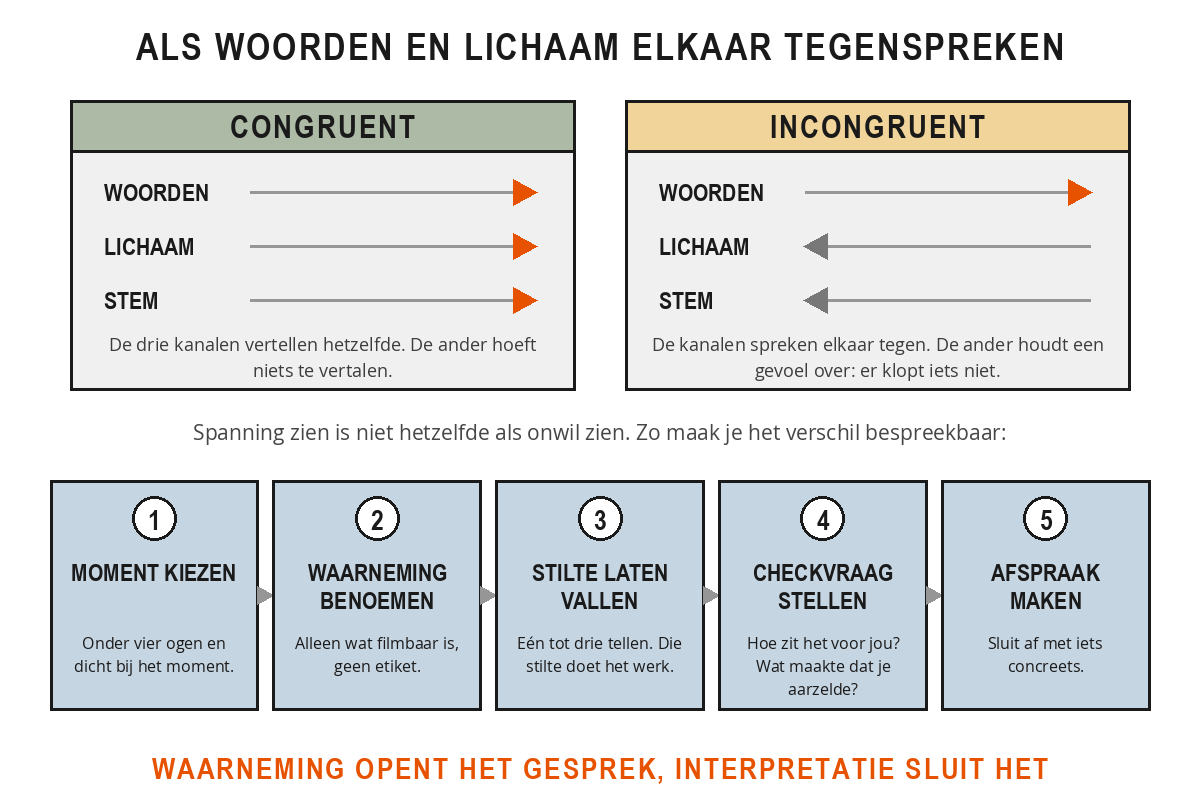
The diagram above shows this with three arrows per situation, for words, body and voice. On the left they all point the same way: that is congruent. On the right the arrow for the words still points one way, but those for body and voice point the other. At the bottom of the diagram are the five steps for making such a difference discussable: choose the moment, name the observation, allow a silence, ask the checking question, make an agreement. Those five are covered in detail later on.
The receiver almost always notices a discrepancy like that, even when they cannot put it into words. What they are left with is a vague feeling: something isn't right. And when in doubt between words and body, the receiver usually goes with the body. That is hardly surprising, because you choose your words consciously and your posture largely not at all.
Where incongruence comes from
Conflicting signals are rarely an attempt at deception. Usually there is a far more ordinary cause, and these five are the most common. Politeness: someone doesn't want to be a spoilsport and says yes while their system says no. Doubt: the content isn't settled yet, the head says yes, the feeling lags behind, and that gap leaks out through the voice. Role expectation: in a role you are supposed to sound confident, so the words meet that expectation while the shoulders do not yet. Lack of safety: the real message is too risky to say out loud, so it comes out sideways. And badly timed automatic responses: you say something friendly while your body is already turning towards the door, because you are in a hurry.
Only in the case of deliberate lying is there any intent, and that is the rarest category. This is why the conclusion that someone is being dishonest is almost always premature. You see tension; you do not see where that tension comes from. That distinction is the most important thing to take away from this chapter.
What exactly you notice
Incongruence almost always lies in a difference between channels at the same moment. These five are the ones you will come across most often. Words versus face: "good to see you" with a tight mouth and a gaze that is already looking past you. Word versus posture: voicing agreement while the torso turns away and the feet are already pointing towards the exit. Words versus voice: a commitment that ends on a rising intonation, which makes the sentence sound like a question. Timing: a smile that only comes once the sentence has already finished, or a nod that follows two beats too late. And duration: enthusiasm that drops off the face again immediately after the sentence.
Here too you work with clusters and with this person's baseline from chapter 1. One deviation is not a conclusion. Someone who always speaks softly is not suddenly insecure because they speak softly.
You ask Wouter whether he can deliver the report on Friday. He says: "Yes, I'll sort that out." At the same time three things happen: he draws breath before answering, his voice rises at the end of the sentence, and he reaches for his diary while saying it.
The temptation is to think: he doesn't want to. That is an interpretation. What you saw was a hesitation, a rising intonation and a move towards his planning. A useful response is then: "You say yes, and at the same time you reach for your diary. How full is Friday actually?" It turns out Wouter has two other deadlines that day. There was no unwillingness, there was a scheduling problem.
Direct versus indirect
Not every contradiction is a slip of the tongue or a hidden emotion. Sometimes it is a style. People differ greatly in how much of their message they put into the words themselves, and how much they leave hanging around them. In direct communication the core is in the words: what you hear is what is meant, and the non-verbal channel supports it at most. In indirect communication the core is somewhere else: in the tone, in the question form, in what is precisely not said, or in the moment someone raises the subject.
Putting things directly produces clarity. The other person does not have to translate anything and there is little room for misunderstanding. When speed matters, in matters of safety, with deadlines or with a technical problem, it is the only workable style. You pay the price on the other side: a direct sentence can land hard, certainly with someone who communicates indirectly themselves. They hear in "the figures on slide 4 are wrong" a correction of the figures plus a judgement about themselves.
Putting things indirectly protects the relationship and the other person's face. You leave room to decline without anyone having to say so out loud, and you test whether a subject is open for discussion before you dive into it. In hierarchical relationships and in sensitive conversations, most people do this automatically. The risk lies in the clarity: the further the core is from the words, the more the other person has to guess. And guessing happens from their own picture of the situation, not from yours. That is how you get a conversation in which two people part satisfied with different conclusions.
This is why indirect speakers more often seem incongruent. With someone who communicates indirectly, the difference between words and body is not interference but the system itself. The words cover the relationship, the body carries the content. "I'll have a look at what's possible", said with a short pause for breath, a glance at the diary and a slight shake of the head, means no. That is not a lie. It is a message divided across two channels, and you are expected to read both.
If you are in a conversation with someone who clearly puts things more indirectly than you do, it helps to slow down your own pace and to wait longer after an answer. In that silence, the real message from indirect speakers often comes out after all.
Naming the difference in five steps
Spotting the discrepancy is one thing. Doing something with it without the other person shutting down is another. Anyone who names a contradiction as an accusation gets a defence in return and loses precisely the information they were after. You don't have to name every incongruence, by the way. You do so when the contradiction has consequences for an agreement, a decision or the atmosphere in the working relationship.
1. Choose the moment. You raise it in private and as close as possible to the moment you saw it. In a full meeting room you put someone on the spot, and then saving face always wins out over honesty.
2. Name the observation. You name only what could be caught on film. "You just said it suits you well, and at the same time I saw your eyebrows go up briefly and things went quiet." No conclusion, no label.
3. Allow a silence. After your observation, you allow one to three seconds of silence. That silence does the work. If you fill it in yourself, you hand the other person a ready-made explanation to hide behind.
4. Ask a checking question. You ask about meaning in plain language: "How do you see it?" or "What made you hesitate just then?" Not: "So you don't agree, do you?"
5. Make an agreement. Whatever comes out of it, you close with something concrete. Otherwise the undertone of the conversation carries more weight than the words spoken in it. And whatever you get back, you take it as it comes, even if it surprises you: anyone who keeps pushing after an honest answer teaches the other person not to say it next time.
Team leader Joost speaks to employee Fatima after a meeting, at the coffee machine, twenty minutes after the event itself.
Joost: "In the meeting you said you were fine with the new schedule. As you said it, I saw you lean back and fold your arms, and your voice dropped." Then there is a silence of three beats.
Fatima: "Yes, the planning itself isn't the problem. I only heard yesterday that I'm also getting Sander's induction period on top of it."
Joost: "So the planning adds up, but the sums don't. What do you need to do both alongside each other?" They agree that Fatima will temporarily hand over two of her four files.
The observation opened the conversation. Had Joost said "I notice you're not behind this", he would have got a denial and would never have got through to Sander.
Phrasings that begin with "I get the feeling that…" or "you seem…" sound gentle, but they are interpretation. The other person hears a judgement in them and starts debating that instead of the situation. "I see you hesitating" lands differently from "you're hesitating": the first is your impression and the other person is free to correct it.
Think back to a conversation in the past two weeks in which you thought: something isn't right here, but I couldn't put my finger on it. Work the situation out on paper:
- Situation: who, where, what it was about.
- Spoken words: what did the other person say, word for word.
- What you saw: posture, face, hands, the direction the body is facing.
- What you heard: pace, volume, intonation, pauses.
- The difference: which channel contradicted which other channel.
- Your interpretation at the time: what did you think it meant.
- The checking question that you could have asked: one sentence, factual and without judgement.
Then have someone else read your write-up and ask them to underline which sentences are observation and which are already interpretation. Finally, take out the sheet from the introduction: can you now answer your learning question?
Summary
- Incongruence is a discrepancy between words, body and voice at the same moment. The receiver notices it and, as a rule, believes the body.
- The cause is rarely deception: politeness, doubt, role expectations, lack of safety and bad timing occur far more often.
- You see tension; you do not see where it comes from. A conclusion about honesty is almost always premature.
- Direct communication puts the core in the words; indirect communication protects the relationship and places more of the message in the non-verbal channel.
- You address a contradiction in five steps: choose the moment, name the observation, allow a silence, ask a checking question, make an agreement.
- Observation opens the conversation, interpretation closes it.
According to this chapter, what is by far the most common cause of conflicting signals?
You want to name a conflicting signal. Which opening sentence fits step 2?
Why do you allow one to three seconds of silence after your observation?
Ready for the next step?
You have completed the free starter of Body Language. The next chapter in the full course is The communication model: From sender to receiver, the three types of noise, the three communication channels and the formula E = K x A.
Take the 2-day course →From €1250,- excl. VAT · with an experienced trainer included