


2. What your posture tells people
Your posture is the longest visible signal in a conversation. Words come and go, but how you stand or sit remains visible the whole time. In the previous chapter you mainly looked at other people. This chapter turns that around: your own posture is the one thing about body language that you can change today.
After this chapter:
- You can describe the difference between an open and a closed posture.
- You check your own stance for stability and for signs of tension in your legs and feet.
- You know how taking up space affects how confident you come across.
- Know the four distance zones and recognise the moment you enter one.
- You use mirroring as a thermometer for how well a conversation is attuned.
Open versus closed
An open posture keeps the front of your body clear. There is nothing between you and the other person: no crossed arms, no folder against your stomach, no laptop screen as a shield. Your torso and your feet point towards the person you are talking to, your shoulders hang behind your ears instead of in front of them, and your hands are visible.
A closed posture does the opposite. You make your torso smaller and put something in front of it: arms folded, one leg turned away, a coffee cup held with both hands at the level of your diaphragm. You turn your upper body a quarter turn away, so that you look at the other person from an angle rather than head-on.
The other person almost always decodes that difference in the same way: open reads as available and trustworthy, closed reads as distance. That does not mean the interpretation is correct. Crossed arms are also simply a comfortable position, and in a cold meeting room they say more about the air conditioning than about the atmosphere. So with other people you use the same tools as in chapter 1: first the baseline, then a cluster, then the context. But with yourself it is different, because there you decide what is on display. And anyone who stands closed off rarely gets an open conversation in return.
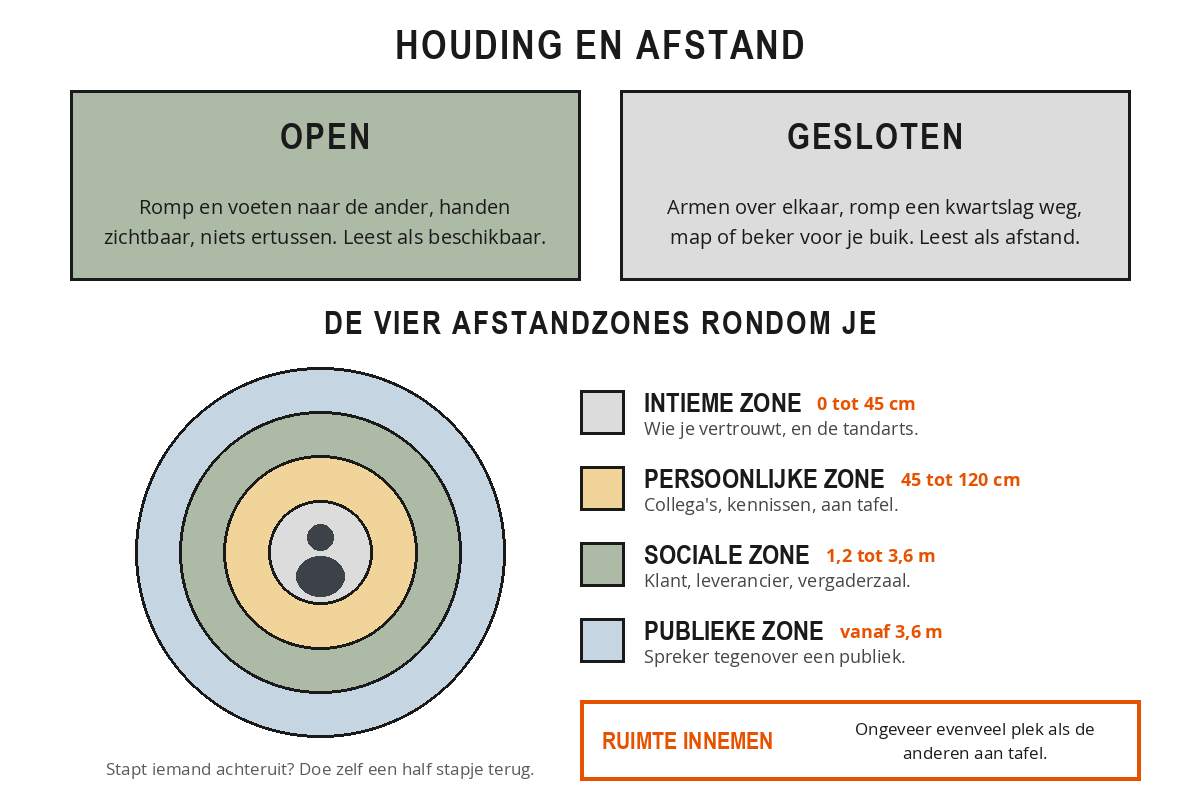
The diagram above places those two postures side by side and shows underneath how the space around your body is divided into four rings. Those rings are covered later in this chapter.
Consultant Bram holds two 45-minute intake conversations in a single morning. With the first client he keeps his folder closed against his stomach and sits turned a quarter away. With the second he puts the folder on the table, keeps his hands visible and points his torso and feet towards the client.
Both times he asks the same six questions, in the same order. The first client keeps to short answers and the conversation is over after half an hour. The second starts talking of his own accord about what went wrong in the previous project, and Bram fills two sides of A4. The difference was not in his questions.
Stability from the feet
Someone who stands restlessly sounds restless. What is more, your lower body is the part people pay the least attention to in themselves, which is where most of the tension leaks away. You can check your own stance in five steps. Place your feet roughly hip-width apart, with both toes pointing forward. Spread your weight evenly between left and right, and between the heel and the ball of your foot. Unlock your knees, so not quite fully straightened. Let your shoulders drop once and breathe out. Then stand still for ten seconds and notice where you still want to move.
That last point is the interesting one. Do you keep shifting your weight from one leg to the other, tap a heel, or shuffle half a step backwards? Those are signs of tension, and the other person picks them up without naming them. Sitting down works on the same principle: both feet flat on the floor gives you a base, one leg crossed over the other makes you narrower and more mobile in your upper body.
Pay attention to direction as well. Your feet usually point towards whatever has your attention, or towards where you want to go. Someone who talks with his torso towards you but with his toes pointing at the door already has one leg on the way out. That too, incidentally, is one signal, and therefore not a conclusion: perhaps he simply has to get to the next meeting.
For a conversation in which you want to come across as self-assured: find a quiet spot, stand as described above and count three breaths. Your body will remember that position for a few minutes.
Taking up space
Taking up space is the amount of physical space you occupy with your body and your belongings, in relation to what is available. It is one of the fastest status signals people read in one another, and it comes down to five small things that together give a clear picture. The distance between your elbows and your torso: arms hanging loosely away from your body take up more room than arms clamped to your sides. The position of your feet: hip-width apart gives you a broader base than feet touching each other. What you put on the table: a laptop, a folder and a mug spread across your part of the table claims space, everything in a neat pile in front of your stomach claims nothing. The height of your head and torso: sitting upright with your chin horizontal gives more volume than slumping with your head forward. And your range of movement: someone who lets an arm travel across the table while talking uses more space than someone who keeps everything within the size of a sheet of A4.
Taking up a lot of space reads as status and confidence, taking up little space as modesty or insecurity. It works both ways: if you give yourself a bit more space, your breathing follows and you often feel calmer too. Where the line lies between confident and space-claiming depends on the situation and on your position in the group. The same wide seated posture reads differently for the chair than for the new intern. Anyone who takes up so much space that others have to shift comes across as dominant. The point is to use your own space fully, not to take the other person's. A useful rule of thumb: take up about as much space as the others at the table, and a little more than you are used to as soon as you notice you are making yourself small.
Two candidates are waiting for the same job interview. Sanne sits with her bag on her lap, knees together and elbows against her sides. Ravi puts his bag beside the chair, rests one forearm loosely on the armrest and keeps his feet hip-width apart. They are equally well prepared and have comparable marks.
The receptionist later describes Sanne as "a bit nervous" and Ravi as "he looked ready for it". That judgement was formed in the two minutes before a single word of substance was exchanged, by someone who has no say in the matter. It says nothing about who can handle the job, and yet there it is.
Your bag, coat and phone go beside or behind you, not on your lap. Anything you hold on to or place against your stomach reduces your visible size and also acts as a shield. It frees up your hands for movement too.
The four distance zones
People maintain fixed zones around their bodies, and those zones match the type of relationship. If you enter the wrong zone, the other person notices immediately, even if they cannot put their finger on why it became uncomfortable. In the diagram above you see them as four rings around a person. From the inside out, they are as follows.
The intimate zone runs from 0 to roughly 45 centimetres and is reserved for people you trust, and for professionals who have to enter it as part of their work, such as a dentist or a hairdresser. Anyone who enters uninvited almost always creates tension. The personal zone runs from 45 to 120 centimetres: the zone of colleagues, acquaintances and conversations around a table. At this distance you can speak softly and see facial expressions clearly. The social zone runs from 1.2 to 3.6 metres and is the business distance, for people you do not know personally: a client, a supplier, a group of colleagues in a meeting room. The public zone starts at 3.6 metres, the distance from speaker to audience. Your voice and your gestures have to get bigger to bridge that distance.
Those measurements are not a law. They shift with culture, with how busy it is around you and with the relationship. In a crowded lift everyone temporarily accepts the intimate zone, provided nobody makes eye contact. Someone at home in a culture with short distances will quickly experience a Dutch conversation partner as cool, and the other way round as pushy.
If you notice that someone steps back, turns their torso away, puts their cup between the two of you or takes half a step sideways, you have probably reached their zone. That is feedback, not rejection. Take half a step back yourself and see whether the other person relaxes again.
Approach someone at an angle rather than head-on. Standing directly opposite each other feels confrontational at close range. At an angle of around 45 degrees you can come closer without it feeling oppressive.
Mirroring
In a café you see it in two people who are talking well together: they lean at the same angle, pick up their glasses at roughly the same moment and move at the same pace. Mirroring is partially taking over the posture, pace and movement of the person you are speaking to. It usually happens by itself, as a by-product of being in tune.
Because it arises naturally when contact is good, you can read it as information. If the other person is sitting in a mirrored posture, the conversation is probably running smoothly. If he stays in a completely different posture while you have been talking for twenty minutes, that is one signal in a possible cluster suggesting you are not in tune. You can also test this: change your own posture slightly, lean forward a little or put your forearm down differently. If the other person follows within half a minute, you are leading the contact. If he does not follow, the connection has not yet been made.
Deliberate mirroring only works if it stays invisible. Three rules keep it usable. Mirror with delay: adopt the posture a few seconds later, not at the same time, because copying directly is noticeable and comes across as mockery. Mirror partial: take over one element, for example the speaking pace or the direction of lean, not the whole picture. And mirror no negative signals: someone who becomes angry, talks louder and leans forward is precisely the person you do not mirror. Instead you start speaking more calmly and moving a fraction more slowly, so that the other person has something to settle towards.
Part A, observing. Find a place where people are talking in pairs, for example a canteen or a waiting area. Choose one pair and watch for five minutes. Note down which zone they are using and whether it changes during the conversation, who takes up more space and how you can tell, and three moments at which one of them takes over a posture or movement from the other.
Part B, trying it out. Hold a ten-minute work conversation and deliberately change one thing about your posture halfway through, for example leaning forward slightly. Afterwards, note down what you changed and at what moment, whether the other person followed within thirty seconds, and what happened in the conversation immediately after that moment.
Summary
- An open posture leaves your torso and hands free and invites contact; a closed posture shuts things off. In someone else it remains a single signal, in yourself it is a choice.
- A stable stance from your feet up prevents tension from leaking away into your lower body. Your feet point towards wherever your attention is.
- How much space you take up determines how confident or how dominant you come across. Take up roughly as much space as the others at the table.
- The four zones run from intimate (up to 45 cm) through personal (up to 120 cm) and social (up to 3.6 m) to public (from 3.6 m). Anyone who steps back is giving you feedback about the distance.
- Mirroring happens naturally when contact is good, which makes it a thermometer. Deliberate mirroring is done with a delay, partially, and never when tension is rising.
During your meeting, a colleague is sitting with his arms crossed. According to this chapter, what is the correct conclusion?
You are discussing a quotation with a new client you do not know personally. Which zone suits that conversation?
The person you are speaking to becomes angry, starts talking louder and leans forward. What do you do about mirroring?