


Introduction
You come out of a meeting of an hour and a half with three pages of notes. It's all there, and that is precisely why you can no longer find anything. A week later you read your own lines and no longer know which point belonged to which topic, or why that one remark seemed important. The problem is not your memory. It is the form in which you wrote it down: a list running from top to bottom never shows what belongs together.
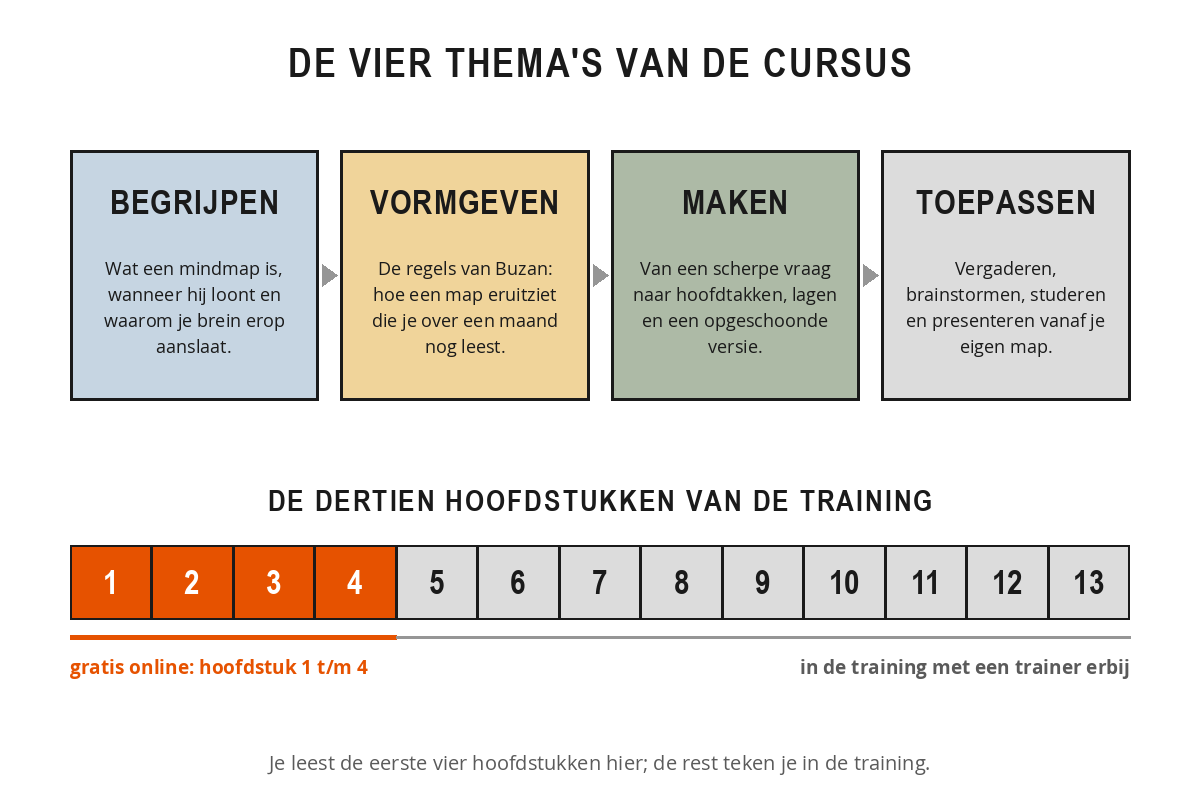
This free course contains the first four chapters: the orange part of the bar above. At the bottom of chapter 4 you will find the full course.
What you will learn
You learn what a mind map is, what parts it consists of and in which situations it delivers more than a list. You see why your brain responds to this form: your working memory only holds a handful of things at a time, and a mind map takes over that work. Then you get the rules with which Tony Buzan set down the technique, and finally you draw your own first mind map in five steps. The common thread: a mind map is not a drawing made afterwards, but a way of thinking on paper.
How the course is structured
The course follows four themes that build on one another. You start with understanding: what is a mind map, and why does it work? Then comes shaping: what does a map look like that you can still read a month from now? After that creating: from a sharp question to main branches, layers and a cleaned-up version. And you finish with apply: meetings, brainstorming, studying and presenting. Each chapter contains theory, a worked example mind map, examples from practice and an exercise that you apply to your own work.
Practical tips for use
- Put a blank sheet of paper in front of you, landscape, and three or four markers. You don't read this course, you draw it.
- With every chapter, make at least one mind map about something from your own work. Reading about mind mapping gets you nowhere; drawing does.
- Don't expect your first map to look good. It may be messy, crooked and full of crossings-out.
- Keep your first maps. When you look back in a month's time, you will see exactly where the form still felt awkward.
- Don't read it all in one go. One chapter a week, with time to try it out, delivers more than reading through it in an afternoon.
Each chapter ends with a short knowledge check of three questions: answer them correctly to mark the chapter as completed. Your progress is saved automatically in your browser.
Enjoy the reading, and above all: enjoy the blank sheet.