


1. What a mind map is and when it pays off
A mind map promises a lot: a single sheet of paper on which you can take in an entire subject in five seconds. That promise holds true, but not for everything. This chapter shows which parts make up a mind map, how it differs from the notes you make now, and in which situations it saves you time. And also where it gets in your way, because that is at least as useful to know.
After this chapter:
- You know which four building blocks every mindmap consists of.
- Can you explain what radiant thinking is and why Buzan chose that term.
- Name five differences between linear and associative note-taking.
- Recognise seven situations in which a mind map wins and three in which it loses.
- You know which five misconceptions about mindmapping you can let go of.
The four building blocks
A mind map is a drawing of your own thinking. The subject sits in the middle, as a word and preferably also as a small image. From that centre the main ideas run outwards as branches, and out of each main branch grow smaller associations in turn. Each line carries one keyword. Colour, thickness and position all carry meaning: the closer to the centre, the more general the idea.
Those are the four building blocks you will find in every mindmap. The central image is the subject in the centre. The main branches are the four to seven broad categories that set off from that centre, thick near the middle. The sub-branches are the elaboration of those, thinner the further out they run. And on each line there is exactly one keyword, never a sentence.
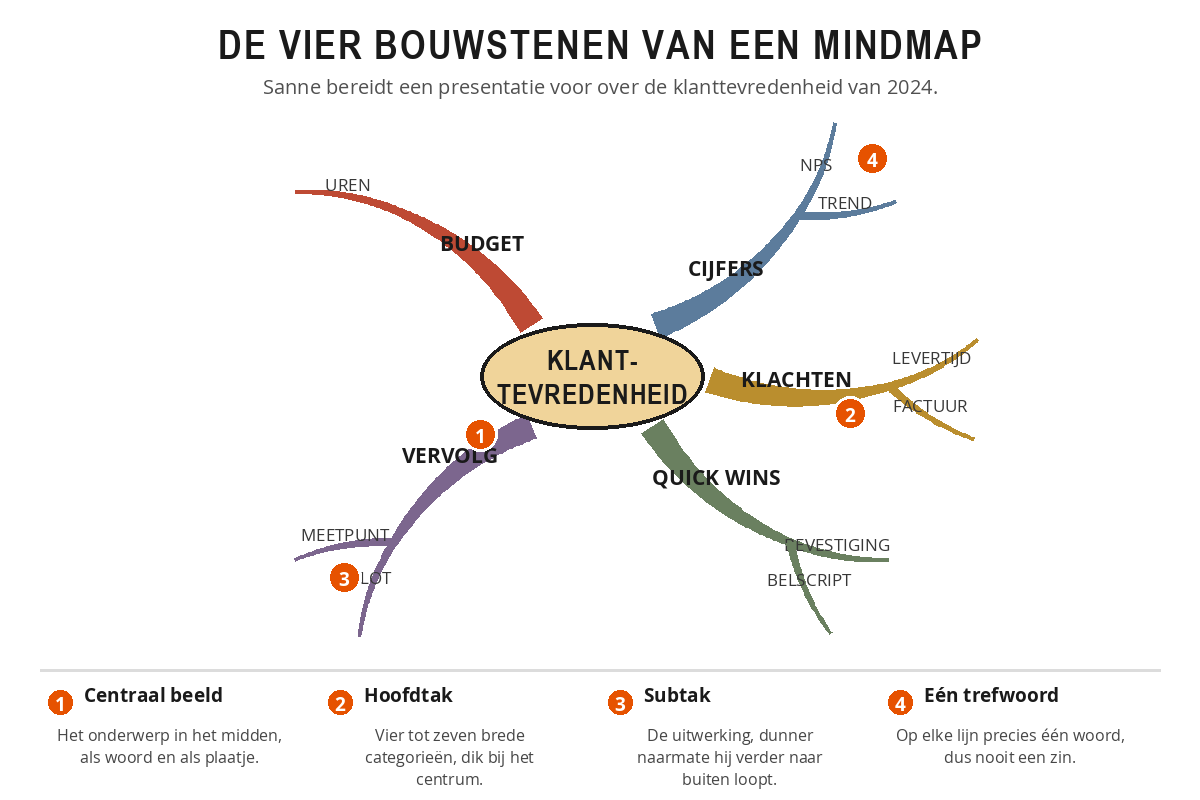
In the diagram above, the centre contains customer satisfaction. Around it run five main branches: figures, complaints, quick wins, budget and follow-up. Under figures hang NPS and trend, under complaints hang delivery time and invoice, under quick wins hang confirmation and call script, under budget hangs hours, and under follow-up hang pilot and measuring point. You can see at a glance that budget has only one sub-branch and complaints has two. That ratio is information in itself: apparently the maker of this map knows a great deal about complaints and almost nothing about budget.
Sanne has to give a twenty-minute presentation on customer satisfaction. She does not start in PowerPoint, but with a blank sheet. In the middle of the sheet she writes "Customer satisfaction 2024". Within eight minutes there are five main branches. Three examples hang under complaints, nine under figures. She sees straight away that the balance does not match her message: her audience does not want to see nine figures, it wants to know what is going wrong and what is being done about it. She moves the branches around and only then makes slides. With a list of bullets she would not have spotted that skewed balance, because in a list everything sits one under the other and everything looks equally important.
Why it looks the way it does
That shape is not a matter of style. The British psychologist Tony Buzan popularised the mindmap from the nineteen-seventies onwards. He saw that students filled their notes with full sentences and afterwards could barely find what was important. His observation: the brain does not store information as a list from line 1 to line 40, but as a network of connections. One word calls up dozens of others, and those call up new ones again.
Buzan called that radiant thinking: thinking that radiates out in all directions from a central point. The word "holiday" probably brings to mind, within a second, sun, suitcase, traffic jam, book and a specific memory of a campsite. Those words do not arrive neatly in alphabetical order. They come at the same time, in clusters, tied to one another. A mind map puts exactly that structure on paper, instead of translating it into a form your head does not use.
Five differences from a list
Most people take notes linearly: line under line, from top to bottom, in the order in which the information comes in. That works fine for a shopping list. As soon as the subject becomes complex, it starts to grate, because you are then doing three things at once: writing along, deciding on the order and keeping an overview of the whole. Those three compete for the same attention.
- Direction: linear notes run from top to bottom. A mind map grows outwards from the centre, in all directions at once.
- Unity: in linear notes you write sentences. In a mindmap each line carries one keyword, which means that when you read it back you make the connection yourself.
- Connections; in a list, the relationship between point 3 and point 17 appears nowhere. In a mind map, the branch structure shows you immediately what belongs together.
- Space: a full list has no room left for an idea that turns up halfway through. A mind map always has room for an extra branch.
- Retrieval speed: you scan a page of text line by line. A mindmap you take in at a single glance, because shape, colour and position all help.
Associative note-taking reverses the order. You first fix the centre and then hang everything in the place where it belongs in terms of content. Does a point come back to an earlier subject halfway through the meeting? Then you simply put it on that branch, even if it is twenty minutes later. The page grows along with the conversation instead of with the clock.
Seven situations in which a mind map wins
A mindmap comes into its own when you have to organise information that has no shape yet. With meetings you attach each remark to the right agenda item as it comes, even if the speaker jumps back three points. With brainstorming associative note-taking keeps the flow going. With the planning a project you can see at a glance which parts there are and where you have not filled anything in yet. With studying you get forty pages on a single sheet. With a presentation the main branches become your sections and the sub-branches your points. With a decision arguments, stakeholders and risks sit side by side, so that one loud consideration does not automatically become the heaviest. And with personal goals you work outwards from one area of life to establish what you want and what the first step is.
The common thread: the less fixed the structure of your subject, the more a mind map delivers. It works best in chaos.
Rachid works in a finance department and thought mindmapping was "something for the marketing colleagues". While preparing the year-end close he gave it a try anyway: "Q4 close" in the middle, with branches around it for systems, people, deadlines and risks. Within ten minutes he saw that under people there was one name that also came back on three other branches. That colleague turned out to be on holiday in the same week. In his usual action list of 34 lines that would only have come to light two weeks later, and by then he would have had no room left to arrange anything.
Where a mindmap does not help
Some information has a fixed order by nature. An installation instruction in which step four may only come after step three is more likely to be lost in a mind map than gained. The same applies to amounts, schedules with dates and data you want to sort or add up later: a numbered list and a table are simply stronger there. And a mind map is first and foremost yours. The associations, abbreviations and little drawings mean something to you and often nothing to anyone else. For documents that others have to be able to read without your explanation, use the mind map as preparation and not as the end product.
A good rule of thumb is the question of whether you are using the mindmap to thinking or to retaining. Thinking work is fine on paper with untidy branches. Work you want to keep calls for a revised version or a transfer into text, because in three months' time you will no longer recognise your own scribbles.
Five assumptions you can let go of
- "You have to be able to draw." An arrow, an asterisk, a dash and a small square are enough. A symbol has to be recognisable to you; it does not have to be pretty.
- "A mindmap has to look neat." The first version is working material and may be crossed out and crooked. Neatness only matters once you reuse the map or show it to others.
- "It is something for creative types." Radiant thinking is not a talent but the way your brain works. Controllers and system administrators get just as much out of it; only the word in the centre differs.
- "It's just a list with branches attached." A list forces you into an order before you know what that order is. A mindmap lets you postpone that choice until the material is there, and that produces different ideas.
- "Mindmapping takes extra time." The first few times, yes, as with any new habit. After that you win time back when looking things up, summarising and handing over.
Take a blank sheet of paper, landscape, and a subject from your own work where you currently lack an overview.
- Write the subject in two or three words in the middle of the sheet and draw a circle around it.
- Spend five minutes putting everything that comes to mind around that centre as separate branches. One word per line, no sentences.
- Then use a colour to mark which branches belong together.
- Answer two questions: which connection do you see now that you would not have spotted in a list, and which branch is conspicuously empty?
That last question is the most important one. An empty branch almost always means you know too little about that part, and that is exactly where your next hour should go.
Summary
- Every mind map consists of four building blocks: a central image, main branches, sub-branches and one keyword per line.
- The form matches radiant thinking: the fanning-out pattern of association that Buzan took as his basis.
- The counterpart of linear note-taking is associative note-taking: you postpone the structure until you have material.
- Mindmapping pays off in meetings, brainstorms, projects, study, presentations, decisions and personal goals.
- For fixed procedures, figures and texts intended for others, choose a list or a table.
- You don't need any talent for drawing, nor neatness, and the technique works just as well for analytical as for creative work.
What did Buzan mean by radiant thinking?
For which of these four tasks is a mindmap, according to this chapter, the least suitable?
In her mind map, Sanne sees that the branch "figures" has nine sub-branches and "budget" only one. What is the gain in that?