


4. Your first mind map in five steps
A blank sheet is the easiest place to get stuck. What you put in the centre in the first minute determines how usable everything that follows will be. This chapter gives you the order: first the question, then the image, then the main branches, then the layers, and finally the tidying up. Anyone who skips step one only notices at step four, when the branches fan out in all directions without arriving anywhere.
After this chapter:
- you can name the five steps and know where you are in the process.
- You formulate a central question that is sharp enough to give your branches direction.
- You choose four to seven main branches along three different routes.
- Do you work in breadth before going into depth, with a parking box for stray thoughts.
- You know when to tidy a draft up into a final version and when not to.
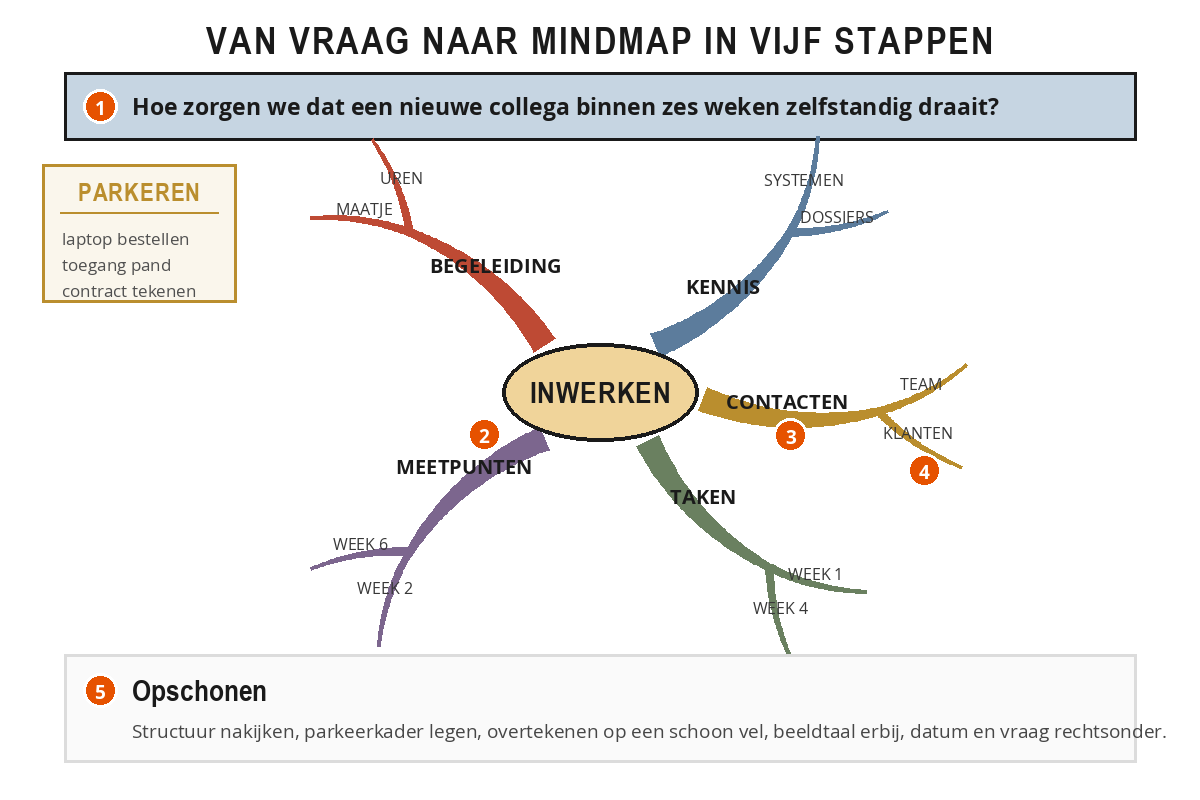
The diagram above shows the five steps using one example. At the top is the question: how do we ensure a new colleague is working independently within six weeks? In the middle is the subject "onboarding". Around it run five main branches: knowledge (with systems and files), contacts (with the team and clients), tasks (with week 1 and week 4), guidance (with a partner and hours) and measurement points (with week 2 and week 6). Top left is a parking box with three stray thoughts that did not fit anywhere: order laptop, building access and sign contract. At the bottom is what happens during the clean-up.
Step 1: start with a sharp question
The central question is the question your mind map answers. It is not on the paper, but it is in your head while you draw, and for every keyword it decides whether that keyword belongs. Without that question you only have a subject, and a subject gives you no reason to leave anything out.
"Marketing" is a subject: literally everything fits under it. "How do we bring in twenty new clients next quarter?" is a question: it steers you towards channels, budget, target group and capacity, and keeps last year's annual report out of the picture. You can recognise a workable question by three things: it contains a verb, it is bounded in time or size, and you can answer it.
Team leader Joost wants to make a mind map about onboarding new colleagues. His first attempt is "onboarding". That is too broad: everything to do with new people fits on it, and after ten minutes he has a map with thirty separate branches and no coherence. He rewrites the question as: "How do we make sure a new colleague is working independently within six weeks?" Now the main branches almost fall into place by themselves: knowledge, contacts, tasks, support and measurement points. And for every keyword there is a test: does this help within six weeks, or not? The idea for an annual team day drops out, which saves him half a map.
If you are in doubt about whether your question is sharp enough, apply the counter-test: think of three things that definitely must not be included. If you cannot name them, your question is still a subject.
Step 2: put down the central image
Take a landscape sheet, preferably A3. A4 in portrait almost always runs out of room too soon: your main branches hit the side edges and your sub-branches creep downwards. Three to five colours are enough, in two thicknesses: a thicker nib for the main branches and a fine nib for the rest. Make sure you have a clear surface so that you can turn the sheet, put your sources next to it rather than underneath it, and block out three quarters of an hour without notifications. That last point makes more difference than an extra colour of marker.
Then draw your subject in the middle, in no more than a minute, with the word in it or underneath it. It does not have to mean anything to anyone else.
Step 3: choose four to seven main branches
Fewer than four main branches usually produces a disguised list, more than seven makes the map hard to read. You are looking for categories that are broad enough to carry what is still to come. Three routes will help you with that. The first are the fixed question words; who, what, where, when, why, how. Useful for reports, plans and analyses. The second is the structure of your source: for an article or report you take the chapter structure as your starting point. The third is dump first, then cluster: you write twenty separate ideas on a notepad, group them and use the group names as main branches. That last approach works best for subjects whose structure you don't yet know; the first two are quicker if the subject already has a shape.
If you are torn between two main branches that resemble each other, choose one for now. If it turns out while working it out that too much hangs underneath it, you can still split it. Splitting takes less time than merging.
Step 4: work it out in layers, breadth before depth
After the main branches comes the temptation to finish one of them off completely straight away. That is precisely what you should not do. In round one you go through all the main branches and attach two to four sub-branches to each. In round two you go deeper into the sub-branches that call for it. In round three you add what is missing and make the cross-connections. As long as you work broadly, you keep your overview in view and you can see where information is missing. If you dive straight into the detail, your working memory fills up with details from branch one while branches two to five are still empty.
Most maps are finished after three or four layers. If a branch runs on to layer six, there is often a separate subject hidden in it that deserves a map of its own.
While you are working things out, something always comes in that belongs nowhere: a task, a name, an idea for next year. Losing it is a waste, and fitting it in spoils your structure. So put a small box in a corner of your sheet with the word "parking" above it. Your map stays clean and your head stays empty.
Ruben is mind mapping a project plan with five main branches. At the branch "planning" it occurs to him that the supplier still has to sign a contract. That does not belong under planning, nor under the other four. He puts it in his parking area and carries on. At the end there are three things parked: the contract, an insurance question and a discussion about ownership of the source code. Together they form a sixth main branch, "legal", which he draws after all when tidying up. Had he hung the contract under planning straight away, the other two would never have come together.
Step 5: cleaning up
The difference between a draft and a final version lies not in beauty but in function. The draft serves your thinking, with crossings-out and a shifting structure. The final version serves your memory and your reader. Not every map has to go through this step: a map you made to think something through and then throw away stays a draft. If you are going to keep it or show it to others, a quarter of an hour spent cleaning it up buys you months of legibility.
- Checking the structure: does every keyword hang under the right main branch? Move whatever does not belong there.
- Empty the parking lot; find a place for every parked idea after all, make it a new main branch, or put it on your action list.
- Redrawing on a clean sheet: take over the structure, now with the final layout and with space where you still expect additions.
- Adding visual language: put a small mark next to the five points that really matter, so that your eye finds them straight away when you look back.
- Noting down the date and the question: write the date and your central question in the bottom right-hand corner, so that the map can still be read on its own six months from now.
Redrawing it feels like doing the work twice, but it is a free repetition. While you rebuild the map you actively retrieve the content, and that gains you more in memory terms than reading through your notes three times.
Choose a task that is on your desk this week and work through the five steps on paper.
- Write down your subject in one word, rewrite it as a question with a verb in it, and add a limit in time or number.
- Apply the counter-test: note down three elements that fall outside the map because of that demarcation.
- Draw the central image and choose four to seven main branches. Note down which route you found them along.
- Work it out in three rounds and keep track of how many sub-branches hang from each main branch, which branch called for more depth, and what ended up in your parking area.
- Tidy it up, and note in two sentences what changed in terms of content between the draft and the final version.
Summary
- The fixed order is: question, central image, four to seven main branches, working out in layers, tidying up.
- A workable central question has a verb, a boundary and an answer. Without a question you have no reason to leave anything out.
- You find main branches through question words, through the structure of your source, or by first dumping and then clustering.
- Work broad before you go deep, in three rounds, and put ideas that fit nowhere in a parking box.
- The draft serves your thinking, the cleaned-up version serves your memory and your reader. Add the date and the question to it.
- Redrawing is not duplicate work but free repetition.
What is the difference between "onboarding" and "how do we ensure a new colleague is working independently within six weeks?"
You have drawn five main branches. What do you do next according to this chapter?
While working it out, it occurs to you that the supplier still has to sign a contract. It does not fit under any main branch. What do you do?
Ready for the next step?
You have completed the free starter of Mind Mapping. The next chapter in the full course is The power of visual thinking: Thinking in images, building up your own visual vocabulary and using the space on the paper as a memory aid.
Take the 1-day training course →From €625,- excl. VAT · with an experienced trainer alongside you