


3. Buzan's rules
Buzan set down his method in a set of rules. They are not dogma, but nor are they arbitrary: each rule connects to something your brain already does anyway. Anyone who follows them properly the first few times will soon notice which ones can be dropped. Anyone who works around them straight away almost always ends up with an ordinary list with boxes around it.
After this chapter:
- You know the seven basic rules for building a mind map.
- You know what Basic Ordering Ideas are and how to choose them.
- You apply the rule of one keyword per line to your own notes.
- You recognise the difference between an organic and a schematic branch shape.
- Do you know when it is sensible to deviate from the rules and when it is not yet.
The seven rules
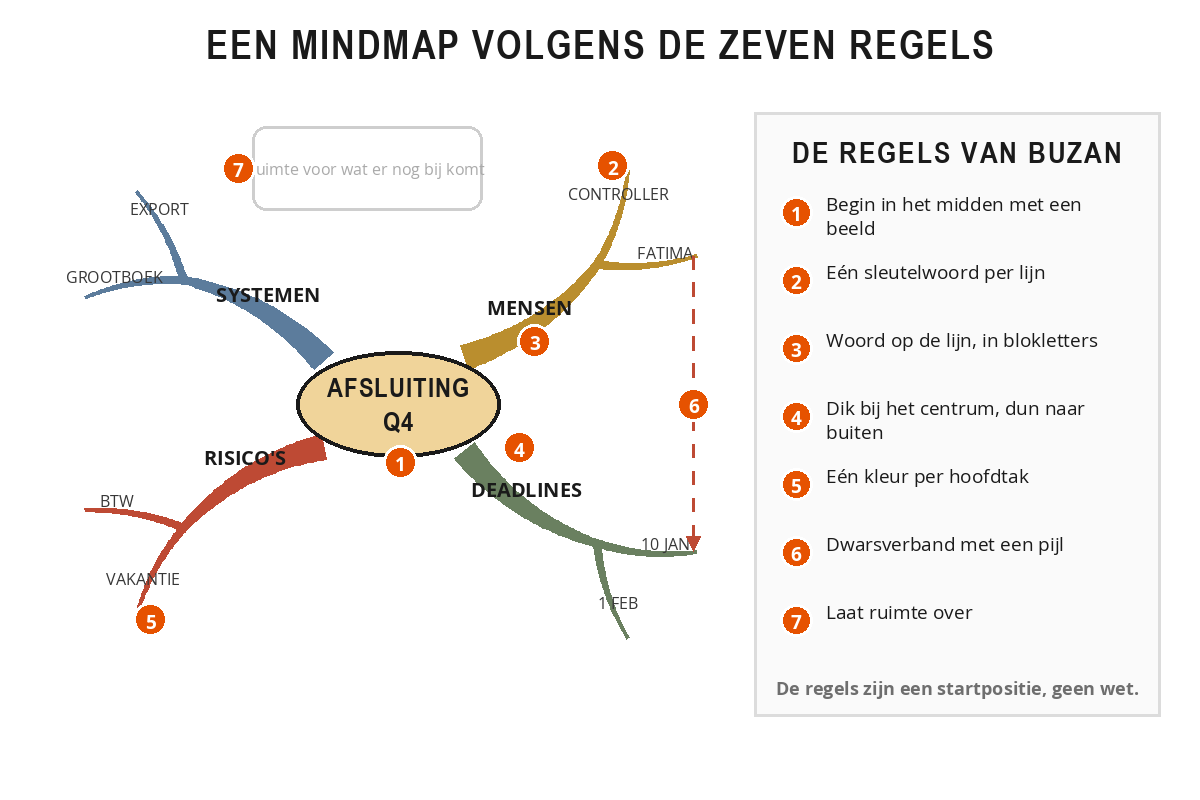
In the diagram above, the centre reads "Closing Q4". Four main branches run outwards, each in its own colour. Under systems hang general ledger and export, under people hang controller and Fatima, under deadlines hang 10 Jan and 1 Feb, and under risks hang holiday and VAT. A red dotted arrow runs from Fatima to 10 jan: Fatima is on holiday on the day the general ledger has to be closed. In the top right, a piece of paper has deliberately been left blank. Those are the seven rules in visual form:
- Start in the centre with an image. A central image is the drawn representation of your subject, in the middle of a landscape sheet. It is not decoration but the entry point, and you apply dual coding with it. Draw your subject as a picture and put the word in it or underneath it. At least three colours, and as large as a coin or somewhat larger.
- One key word per line. Each line carries exactly one word, preferably a noun or a verb. With "transport" you can still go in ten directions; with "arranging transport by train" hardly any.
- Word on the line, in block capitals. The keyword sits on the branch, not above or below it, and line and word are the same length. That way there is no doubt about which word belongs to which branch. You write horizontally, even if the branch runs at an angle; turn the sheet round if you have to.
- Thick near the centre, thin towards the outside. An organic branch shape is a slightly curved line that starts out wide and becomes narrower towards the outside, like a branch on a tree. Straight, right-angled lines turn your mind map into an organisation chart: tidy, but dull to the eye and without a silhouette of its own.
- One colour per main branch. Everything growing from the same main branch gets the same colour. That way you can see at a glance which information belongs together.
- Cross-links with an arrow. If there is a substantive link between two distant branches, draw an arrow or a dotted line between them. It is precisely there that a new idea often emerges.
- Leave space. A mind map that is full right into the corners can no longer be added to. Space is an invitation.
A landscape sheet works better than a portrait one. In portrait you automatically work from top to bottom, and within two minutes you slide back into linear note-taking. In landscape you have the same amount of space on all sides.
Basic Ordering Ideas: the branches that carry the rest
Basic Ordering Ideas are the organising core ideas: the few broad categories that radiate out from the centre and under which everything else finds a place. Buzan shortened them to BOIs. No other choice determines so strongly how usable your mind map becomes.
A BOI is an umbrella term, not a detail. If, for a client project, you choose "quotation", "planning", "team" and "risks", you have four hooks on which almost any new piece of information will fit. If you choose "quotation version 2", you are stuck as soon as version 3 appears. A few questions almost always produce good BOIs: who is involved, what needs to happen, where and when does it take place, why is this needed, how much does it cost. The classic categories work too: parts, properties, functions, causes, effects, phases.
Why one word makes such a difference
This is the rule that participants skip most often and that yields the most as soon as you do stick to it. A sentence is finished: nothing can be added to it without rewriting it. A single word is not finished, and it is precisely that unfinishedness that drives your mind map. The word "budget" automatically evokes "management", "limit" and "reserve". The sentence "request budget from management" evokes nothing, because the answer is already in it.
Project manager Nadia makes a mind map of a client meeting. On the branch "wishes" she writes: "client wants delivery earlier than agreed". When she reads it back two days later, that branch turns out to be dead; nothing more could be added. In the second version the branch "wishes" carries the word "delivery", with "brought forward", "reason" and "additional costs" beneath it. During the next meeting, "trade fair May" appears effortlessly under "reason". Under "additional costs" comes "overtime", and beneath that "€ 4.200". The mind map grows along with the project, because every word left room for the next.
This is how you choose the right word when in doubt. First cross out the filler words: articles, prepositions and auxiliary verbs rarely carry meaning. Then choose the word that evokes the most; say it out loud and see which associations come of their own accord. Put the general word closer to the centre, because "costs" belongs higher up than "catering invoice". And split compound thoughts: "fast delivery" becomes "delivery" with "fast" underneath it, so that "expensive" or "reliable" can be added as well.
Caught yourself with a long branch? Look at where the word "and" or "of" appears. That spot almost always hides a split you have not yet made. "Planning of the delivery" becomes two lines: "planning" with "delivery" underneath it.
The rule is strict, but not sacred. A proper name such as "Van der Meer" remains a single concept. Fixed combinations such as "social security" lose their meaning as soon as you pull them apart. And figures with a unit, such as "€ 12.000" or "3 weeks", belong together. The rule of thumb: if the word cannot be split without the meaning shifting, keep it together.
Organic drawing
The shape of your branches is not decoration. A mind map in which the lines run from thick to thin and curve slightly is read faster by your eye than a mind map of straight strokes of equal thickness, because you then see the hierarchy without having to think about it. Four things determine whether a branch looks organic: it runs from thick to thin, it is curved rather than straight, the word sits on the line, and the line is as long as the word. There is a fifth point that is often forgotten: branches always touch. A sub-branch begins where the branch above it ends, with no gap in between. A word floating on its own loses its place in the network, and it is precisely that place that your spatial memory retrieves later on.
When you may deviate
The rules are a starting position, not a law. If you are taking notes live during a meeting, there is no time for thick curved branches and little drawings; you capture the structure then and tidy up the form later. If you are making a map that someone else has to be able to read without your explanation, a short phrase is sometimes clearer than a keyword that only means something to you. And for a technical diagram in which the order is fixed, a list is simply better.
There is, however, an order to it. Beginners who immediately develop their own style almost always end up with something resembling a list with boxes around it: your hand falls back on what it is used to. Only once you have followed the strict form all the way through a number of times do you know from experience what each rule gives you. A practical agreement with yourself: the first ten mind maps by the book, with a short note for each map about what worked and what jarred. From the eleventh onwards you start varying, and then you know why.
Take a note you made over the past week: a meeting note, a worked-out idea, an action list.
- Count how many words there are on average per line.
- For each line, mark the one word that carries the meaning.
- Note down which three of the seven rules are most lacking in your note.
- Redraw the note as a mind map, with four to six BOIs, and describe in two sentences what changed.
Summary
- The seven rules: image in the centre, one key word per line, the word on the line in block capitals, thick to thin, one colour per main branch, cross-links with an arrow, and leaving space.
- Basic Ordering Ideas are the broad collective categories under which everything else fits. Choose collective words, not details.
- An unfinished word calls up new associations; a finished sentence does not. That is the essence of the one-word rule.
- Proper names, set terms and amounts with a unit do stay together.
- Drawing organically means: thick to thin, slightly curved, the word on the line, and branches that touch one another.
- Deviating is allowed as soon as the situation calls for it, but only once you have applied the rules in full a number of times.
Why does "delivery" work better as a key word than "client wants to deliver earlier than agreed"?
Which of these four is the best Basic Ordering Idea for a mind map about a client project?
You are making your third ever mind map and think curved branches are nonsense, because straight lines are quicker to draw. What does this chapter say about that?