


Introduction
You explain why things have to change. You name the consequences, you put forward a solution, you hear yourself sounding reasonable. The other person nods, and then does exactly what they were already doing. That is not down to their character and not down to the quality of your arguments. It is down to the division of roles that you set in motion without noticing.
Motivational interviewing turns that division of roles around. You are not the one supplying the arguments for change; the other person does that. Your job is to ask questions, listen and make room for doubt, so that someone hears themselves say out loud what they actually want. That sounds passive. It is the opposite: it is a method with its own concepts, its own skills and a basic attitude that you deliberately switch on.
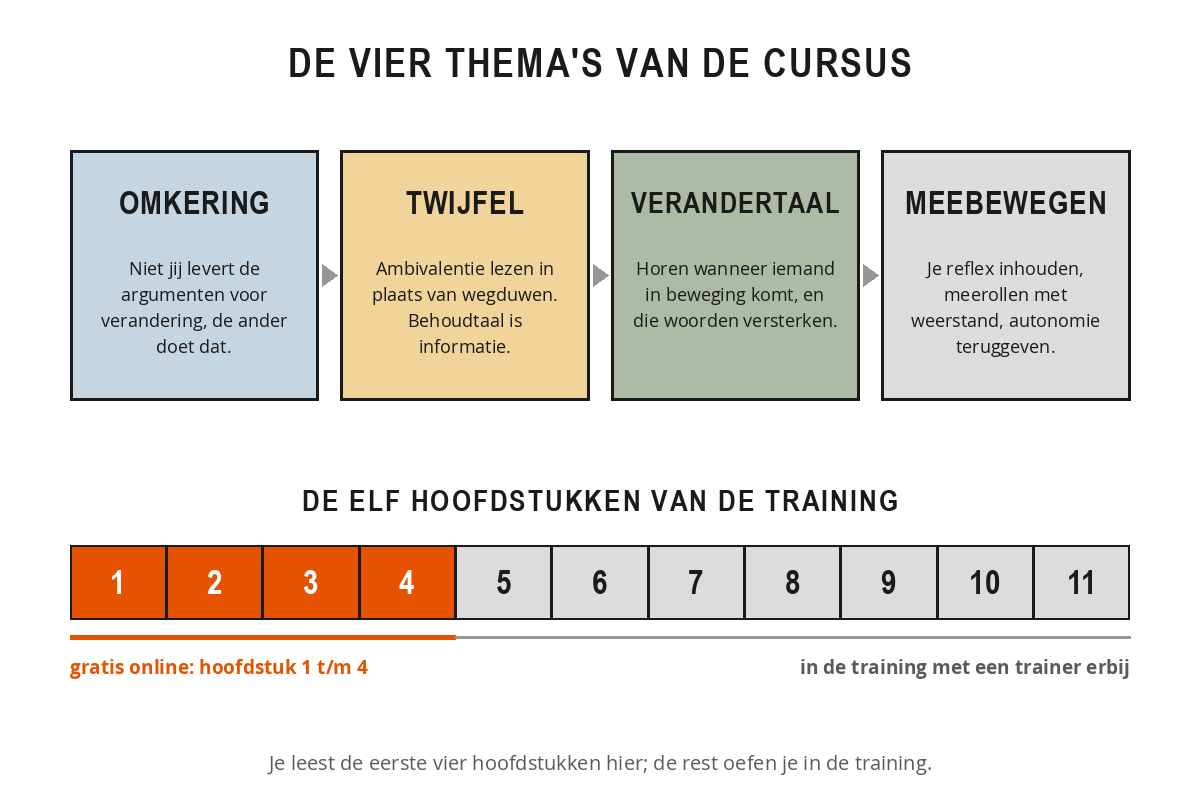
This free course contains the first four chapters: the orange part of the bar above. At the bottom of chapter 4 you will find the full course.
Where the method comes from
The American psychologist William Miller worked in addiction care in the 1980s and saw something nobody expected. The people who were dealt with most firmly, with strong warnings and watertight arguments about the harm their drinking was doing, did no better after treatment. Often they did worse. The people who met a practitioner who listened were the ones who sustained the change.
In 1983 Miller wrote an article about this, and only afterwards did he come into contact with the British psychologist Stephen Rollnick. Together they published the first book on the method in 1991. Hundreds of controlled studies have since been carried out and the field of application has grown far beyond addiction care: general practice, youth care, return-to-work support, education, HR and management. Anywhere someone is torn between staying the same and changing, where advice does not land, and where people dig in as soon as you touch on their behaviour.
What you will learn
You start with the mechanism. In chapter 1 you see why persuading so often produces the opposite of what you want, and why resistance is not inside the other person but arises between the two of you. That is not a comforting thought, but a useful one: what arises between you is something you can influence yourself.
In chapter 2 you learn to read doubt. Ambivalence is the normal state of someone on the verge of change, and sustain talk is the audible side of that. You learn to recognise the five forms and you learn why you should not argue against them, however much you want to.
Chapter 3 deals with the other side of that same scale: change talk. You learn to hear the difference between someone who wants something and someone who is going to do something, using the letters DARN and CAT as an aid, and you are given four questions with which you bring that language out rather than waiting for it.
Chapter 4 is about what you do when things become difficult. You learn to recognise your own repair reflex, you learn the difference between pushback about the subject and friction in the relationship, and you learn to roll with it: not pushing back when the other person pushes, but moving with them until there is room again.
How the course is structured
The course follows four themes that build on one another. You start with the reversal: the arguments for change come from the other person, not from you. Then comes doubt: reading ambivalence instead of pushing it away. Next comes change talk: hearing when someone starts to move and reinforcing those words. And you finish with rolling with it: holding back your reflex, rolling with resistance and handing autonomy back. Each chapter contains a model, examples from practice and an exercise that you apply to your own conversations.
Practical tips for use
- Keep a notepad or a blank document to hand. The exercises only work if you actually fill them in, and they work better with a conversation from last week than with a made-up example.
- For each chapter, choose one thing you will try in a real conversation within a week. Small and concrete works better than everything at once, because otherwise you are mainly occupied with yourself instead of with the other person.
- Do not read it all in one go. Between two chapters lies the time in which you try something and notice what it does.
- Train your ear. In today's conversations, simply count how much sustain talk and how much change talk you hear. Do nothing further with it. After about three days you will hear the difference automatically.
- Be kind to yourself. The reflex to help by solving runs deep, and you will not have lost it after one chapter.
Each chapter ends with a short knowledge check of three questions: answer them correctly to mark the chapter as completed. Your progress is saved automatically in your browser.
Enjoy the reading. And if halfway through you notice that you are keeping quiet in a conversation while you have a perfectly good tip ready: then it is working.