


1. Why persuading backfires
A colleague tells you she drinks too much at the weekend. She knows it herself, she says so herself. You hear yourself saying that it really isn't healthy, that there are good apps for it, that she should talk to someone. She nods politely. The next weekend the same bottle is on the table. You haven't said anything wrong, and still nothing has changed. This chapter is about the reason behind that, and it is surprisingly mechanical.
After this chapter:
- You can explain what motivational interviewing is and where the method comes from.
- You understand why persuading someone who is in two minds often produces exactly the opposite result.
- You recognise the division of roles that arises as soon as you defend the side of change.
- You see resistance as a signal in the conversation, not as a trait of the other person.
- You can name the reversal on which the whole method rests: the other person supplies the arguments.
Two voices in one head
Someone who is in two minds about their behaviour has two voices speaking. One says: I want to change this, it is costing me money, health and self-respect. The other says: I want to keep things as they are, it gives me peace, it is part of my day, and changing is frightening. Both voices are real. They exist side by side in the same head, at the same moment.
So what happens when you start listing the arguments for change? You take over one of those two voices. In effect you are saying: I'll defend the wanting-to-change side, so you can take the other one. And that is exactly what happens. The other person starts explaining why it is so difficult, why now is not a good time, why things are different in his case. There is only one role left, and he takes it.
That is where the sting is. What people say out loud, they believe more themselves. You have just heard the other person utter three sentences about why change won't work, and afterwards those sentences are not lodged in your head but in theirs. The conversation has not raised their motivation, it has lowered it. The harder you push, the more firmly the other person builds up their own counter-arguments.
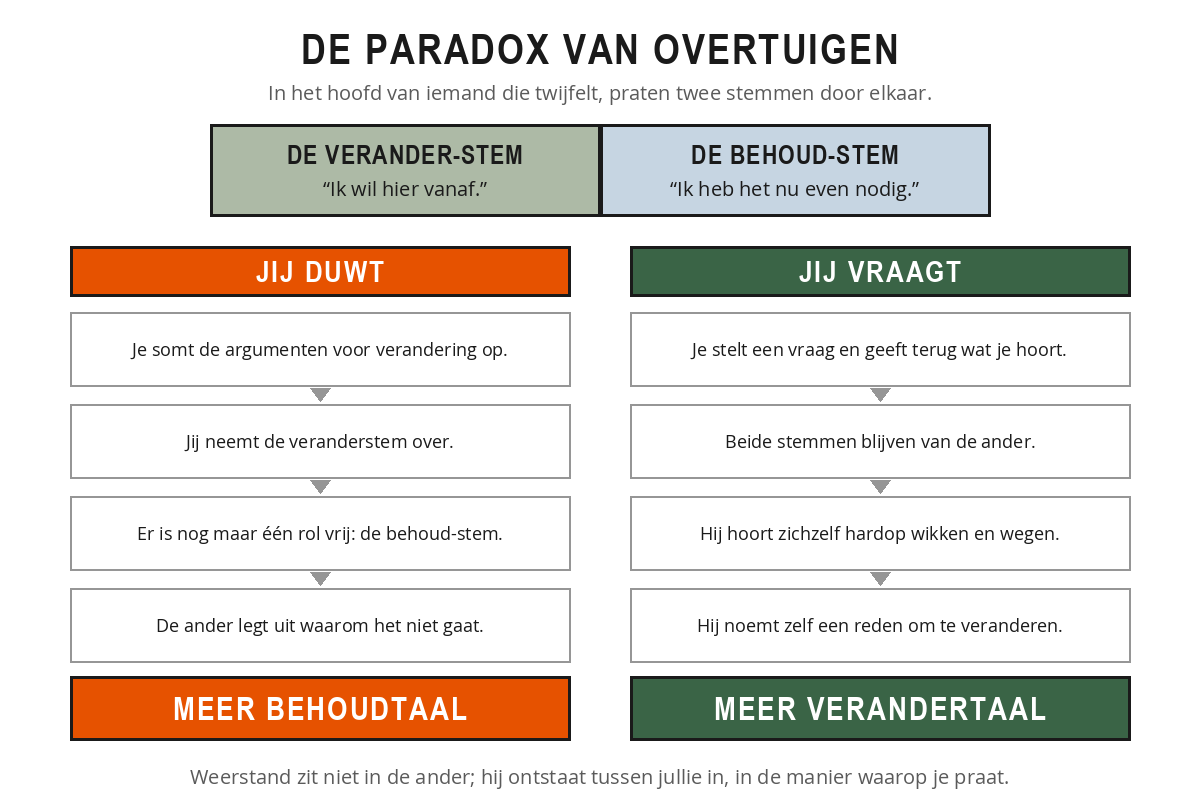
The diagram above sets the two routes side by side. At the top are the two voices: the change voice ("I want rid of this") and the sustain voice ("I need it for now"). The left-hand route starts with you push: you list the arguments for change, in doing so you take over the change voice, only one role is left, and the other person explains why it won't work. Outcome: more sustain talk. The right-hand route starts with you ask: you ask a question and reflect back what you hear, both voices stay with the other person, they hear themselves weighing things up out loud, and they name a reason to change themselves. Outcome: more change talk. The same person, the same subject, a different division of roles.
Practice nurse Ilse sees Mr De Wit, 58 years old, diagnosed with type 2 diabetes three months ago. His fasting glucose is 9.4 and he has put on two kilos in those three months.
Ilse: "If you carry on eating like this, within two years you'll have real problems with your eyes and your feet. You need to do something now."
Mr De Wit: "Yes, I know all that, but I'm already so busy. And my wife just cooks traditional food, I can't eat separately all the time. And you know, my uncle is 82 and he eats anything."
Ilse has taken on the role of defender of change. Mr De Wit fills the other role and hears himself come up with three good reasons to do nothing within twenty seconds. He takes those three reasons out of the door with him. The next appointment starts a little further away from change than this one did.
The same patient, a different question
It is not a matter of being nicer or less clear. It is about who does the talking about the change. Look at what happens when Ilse sees the same man again three weeks later and takes a different tack.
Ilse has already explained the risks in two earlier conversations. This time she puts the result on the table without adding anything to it, and asks: "What would make you want to do something about it yourself?"
Mr De Wit is quiet for a moment. Then he says: "Well, my daughter is having a baby in March. I'd like to be a grandfather, and I'd like that child to have me around for a good while."
Ilse has not supplied an argument, named a risk or given any advice. What is now on the table is his: a reason that does not disappear the moment his glucose levels happen to look better. The rest of the conversation is about what he would like to do about it, and that is a very different conversation from the previous one.
Resistance is not in the other person
When someone is being difficult, we often say he is unmotivated, or in denial, or simply awkward. As if it were down to him. Motivational interviewing turns that around. Resistance is not a character trait but a signal within the conversation itself. It arises between two people, in the way they talk to each other.
That is more than a friendly gesture towards the other person. As long as you think the resistance comes from them, you keep trying to change them, and you have no lever of your own to pull. If you see resistance as something the two of you produce together, you can adjust something on your side and notice straight away what that does. Push harder and the resistance increases. Ask a question and reflect back what you hear, and it often subsides by itself.
You probably know the moment: someone suddenly says of their own accord, "actually, I really should do something about it". That almost never happens after a good argument. It happens after a good question or an apt summary.
Do you notice that you are talking faster than the other person, or that you feel mildly irritated because your good tip isn't being picked up? Those are not signals about him, those are signals about you. You are pushing. Pause for a moment and make your next sentence a reflection of what you have just heard, without adding anything to it.
The reversal everything rests on
The core of the method is a simple and fairly radical idea: people change on the basis of their own arguments, not yours. However good your arguments are, they come from outside. And what comes from outside can be set aside, waved away or forgotten. What someone says out loud themselves, about their own life, in their own words, is much harder to ignore.
If you manage to get the other person to put into words themselves why change would pay off, you move the motivation from the outside to the inside. And motivation from within lasts longer than pressure from outside. If Mr De Wit's glucose levels turn out fine again, Ilse's warning disappears. His grandchild does not.
For you that means an uncomfortable shift. You no longer have to supply the arguments. You don't have to come up with the solution. You don't have to bring the motivation. All you do is help the other person say those things out loud themselves. That is less work and far harder, because it asks you to hold back something that wants to come out of its own accord.
Take a conversation from your own practice in which you tried to convince someone of something they didn't want.
- What did you want the other person to do or realise? Write it down in one sentence.
- Which arguments did you put forward? Write them down word for word, as well as you can remember them.
- What did the other person say next? Write those sentences down verbatim too.
- Did he move closer, or did he put on the brakes even harder? How could you tell?
- What question could you have asked instead of giving your strongest argument?
Keep your answers. You will use this case again in the next three chapters.
Summary
- Motivational interviewing was developed by William Miller in addiction care; his first article appeared in 1983, and the book with Stephen Rollnick in 1991.
- Someone who is in two minds has two voices speaking: the change voice and the status quo voice. Both are real.
- As soon as you take over the change voice, there is only one role left and the other person will fill it.
- What people say out loud, they believe more themselves. So persuading mainly produces stronger counter-arguments, in their head and not in yours.
- Resistance is not a trait of the other person but a signal in the conversation; it arises between the two of you, so you can do something about it yourself.
- The reversal on which the method rests: the other person supplies the arguments for change, you ask the questions.
- Motivation from within lasts longer than pressure from outside, because it doesn't disappear as soon as the numbers happen to look good for once.
Why does listing arguments often produce less motivation in someone who is in two minds?
What does this chapter say about resistance?
Mr De Wit himself mentions his grandchild as a reason to change something. Why is that stronger than the same argument coming from the practice nurse?