


Introduction
Most opportunities come through people. Through someone you know, or through someone they know. Almost everyone is aware of this, and yet most people would rather stand at the coffee table half an hour too long than approach a stranger. Networking has a reputation for being something for people who talk easily and like being the centre of attention. That is not true. Networking is a series of ordinary conversations, and you can learn to hold ordinary conversations.
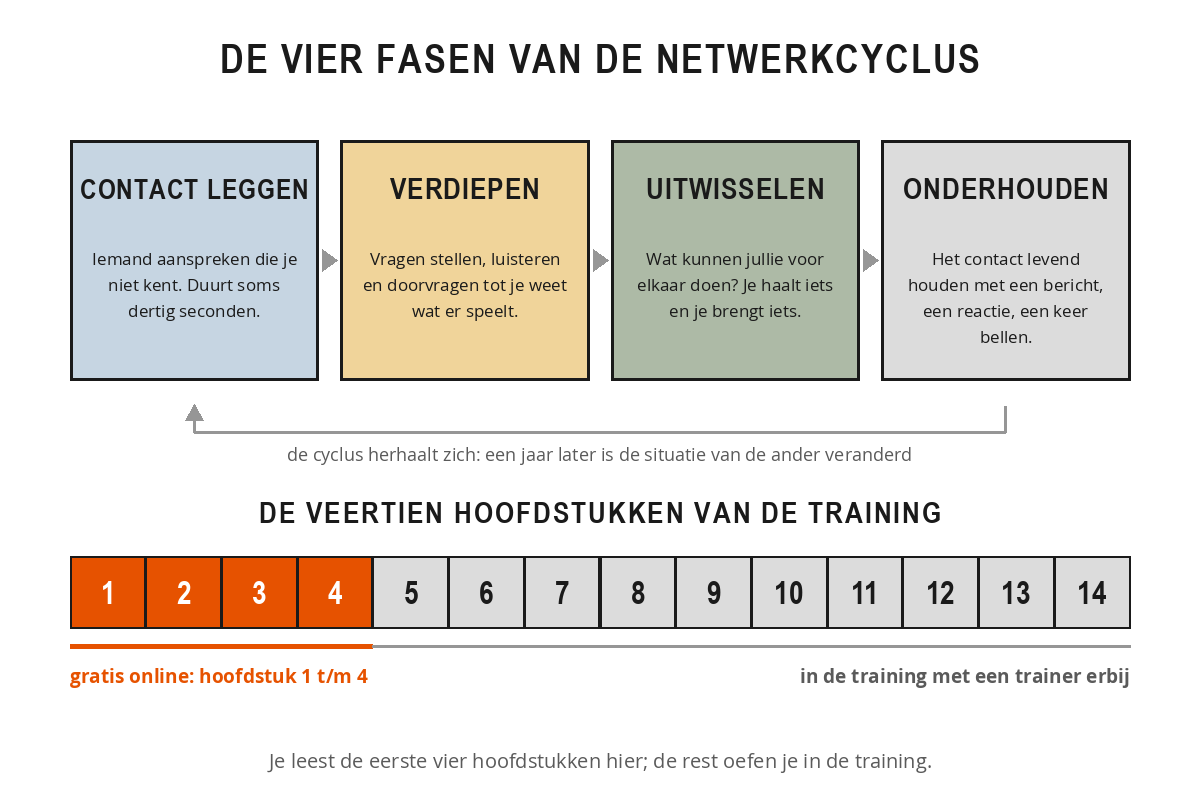
This free course contains the first four chapters: the orange part of the bar above. At the bottom of chapter 4 you will find the full course.
Who this is written for
For the majority, in other words. For anyone who opens an invitation to an industry event and immediately starts working out how to get out of it. For anyone who drives home afterwards with the feeling that they mainly stood talking to their own colleagues. And for anyone who has typed a message three times to someone they haven't spoken to in two years, only to delete it again.
If you find networking uncomfortable, you are not the exception. In fact, that discomfort is often an advantage. Those for whom it does not come naturally prepare themselves, listen better and ask more questions. The people who talk most fluently are rarely the ones who get the most out of an evening.
What you will learn
You learn how to approach someone you do not know, and how to join a group that is already talking. You are given two models for moving a conversation from the weather to something that matters: the conversation funnel and the FORD model. You learn to ask follow-up questions in a way that does not feel like an interrogation and does not sound like a sales pitch. And you learn what to do in the 48 hours afterwards, because that is where most of it falls away: a conversation that went well and that nobody followed up on is not a contact.
What these four chapters do not contain is a trick for coming across as likeable more quickly. The common thread is precisely the opposite: your attention on the other person, and your own story only when you are asked for it.
How the course is structured
The course follows the networking cycle shown in the diagram above. You start with making contact: the first thirty seconds, in which all that has to happen is that an opening arises. Then comes deepening: asking questions and listening until you know what the other person is working on. After that exchanging: what can you mean for each other, and what do you bring. And finally maintaining: keeping the contact alive, even if a year goes by. That cycle doesn't stop; after a while it simply starts again, because the other person's situation has changed.
The four free chapters follow that line: chapter 1 is about making contact, chapters 2 and 3 about going deeper, chapter 4 about maintaining contact. Each chapter contains theory, a diagram, conversation examples and an exercise that you apply to an event from your own diary.
Practical tips for use
- Choose one occasion now that you will attend over the next two months. All the exercises become more concrete once you know where you are going to use them.
- For every exercise, fill in names, not categories. "Someone from the industry" gets you nowhere, "Marleen from the purchasing department" does.
- Practise between the chapters. An opening line takes two minutes to read, but it only sits comfortably in your mouth after the fifth time.
- Start in places where nothing is at stake: the checkout, your neighbour, the reception desk. That really does count.
- Read chapter 4 as well, even if you are not ready for chapter 1 yet. Following up takes the least courage and produces results the fastest.
Each chapter ends with a short knowledge check of three questions: answer them correctly to mark the chapter as completed. Your progress is saved automatically in your browser.
Enjoy the read, and above all: good luck with that first conversation.