


1. Making contact with someone you don't know
You are standing in the room, you have fetched your coffee twice already and you haven't spoken to anyone yet. You see someone standing alone, you roughly know what you would like to say, and still you don't take those three steps. This chapter is about those three steps: why they feel hard, who is best to take them towards, and what you say then.
After this chapter:
- You know what approach anxiety does to you and which three thoughts lie beneath it.
- Whether you can lower a threshold with a ladder of exercises rather than with willpower.
- You can tell from posture and stance who is approachable at that moment.
- You know four types of opening lines and you know which three you have ready.
- Whether you can join a small group already in conversation without interrupting it.
What approach anxiety does to you
Approach anxiety is the hesitation just before you speak to someone. It is not a character trait and it says nothing about your self-confidence. It is a short, predictable reaction to a situation in which you are taking a social risk, and it subsides of its own accord as soon as you are in conversation.
The hesitation is in your body before you have words for it. Your heart rate goes up, your breathing becomes shallow and your voice sounds too high to your own ears. At the same time your attention turns inwards: you are busy with how you come across, not with who is standing in front of you. That explains why, just before approaching someone, you suddenly no longer know what you wanted to ask.
There is procrastination involved too. Another coffee, a quick look at your phone, one more round of the stands. Each round feels like preparation, but it is delay. And it works against you, because in the meantime the groups have formed and the conversations are under way.
The three thoughts underneath
Beneath the hesitation there are almost always the same three thoughts. They sound reasonable, and that is why they hold you back.
- "I'm intruding." You assume the other person would rather be left alone. At a networking event, everyone is there precisely to be approached. Anyone who really does not want to be disturbed is on the phone.
- "I have nothing to report." You are comparing your own story with that of people you have not yet spoken to. You always lose that comparison, because you do not know their doubts. What is more, a good networking conversation starts with a question, not with a story.
- "I'll run out of things to say." This is the only thought that holds up, and at the same time the easiest one to solve. Anyone who has three topics ready beforehand will not run out of things to say.
The practice ladder
You do not lower a barrier by taking it in one go. You practise at moments so small that they hardly create any tension, and you work your way up from there. Every rung you have managed successfully a few times becomes your new ground level.
The bottom rung is greeting someone and saying a sentence to a person you are already standing with anyway: the checkout, the neighbour, the reception of an office you are visiting. Above that is the colleague from another department in the lift. Above that, a stranger at an event you are attending anyway. And right at the top, the speaker who has just come off the stage. Rungs one and two you do this week, several times a day. Rungs three and four you schedule in the weeks after, at moments that are already in your diary.
The hesitation lasts shorter than you think. Between the decision and the first sentence there are three to five seconds. Anyone who starts weighing things up in those seconds never wins the weigh-up. So you walk over at the moment you make the decision, not afterwards.
To whoever you can see is open to it
Who you approach determines how difficult approaching someone feels. In every room there are people who are open to contact at that moment, and people who clearly are not. You can read that difference from their posture and from the way they are standing.
Start with the people standing alone doing nothing: no phone, no plate of food, eyes scanning the room. That person is in exactly the same position as you and will be grateful for the first sentence. Next come the pairs standing and watching in silence. A group of three or more, laughing loudly and turned inwards, is the hardest category; save those for later in the evening.
The functional spots help too. At the coffee table, at the high table by the entrance and in the queue for the cloakroom, striking up a conversation is a matter of course, because you are both doing the same thing there and there is an immediate reason to speak.
Four opening lines
An opening line is not a business card, nor is it a clever way in. It is an invitation to reply. That gives you the only yardstick that counts: a good opening is a sentence the other person can effortlessly respond to, even if they were looking forward to this evening just as little as you were.
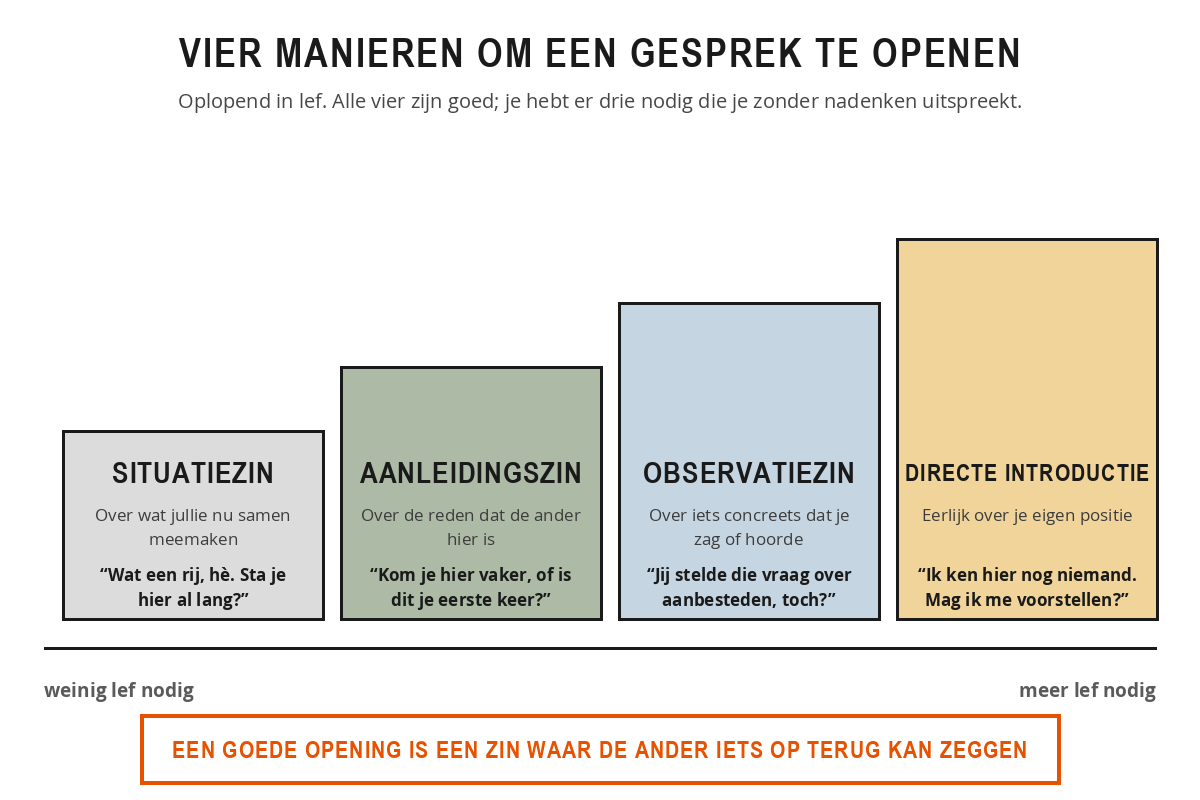
The situation line is about what the two of you are experiencing right now: the queue, the room, the coffee, the speaker who overran. "Quite a queue, isn't it. Have you been standing here long?" That line almost always works, because the answer is there for the taking. It takes the least nerve and is therefore your standard starting point.
The reason-for-contact line goes a step further and asks about the other person's reason for being here. "Do you come here often, or is this your first time?" You will almost always get an answer you can follow up on straight away, because it contains a job role, an industry or a reason.
The observation line is the strongest of the four, provided it is accurate. You name something concrete that you have seen: a question the other person asked in the room, a name on the badge, the logo on the folder. "You were the one who asked that question about tendering, weren't you?" This sentence shows that you were paying attention before you wanted something.
The direct introduction is honest about your own position. "I don't know anyone here yet. May I introduce myself?" That is not a sign of weakness but the most recognisable sentence of the evening, and it takes the most nerve because you are revealing something of yourself.
Four things make an opening unnecessarily hard for the other person. A closed question produces a yes or a no, followed by silence. An opening that starts with yourself forces the other person into listening mode before they know who you are. Forced humour puts the pressure on them to laugh. And the complaining opening ("What a dull affair this is") forces them to choose between grumbling along and contradicting you.
Sanne goes to a meeting of her industry association and agrees with herself that she will approach three people. At the cloakroom she uses her situation line: "There's only one rail, I think." That produces two minutes of conversation and nothing more, and that is fine: it was her first. Over coffee she uses her occasion line on a woman standing alone, who turns out to come from a small organisation just like Sanne. They talk for twenty minutes. After the break she spots the man who asked a question about hourly rates during the session, and there she uses her observation line. Three conversations, three different lines, not one of them original.
Joining a group
Joining a conversation is not the same as approaching someone. There is already a topic, someone is already speaking and attention is already divided. Your task is not to barge in, but to be given room.
That starts with the shape. Groups rarely stand in a closed circle; usually they stand in a horseshoe, with an opening on the side where nobody wants to have their back to the room. That opening is your way in. If a circle is completely closed, with everyone's shoulders turned towards each other, you walk on.
This is how you join a group that is open to it. First look for a circle where the shoulders are not turned fully towards one another and where someone occasionally lets their gaze wander across the room. You position yourself in line with that circle, not in it, at about half a metre. You listen for twenty to thirty seconds without saying anything, and you nod or smile along so that your face shows you are listening. Then you seek eye contact with whoever is speaking, because that person decides whether the circle opens up; if they look back, you will almost always be given room. As soon as someone takes half a step aside, you step in. You join in on the substance of what has just been said, so you add something to their topic rather than laying your own topic over it. And you give your name at the first natural pause, after your first contribution, not before it.
Ruben is at an industry event, ten metres from a group of four. He walks over calmly, stands slightly to one side of the circle and listens. One of the four is talking about a trial that came unstuck at the IT department. Ruben laughs along at the moment the rest laugh and gets a glance back from the speaker. The man next to him takes a small step aside. Ruben steps in and says: "I recognise that trial painfully well. Did it get stuck on the interface for you as well?" Only two minutes later does he mention his name.
If there is no eye contact and the circle does not open up, you move on calmly after half a minute. That is not a rejection, that is a group in the middle of something.
Whether you put three sentences down on paper and test them outside of any networking occasion.
- Your situational sentence: which sentence, and in which situation it can be used.
- Your reason line: which sentence.
- Your observation line: what structure, and what do you fill in on the spot.
- Five moments to test this in the next two weeks: which situation, which sentence.
- Each time, note down what the other person said in reply and how long the conversation lasted.
After five entries you will see which type of sentence works best for you. A sentence that felt awkward twice is one you rewrite before taking it to an event.
Summary
- Approach anxiety is a short physical reaction, not a character trait. It subsides as soon as you are in conversation.
- Underneath it sit three thoughts: I'm intruding, I have nothing to report, I won't know what to say. Only the third is true, and you solve that with preparation.
- You lower the barrier with a ladder of practice: first situations without tension, and only then the event itself.
- First approach the people standing on their own doing nothing, then the silent pairs, and the busy groups last.
- Four openings, in increasing order of nerve: the situation line, the reason line, the observation line and the direct introduction. Having three at the ready is enough.
- A good opening is a sentence the other person can effortlessly respond to. Avoid closed questions, your own story, forced humour and complaining.
- With a small group you take up position at the open end, listen for half a minute, make eye contact, step in and join in on the content. Your name comes afterwards.
You arrive at an event where you don't know anyone. According to this chapter, who do you speak to first?
According to this chapter, what makes an opening line a good one?
You have joined a small group and a natural moment to say something arises. What do you do?