


1. 2. From small talk to the heart of the matter
You have approached someone and it is going well. You have talked about the venue, about the journey and about the speaker who overran. And then comes the moment when you think: now what? Networking conversations rarely start at the heart of the matter. This chapter is about the route towards it, and about what you do when that route stalls halfway.
After this chapter:
- Do you know what function small talk serves in the first few minutes of a conversation.
- Do you know the four layers of the conversation funnel and can you work your way down through them layer by layer.
- You use the four FORD topics to find things to talk about without it turning into an interrogation.
- You choose your topics based on the other person's energy rather than on a fixed order.
- You have four ways to get a stalled conversation moving again.
Small talk is the runway
Small talk is light, non-committal chat about subjects that hurt no one and that no one has to have an opinion about: the weather, the journey, the venue, the coffee. The content hardly matters, and that is precisely the point. The conversation is not about the subject, it is about whether the two of you can talk together.
In that first minute two people do three things at once. They test each other's pace and tone. They see whether there is mutual interest. And they build up a minimum of trust, so that a substantive question later does not feel like an ambush. Anyone who skips that warm-up round and immediately asks what the other person is working on in their new role gets a short and polite answer. Not because the question is bad, but because it comes too early.
At the same time, small talk is not a destination. A conversation that is still about traffic jams after ten minutes is no longer going anywhere. The art lies in the transition, and that goes wrong in three ways. You linger too long in the safe zone because the step towards substance feels daunting. Or you start talking about your own work too soon, which puts the other person into listening mode. Or you choose topics that mean nothing to them, and after two sentences you feel the silence fall. All three are solved in the same way: a picture of how a conversation deepens, and a stock of topics to draw on.
The conversation funnel
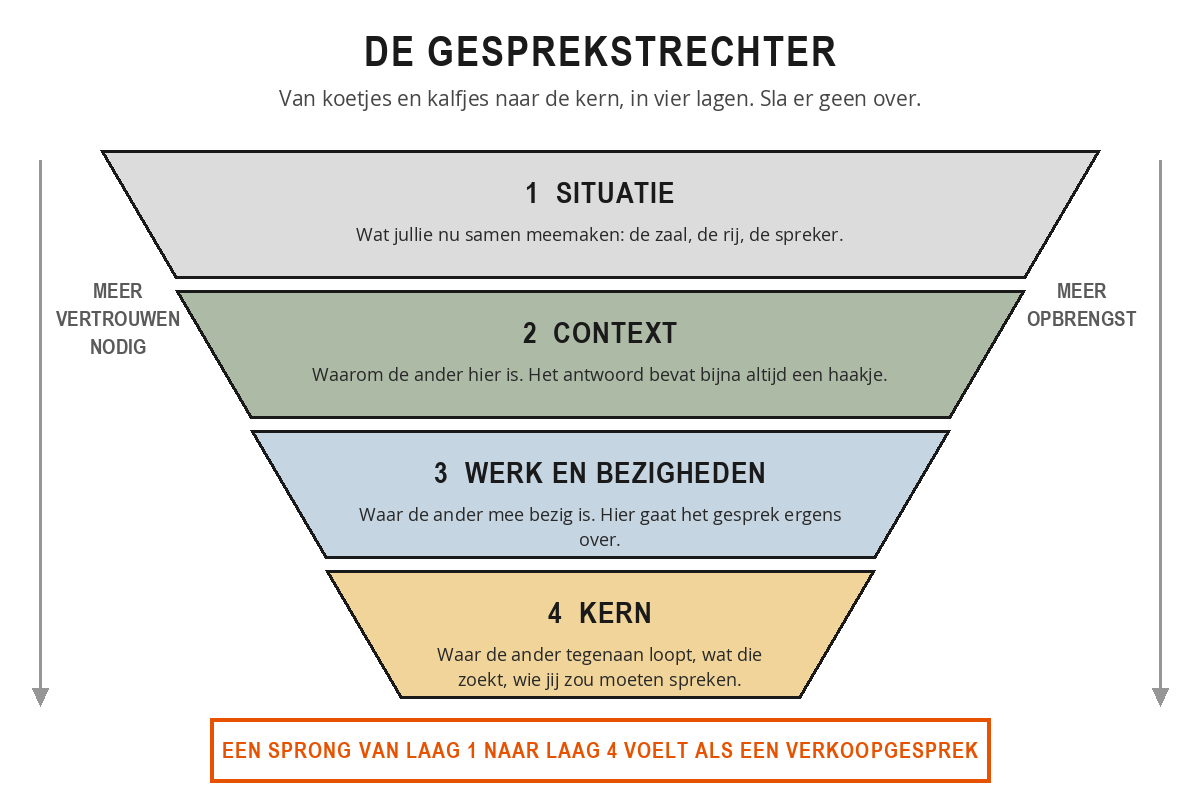
The conversation funnel is the image you use to steer a networking conversation. You start with subjects that are broad and safe and move step by step towards subjects that are more specific and more personal. Each layer down asks for a little more trust and yields a little more.
Layer 1 is the situation. You start with what you are both experiencing: the room, the queue, the speaker. This is where your situational sentence from chapter 1 lands. You are not expecting information here, you are expecting a response.
Layer 2 is the context. You ask the reason why the other person is here. The answer almost always contains a hook: a job, an industry, a reason for coming.
Layer 3 is work and occupation. You pick up on that opening and ask further questions about what the other party does and what they are working on. This is where the conversation starts to be about something.
Layer 4 is the core. Now questions that lie closer to your own goal are appropriate: what is the other person running up against, what are they looking for, who should you actually be speaking to.
You don't have to work all the way down the funnel in a single conversation. With one person you reach layer four within five minutes; with another you stay stuck at layer two and arrange to meet again later. What you do always do is take the layers in order. Jumping from layer one to layer four feels to the other party like a sales pitch.
Yvonne is standing at the high table next to a man she does not know.
Yvonne: "That room was warmer than the session itself, don't you think?" (layer 1)
He laughs: "True, I spent half the time staring out of the window."
Yvonne: "Do you come here often, or is this your first time with this club?" (layer 2)
Him: "Second time. I have been with a software company in Utrecht since the start of this year, and I am trying to get to know some people from the healthcare sector."
Yvonne: "Healthcare is a world of its own. What do you run into when you want to get in there?" (layer 3 to 4)
After four sentences the conversation is actually about something. Yvonne hasn't said anything clever; she has simply worked down layer by layer.
When the conversation stalls, you move up one layer instead of pushing harder. Returning to a lighter topic gives both of you some breathing space, after which you can go deeper again.
Four topics to exhaust
The funnel tells you how deep you are, but not what you are talking about. That is a separate question, and many people know the feeling of running out of material after "so what do you do?". There is a simple memory aid for this: FORD, after the four words family, occupation, recreation and dreams. Four areas that almost everyone has something to say about.
F for family and home life. In a business setting you keep this light: where someone lives, whether they came from far away, how the journey was. You do not ask about relationships or children unless the other person raises the subject themselves. This area is mainly useful in layers 1 and 2 of the funnel.
O for occupation, in other words work. This is the richest area at a networking event. You ask follow-up questions about the route to the job: how someone ended up in it, what is changing in the field, what the other person is spending most of their time on this month.
R for recreation and leisure. What someone does when work is quiet, where they get their energy from, which sport, which project, which club. This area makes a conversation personal without it becoming awkward, and it often yields the detail you still remember six months later.
D for dreams, in other words plans and ambitions. Where someone wants to go, what they would want to be different a year from now, which idea has been sitting in a drawer for three years. This is the deepest area. You rarely get there straight away, but almost always via work or leisure.
It is not a route you walk through from left to right, it is a store cupboard. You watch where the other person puts their energy: where the pace picks up, where the sentences get longer, where someone straightens up. That is the area you open up further. Where the answer stays short and polite, you move on to another one. And note the link with the funnel: family and work open up easily and belong to the upper layers, recreation and plans belong to the lower ones, where the conversation becomes more personal.
Pieter is at an industry event, standing opposite someone who gives short answers to everything to do with work. He asks two questions about the job and twice gets a five-word answer. Instead of pushing on, he switches: "I saw you came by bike. Do you do that often?" What follows is a two-minute story about a cycling holiday in the Vosges. From that story they move on to planning, to pressure at work, and eventually to the reorganisation the other person is in the middle of. Pieter has not become any cleverer. He has simply tried a different shelf of the cupboard.
Keep one FORD detail from every conversation. Not the job title, because that is on LinkedIn, but the cycling holiday, the home renovation or the son who is off to university. That detail is your opening when you get back in touch three months later.
When the conversation falls silent
Every conversation falls silent at some point. That is not a failure and usually not a problem either: a silence of two to three seconds feels like an eternity to you and like a breather to the other person. Anyone who immediately plasters over that pause with a random question only makes the conversation more hurried. So let it stand for a moment first.
If things stall after that, you have four ways to get going again. All four are equally usable; which one you choose depends on what has just happened.
- Picking it back up. You return to something the other party said earlier that you never finished discussing. "You said just now that you've been working from two locations since January. How is that going?" This is the strongest option, because it shows you have been listening.
- Change the subject. The current topic is exhausted, so you move on to another FORD area: from work to leisure, from leisure to plans. You are free to announce it: "On a completely different note."
- Naming the surroundings. Back to layer 1 of the funnel: the programme, the room, the speaker who overran. Not a step backwards but a breather, after which you can descend again.
- Rounding off properly. Sometimes a conversation has simply run its course. Wrapping up is a perfectly good solution, not a defeat. "Good to have spoken to you, I'm going to have a wander round" leaves both sides with a good feeling.
There are signals you should take seriously: the other person repeatedly looks past you, turns a shoulder away, gives three one-word answers in a row, or pointedly holds up an empty glass. Carrying on gains you nothing at that point. Whoever wraps things up before the other person escapes leaves the better impression.
Choose an event you will be attending within the next two months, and work out the funnel for it.
- Layer 1: two situation sentences that fit that venue or that programme.
- Layer 2: one question that asks the other person about their reason.
- Layer 3: two questions about the work of the people walking around there.
- Layer 4: one question that ties in with what you want to get out of that evening.
Then read your four layers aloud. Does layer 4 sound like a logical follow-on from layer 3, or does it jump out? If so, rewrite it until the jump disappears.
Summary
- Small talk is not a waste of time but the runway: you test each other's pace and build just enough trust.
- The conversation funnel has four layers: situation, context, work and activities, and core. You take them in order.
- A jump from layer 1 to layer 4 feels like a sales pitch to the other person.
- FORD gives you four areas to draw on: family, occupation, recreation and plans.
- You choose your area based on the other person's energy, not on a fixed order. Family and work belong at the top of the funnel, recreation and plans at the bottom.
- If the conversation falls silent, first let the silence stand for three seconds.
- After that you have four options: picking it back up, changing the subject, commenting on the surroundings, or wrapping up politely.
You've been talking to someone for two minutes about the delays on the A2. According to the conversation funnel, what is your next step?
What does FORD stand for, and how do you use it?
The conversation falls silent and the silence has now lasted a few beats too long. Which response does this chapter call the strongest?