


3. Listening, summarising and asking follow-up questions
People who find networking uncomfortable are usually afraid they have nothing to say. That is the good news of this chapter: you do not have to say anything. Listening sounds passive, but in a networking conversation it is your most important steering instrument. If you listen well, summarise and ask follow-up questions, you do not have to carry the conversation. The other person supplies the topics; you decide which ones to pick up.
After this chapter:
- You recognise which of the three levels you are listening at and can switch deliberately.
- Do you use summarising to check whether you have understood correctly and to steer the conversation.
- You ask open questions that get the other person talking.
- You know four ways to ask follow-up questions and you know when it turns into an interrogation.
- You know when it is better to stop asking follow-up questions on a topic.
The loop you keep going round
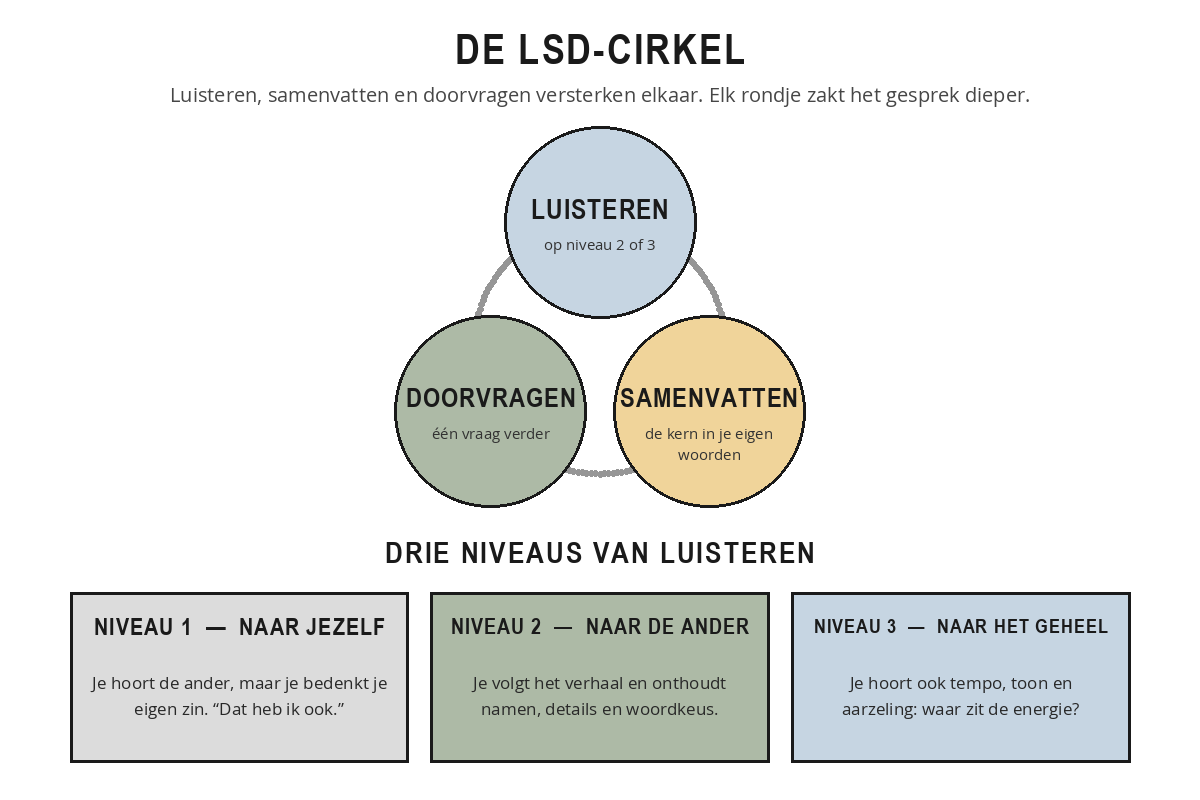
Together, the three steps are known as LSD: listen, summarise, ask follow-up questions. You listen, you summarise in your own words what you have heard, and on the basis of that summary you ask a question that takes the conversation deeper. Then you listen again. You keep going round in circles, and with each round you move further down the conversation funnel from chapter 2.
Not every layer of that funnel calls for the same amount of LSD. In layers 1 and 2 a summary is overkill: nobody needs to hear that you understood the train was delayed. A response and a second question are enough there. From layer 3 onwards it starts to pay off, because that is where the other person tells you something with several sides to it. In layer 4 it is indispensable: that is where you hear what the other person is struggling with.
Three levels of listening
Listening is not an on-or-off switch. The level you are operating at determines how much you get out of a conversation, and the difference lies not in what the other person says but in where your attention goes.
Level 1 is listening to yourself. You do hear the other person, but your attention is on your own thoughts. You are working out your next sentence, or scanning their story for a hook for your own anecdote. You nod at the right moments, so from the outside it doesn't show. Level 1 isn't wrong; it is the setting almost everyone starts in. The problem is that you stay there. Afterwards you still remember that the conversation was pleasant, but you can't recount what the other person is working on, and then you have nothing to get back in touch about later. The clearest signal is hearing yourself say: "I have that too" or "funny, at our place that's...". That is the reflex to pull the conversation towards yourself.
Level 2 is listening to the other person. Here you shift your attention entirely to the other person's story. You follow the content, remember names and details, and notice which words they choose. That calls for something uncomfortable: allowing silences. Saying nothing for two seconds feels long, but it is often in those two seconds that the sentence that really matters comes out. You recognise level 2 by what you can recount afterwards. Can you say what this person is working on, what problem they are facing and where they want to go? Then you were listening properly.
Level 3 is listening to the whole. Now you also listen to everything around the words: pace, tone, hesitation, what is dismissed strikingly quickly and what someone lingers on. That yields information that is not in the sentences. Someone who says the reorganisation "went fine" and immediately talks past it gives you a hook. Someone who speeds up at the word "project" shows you where the energy is. At this level you also keep an eye on yourself: if you notice that you are becoming impatient or drifting off, that is information about the conversation, not only about you.
Three responses to the same sentence: "I've been team leader since January, so I'm still finding my feet."
Level 1: "That sounds familiar, I moved up from a hands-on role myself. Where I worked, it went like this..."
Level 2: "Only since January. What does that searching mainly involve?"
Level 3: "You say 'let me have a look', but I hear you hesitating. Is it disappointing?"
All three are polite. Only the second and the third give you something to work with.
You move from level 1 to level 2 with a single agreement with yourself: you ask one more question about the answer you have just been given before you say anything about yourself. That one extra question changes the whole tone of the conversation.
Summarising is steering
When summarising, you briefly give back in your own words what the other person has just told you, and then you keep quiet for a moment. Not a literal repetition, but the essence in one or two sentences.
That does three things at once. It proves you have listened at level 2 or 3. It gives you a correction if you had misunderstood something. And it gives you control over where the conversation goes, because a summary is never neutral: you choose which part of the story you reflect back, and that is where the conversation continues. That makes summarising the quietest steering instrument you have. You do not interrupt, you do not ask an awkward question, and yet you move the conversation.
The other person: "I have just moved from marketing to business development, after the reorganisation. Quite an adjustment, because I now have to look outwards far more. I am also doing a programme for it, in the evenings."
Summary A: "So you've recently become much more outward-facing and you're finding your way in that." The conversation moves on to making contacts, exactly what you are working on too.
Summary B: "So you are studying in the evenings on top of a new role." The conversation moves on to his schedule and the programme.
Both summaries are accurate. They simply lead to a completely different follow-up.
Probing without interrogating
Asking follow-up questions means asking a second and a third question about the same subject, instead of jumping to a new topic after the first answer. In practice this rarely happens: most conversations move in leaps and therefore stay on the surface.
The difference between probing and interrogating lies in what you do between the questions. Anyone who piles question upon question is interrogating. Anyone who responds briefly after an answer, summarises or reveals something of themselves and only then asks a further question is holding a conversation. The rule of thumb: after every two questions, put something back.
Open questions provide the material. An open question cannot be answered with yes or no; it starts with what, how, which, where, when or who, and forces the other person to supply content themselves. A closed question can be dealt with in a single word: yes, no, three years, in Utrecht. Closed questions are useful when you want to check or narrow something down, but anyone who builds a conversation out of closed questions becomes the interrogator and keeps all the work to themselves. Why-questions are a category of their own: they are open, but quickly sound like an accusation. "Why did you tackle it that way?" becomes a good deal friendlier as "How did you arrive at that approach?"
Probing does not have to mean a new question every time. There are four moves you can alternate between:
- Going deeper. You ask about the level beneath the answer. "You say the project stalled. What exactly caused that?"
- Making it concrete. You ask for an example or a figure. Abstract answers only become usable once there is a situation behind them. "Can you give an example of such a week?"
- Asking follow-up questions about feelings. You ask what something did to the other person. "What was that like for you, that takeover?" This only works if there is already some warmth in the conversation.
- Probing about the future. You shift the question to what is going to happen next. "What is the next step you are going to take?" This is often the question that reveals what the other person is looking for.
A superficial conversation: "What do you do?" — "I'm a buyer at a care institution." — "Nice. And do you come here often?" — "No, first time." — "Lovely venue, isn't it."
The same opening, but with follow-up questions: "What do you do?" — "I'm a buyer at a healthcare institution." — "What sort of things do you buy?" — "Mainly medical devices. And since recently the IT contracts as well." — "That's quite a jump. How did that come about?" — "Someone left and it was left lying around. I'm getting to grips with it now." — "What are you running into?" — "I don't know the market. I'd actually like to talk to a few people who do."
Four questions later, a concrete need is on the table. You can do something with that, now or in a month's time.
During a conversation, count how many questions you ask in a row without putting anything in between. At three or more you are in interrogation mode. A summary or an experience of your own in between immediately relaxes the conversation.
When to stop
There comes a point where digging further yields nothing more. The answers get shorter, the other person looks away or gives a general answer without any new information. Those signals rarely mean the conversation is over; usually this topic is over. You then summarise what you have heard, offer something of your own in return and move on. You do not need to go back to the top layer of the funnel for that: another FORD area at the same depth works perfectly well.
What you take away from this only becomes clear afterwards. You leave knowing what the other person is working on, and that is exactly the information that lets you send a message the next day that gets answered. "How did that conversation with the supplier go?" gets a reply. "Nice talking to you" disappears.
Hold three conversations of at least five minutes this week: a colleague, a customer and someone you barely know. Agree with yourself that in the first part you will say nothing about yourself, and deliberately run through the cycle of listening, summarising and asking follow-up questions twice per conversation. Note down immediately afterwards:
- Conversation partner and occasion.
- Your first summary, written down word for word.
- What the other person then added or corrected.
- The follow-up question that yielded the most.
- What the other person is working on, in one sentence.
- The level at which you spent most of the conversation.
Then compare the three: with whom did you drop back to level 1 fastest, and what caused that?
Summary
- LSD stands for listening, summarising and asking follow-up questions. You go round that loop several times in a conversation and so work your way down the funnel.
- Level 1 is listening to yourself: you are working out your own sentence, recognisable by "I have that too".
- Level 2 is listening to the other person: afterwards you can recount what they are working on.
- Level 3 is listening to the whole: pace, tone and hesitation tell you where the energy lies.
- Summarising proves that you have listened, prompts a correction and steers the conversation, because you choose which part you give back.
- Open questions produce a story, closed questions a single word. Replace why with how or what.
- You ask follow-up questions in four movements: going deeper, making things concrete, asking about feelings and asking about the future. After every two questions you give something back.
- If the answers get shorter, it is usually the subject that is finished and not the conversation. Summarise and move on.
Someone tells you that he has recently taken on a management role and that it is "taking some getting used to". You say: "That sounds familiar, I made that step too. Where I worked, it went like this..." At which level are you listening?
Why does this chapter call summarising a steering tool?
According to this chapter, when does probing turn into an interrogation?