


4. Keeping in touch afterwards
Two days after a good conversation, the other person still remembers that it was enjoyable, but no longer what it was about. This is the chapter where most networking falls apart, and at the same time the chapter that takes the least courage. There is no one standing in front of you, there is no room full of people and there is no opening line. There is only a message that you either write or you don't.
After this chapter:
- You know which three actions you carry out within 48 hours of a meeting.
- Whether you can write a follow-up message that refers back to something concrete from the conversation.
- You know why that first message should not yet contain a request.
- You decide per network ring how often you get in touch.
- Can you reopen a contact that has lain dormant for years with a message in four parts.
The first 48 hours
Your memory works against you. On the way back you still know exactly who you spoke to; two days later a name has gone and you no longer know which face that story about the reorganisation belonged to. So you follow up while it is still fresh. Three actions fill those two days.
Recording it while it's still fresh. While still in the room, or in the car, note down for each person their name and three keywords: what the other person is working on, what you promised and what you want to know. You're not going to write full sentences anyway, so don't try. The first keyword is the most important, because that is the column most people leave blank and the one you'll later draw all your reasons for contact from.
Make contact within 24 hours. You send your message or your invitation with context included. You refer to the moment itself ("we were standing by the coffee talking about that tender") and to one substantive point from the conversation. That single point is the difference between a message that sticks and a message that gets clicked away.
Keeping your promise. If you have promised an article, a name or an introduction, you send it within two days. Reliability in small things is the cheapest way to set yourself apart, because most people do not do it.
At an industry event, Ruben speaks to a purchasing manager who is struggling with her department's tendering process. He promises to forward her a webinar.
His message the next morning: "Hi Marleen, good to have spent so long talking about your tender over coffee yesterday. You were wondering how other departments organise that pre-selection. Here is the webinar I mentioned; from minute 18 onwards it deals with exactly that. If you would like to talk it through further, do let me know."
Four sentences, with one reminder of the moment, one promise kept and an open door.
What you deliberately do not do in those 48 hours is make a request. You have spoken to the other person once; asking for an introduction at that point feels like being handed the bill with the starter. Your follow-up has one job: to confirm that the conversation took place and that you do what you say.
Put a twenty-minute block in your diary for the morning after an event. That does more than good intentions. Your follow-up doesn't take hours, but it does take a moment when you don't have to weigh up whether you have time for it.
Four rings, four rhythms
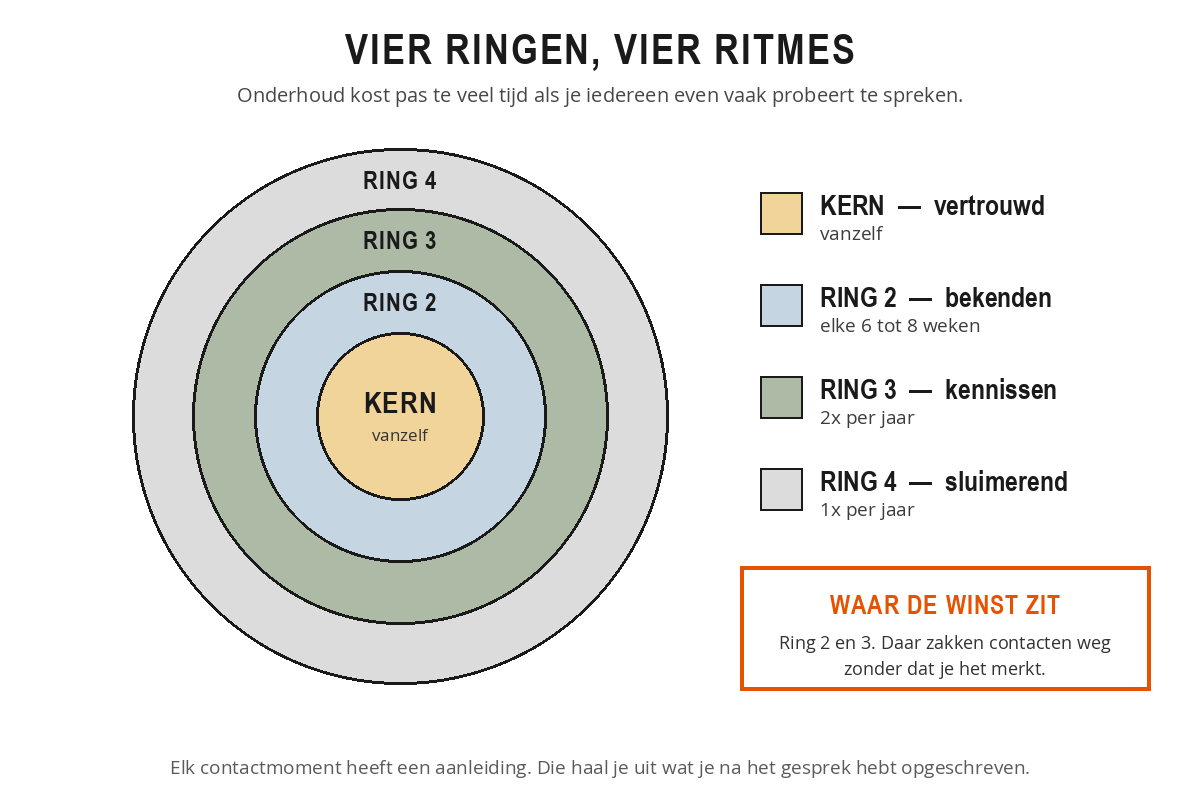
Maintaining contacts feels like a task without end, and that is because most people make no distinction. As soon as you divide your contacts across four rings, the number of moments you need per month suddenly becomes small.
The essentials maintains itself. Those are the people you run into anyway: colleagues, regular customers, friends. There is no need to set up a system for that.
Ring 2, your acquaintances, you speak to every six to eight weeks. One message, one phone call or one coffee. With thirty to sixty people, that works out at roughly one point of contact per working day.
Ring 3, your acquaintances, twice a year. Here a response to something the other person shares is enough, or an email when you come across something that suits them. The aim is that your name sticks.
Ring 4, the dormant contacts, once a year. You choose five to ten names and reopen contact. This ring is large, and the return lies in the reason for getting in touch, not in the numbers.
The gains are in rings 2 and 3. That is where contacts slip away without you noticing: you have not neglected them, you simply have not spoken to them for eighteen months, and then suddenly there is a barrier.
A reason above an agenda
Getting in touch without a reason feels empty on both sides. "How are things?" after nine months of silence produces "fine thanks, and you?", and that's where it ends. A reason makes the message concrete: an article on the subject the other person was working on, a name you heard, a vacancy, a conference.
You will find those reasons in what you wrote down after the conversation. Anyone who leaves that column empty has to invent reasons. Anyone who fills it in sees them come along by themselves.
Go through your timeline once a month with your list beside you. You are not looking for interesting posts, but for posts from people in rings 2 and 3. Three responses a month keep you visible to people you have not spoken to in six months.
Waking up a dormant contact
The largest untapped reserve in your network sits in ring 4. Yet hardly anyone goes there, because the silence itself has become a threshold. That threshold is misleading: you are the only one who has been counting the silence. The other person has not kept any accounts and does not feel passed over. Usually a message after two years is received as a surprise that turns out well.
What does count is the reason why you are getting in touch now. If your first message after two years immediately contains a request, the other person hears exactly what is happening: something was needed. That is not fatal, but it is a worse start than necessary. A message that works consists of four parts and stays under a hundred words.
- The reason for writing now. Something concrete that you saw, heard or came across. Without a reason, your message sounds like a mailshot.
- The shared history in one sentence. Where you know each other from, including a detail. "We were on the archiving working group together" is stronger than "we know each other from way back".
- What has changed for you. Two sentences, no more. That way the other person knows where you stand now, without it turning into a CV.
- A low-threshold next step. Coffee, half an hour on the phone, or simply the remark that you enjoyed seeing something from the other person. No request that creates work for the recipient.
"Hi Marieke, I saw that you have gone live with the new client portal. That is rather different from the spreadsheets we worked on together in 2019 in the archiving working group. Since last year I have been working at a consultancy, dealing with data quality at local authorities. Would you fancy catching up sometime? Half an hour on the phone is fine too."
What it does not contain: a request for an introduction, a request to be passed on to the purchasing department, or three paragraphs explaining what you do now.
If you don't get a reply, that is not a rejection. One reminder after three weeks is fine; after that you let it rest and make a note of when you tried.
A routine you can keep up
A routine is a small number of fixed moments at which you work on your network, small enough that you keep it up in a busy month. The balance is right when the weekly part is the smallest. Twenty minutes a week keeps your list up to date and your ring 2 warm. An hour a month produces the appointments. Two hours a quarter keeps track of whether you are still working towards the right goal.
Build your own networking routine and put it straight into your diary.
- Fixed weekly slot: which day and which time.
- Fixed monthly slot: which day of the month.
- Quarterly moment: which four dates in the coming twelve months.
- Five names from ring 4 that you will reopen this year.
- One person from ring 2 you will send a message this week, plus the reason for doing so.
Then add one thing you know for certain you won't manage, and cross it out. A routine that is too full will last you six weeks and after that not at all.
Summary
- Three actions fill the first 48 hours: record it while it is still fresh, make contact within 24 hours with context, and keep your promise.
- That first message contains no request as yet. It only confirms that the conversation took place and that you do what you say.
- The core of your network maintains itself. You speak to ring 2 every six to eight weeks, ring 3 twice a year, ring 4 once a year.
- The gain is in rings 2 and 3, because that is where contacts slip away without you noticing.
- Every contact moment has a reason, and you take that from what you wrote down after the conversation.
- You reopen a dormant contact with four parts in under a hundred words: the reason for getting in touch, the shared history, what has changed on your side and a low-threshold next step.
- No reply is not a rejection. One reminder after three weeks, and after that you let it rest.
- Twenty minutes a week, an hour a month and two hours a quarter keeps the whole thing running.
Last night you had a good conversation with someone who is looking for a new supplier. According to this chapter, what does not belong in your message today?
According to this chapter, which ring offers the most to gain, and why?
You want to approach someone you have not spoken to for two years. How do you begin your message?
Ready for the next step?
You have completed the free starter of Networking Conversations. The next chapter in the full course is Networking in perspective: Networking without a sales pitch, the most persistent networking myths and what networking actually gets you.
Take the 1-day training course →From €625,- excl. VAT · with an experienced trainer alongside you