


Introduction
A report is usually only really read once a disagreement arises. Who was it again who promised to deliver that report? Was that decision final or provisional? At such a moment it becomes clear how much a good report is worth, and how much trouble a sloppy report causes. Minute-taking looks simple as long as you view it from a distance. You listen, you write it down, you write it up. Meanwhile, at the table you are sitting in a meeting where three people are talking over one another and where a discussion rambles on for seven minutes before anyone formulates a decision.
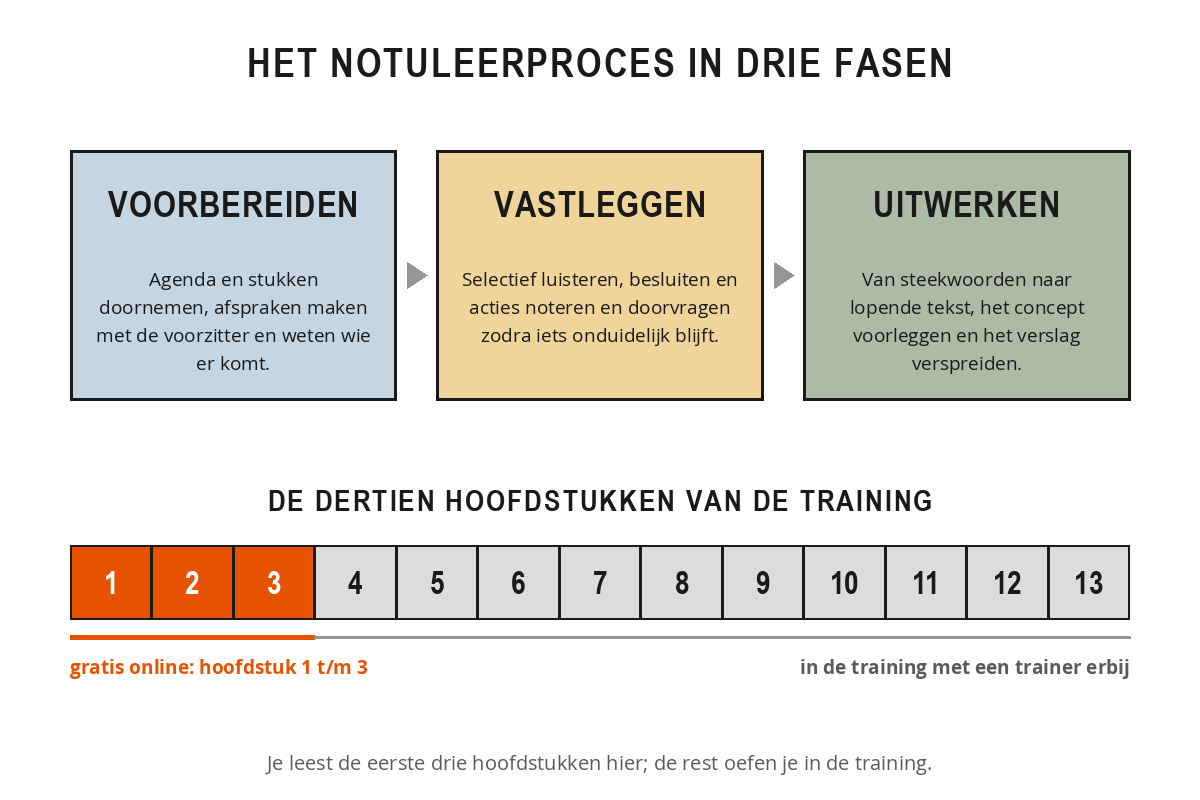
This free course contains the first three chapters: the orange part of the bar above. At the bottom of chapter 3 you will find the full course.
What you will learn
You learn how to define your role as minute-taker clearly: what is expected of you, what is not, and which arrangements to make with the chair before the first participant walks in. You learn to choose between the four report formats, from a bare list of actions and decisions to a full report attributed to each speaker, so that you no longer write the way it has always been done but the way your readers need it. And you learn to separate the essentials from the side issues at the table, using the six questions of WWWWWH to check whether your note is complete. The common thread: minute-taking is choosing. Not writing down everything, but writing down the right thing.
How the course is structured
The minute-taking process falls into three phases that build on one another. You start with preparation: reading the agenda and the documents, knowing who will be attending, and agreeing with the chair how you may interrupt. Then comes recording: listening at the table, selecting and asking follow-up questions as soon as something remains unclear. And you finish with writing up: from key words to flowing text, submitting the draft and circulating the report. Most of the benefit lies in the first and the last phase, and it is precisely those two that are usually skipped. Each chapter contains theory, a diagram, examples from meeting practice and an exercise that you apply to your own meetings.
Practical tips for use
- Keep a recent report of your own to hand. As you progress you will start to look at it with different eyes, and that report becomes your own yardstick.
- Do not read it all in one go. A chapter, then a meeting, then the next chapter yields more than reading straight through for an afternoon.
- For the exercises, have a real meeting in mind, with real participants and real agenda items.
- Change one thing at a time. A new report format and a new way of taking notes in the same week will come to nothing.
- Discuss what you learn with your chair. Half the gain lies in arrangements you make together, not in what you alone do differently.
Each chapter ends with a short knowledge check of three questions: answer them correctly to mark the chapter as completed. Your progress is saved automatically in your browser.
Enjoy the reading, and above all: enjoy the meetings that will now actually be properly set down on paper.