


1. The tasks of the minute-taker
A meeting lasts an hour; the minutes last for years. What is written in those minutes determines what the organisation later remembers of the discussion, the decision and the agreements. That is quite a responsibility for someone who is officially only sitting there taking notes. This chapter is about what that role actually involves: which functions your minutes serve, which tasks come with them, and where your limits lie.
After this chapter:
- You can name the four functions a meeting report fulfils within an organisation.
- You know what the difference between participants and other readers means for the amount of context you write down.
- You map out your sub-tasks before, during and after the meeting.
- You know where your limit lies: what you do record and what you never fill in.
- You have four questions with which to establish in advance what is expected of your report.
What a report does in an organisation
A meeting report is the written record of what was discussed, decided and agreed. Producing it is called minute-taking, and the person who does it is the minute-taker. That title suggests a single activity, namely writing down what is said. In reality it is a series of tasks that begins before the first participant walks in and only ends once the report has been finalised.
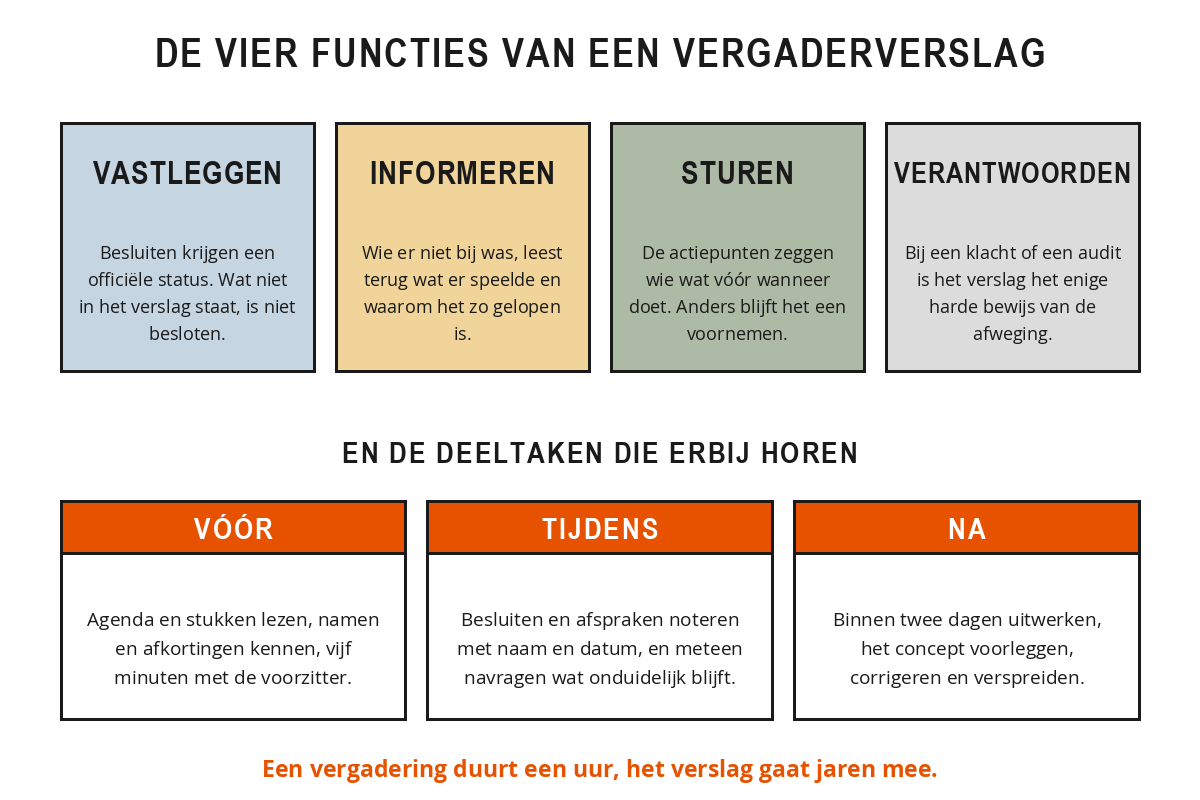
In most organisations the minutes serve four functions at once. Recording: decisions and agreements acquire official status, and whatever is not in the minutes has, as far as the organisation is concerned, not been decided. Informing: anyone who was not there can read back what was at stake, and that applies just as much to absent participants as to colleagues the subject concerns. Directing: the action points tell you who does what by when, and without those lines a good intention remains just a good intention. Accounting for it: afterwards the report shows on what grounds a choice was made, and in the event of a complaint, an audit or a discussion with the client it is the only hard evidence.
You also write for those who were not there
Almost every set of minutes has secondary readers: people who were not at the table but who do get to see the minutes. A manager following progress, a colleague who has to carry out a decision, a works council member keeping a file, or someone who wants to know in six months' time how a particular agreement came about.
The difference between those two groups determines how much context you write down. Participants need no more than a keyword, because they experienced the discussion themselves. A reader who was not present has not. For that reader, it must be clear even without explanation what the matter was about and why it was decided as it was.
The minutes of the project meeting state: "The proposal will not go ahead, given the comments from Finance." The four people present know exactly which comments those were. Project manager Sander Bakker, who reads the minutes three weeks later because he is taking over the project, does not. He rings the minute-taker.
A better formulation: "The proposal is not going ahead. Finance expects a structural overrun of 40,000 euros a year, for which there is no funding." That costs two extra sentences and saves you a phone call.
For each agenda item, ask yourself the check question: would a colleague who was not there also understand this? If not, a sentence with context is missing. While writing it up that costs you half a minute; later it saves you a string of questions.
What you do before, during and after the meeting
Anyone who only sees the tasks at the table makes it unnecessarily hard on themselves. The greatest return lies in the preparation and in the speed with which you write things up afterwards.
Before the meeting how much preparation you do determines how much you still have to work out at the table. You draw up the agenda together with the chair or it is handed to you, you read the accompanying documents and the report of the previous meeting, so that you already know the names, abbreviations and ongoing matters. You also know who is attending, what they are called and what role they have.
During the meeting you listen selectively. You do not write down everything, but you watch for the moments when the discussion produces something: a decision, an agreement or a point that is being deferred. For every agreement you record who will carry it out and by when. If anything remains unclear, you ask about it there and then, because afterwards there is little chance that anyone will remember it precisely.
After the meeting the rule is: the sooner you write things up, the more your notes still tell you. You produce a draft, submit it to the chair, process the corrections and circulate the report among participants and other readers. A report that goes round within two days raises questions that everyone can still answer. After three weeks that knowledge has evaporated.
You and the chair are a duo
Minute-taking is never a solo activity. The chair leads the discussion, you record it, and those two tasks interlock. A chair who summarises neatly, for example with "so we are deciding that Karin will request the quotation before 1 May", does half your work for you. A chair who does not do this leaves you guessing.
That is why it pays to spend five minutes with the chair before the meeting. You go through the agenda, you ask at which points a decision will be taken, and you agree on how you will signal that you have missed something. A raised pen or a brief "could I just get that decision clear?" works better than puzzling it out afterwards.
Agree a signal with your chair that you can use when you get stuck. A hand gesture or a simple phrase will do. If the chair knows what it means, interrupting feels far less like a disturbance.
What you do and do not do
You are neither a stenographer nor a judge. You record what happens, you do not colour it in and you do not add your own opinion. At the same time you are not a passive typist either: you may and must step in if something remains unclear. Four boundaries help in practice.
- You ask; you don't invent. If you are not sure what has been agreed, ask during the meeting. Not afterwards on the basis of guesswork.
- You record the outcome, not the entire conversation. The report is not a transcript. Anything that does not lead to a conclusion or an agreement usually does not need to be written out.
- You safeguard the agreements, not the content. Whether a decision is sensible is up to the meeting. Whether the decision is written down clearly is up to you.
- You are not a participant. If you combine both roles, say so in advance. Taking part in the discussion and taking the minutes at the same time costs attention you do not have at that moment.
During the project meeting, a participant says: "Yes, we'll pick that up." The discussion moves on to the next point. As minute-taker, you then have nothing usable written down.
You interrupt briefly: "Before we move on, who is picking this up and by what date?" The answer is: "Sander, before the next meeting." That can be noted down, and in your action list it becomes "Sander Bakker to deliver the quotation comparison before 14 March". Without that single question, the minutes record an agreement without an owner, and it will be back on the agenda in three weeks.
Four questions to ask in advance
Much of the frustration around minute-taking does not stem from poor listening, but from unspoken expectations. One person expects a page, another expects eight lines. As long as this has not been discussed, you will always deliver the wrong thing. These four questions will save you a lot of rewriting afterwards.
- What is the purpose of these minutes? Does it serve as a memory aid for the participants, or as a document used later to justify a decision?
- Who else is reading? How much context does that reader need in order to understand the minutes?
- How long does it have to be kept? A report that sits in the archive for three years calls for more precision than an action list that is dealt with after two weeks.
- When does it need to be ready? A report that appears after four weeks has become worthless to most readers.
Together, the answers determine how detailed and how formal your writing should be. In the next chapter you will see which specific report formats go with that.
Choose a meeting for which you are taking the minutes, or will be doing so shortly. Note down in keywords:
- The name of the meeting and who is chairing it.
- The participants: how many, and in what role?
- The other readers: who else receives the report, and what do they want to get out of it?
- The purpose of the minutes in one sentence.
- The retention period, in so far as you know it.
- The final delivery date after the meeting.
Then look at which point you were unable to fill in. Note down who you are going to ask that question and when. Asking that question is the whole exercise.
Summary
- A report fulfils four functions at once: recording, informing, steering and accounting.
- Whatever is not in the minutes has, as far as the organisation is concerned, not been decided.
- You are also writing for readers who were not there. They determine how much context is needed.
- Minute-taking breaks down into tasks before (reading the agenda and documents, agreements with the chair), during (selecting, noting, checking) and after the meeting (writing up, submitting for approval, circulating).
- Write it up within two days. After that your notes tell you less and less.
- You check, you do not invent. You record the outcome, not the whole conversation. You keep track of the agreements, not the content. And you are not a participant.
- Agree in advance: what is the purpose, who will be reading it, how long will it be kept and when does it need to be ready?
A colleague who was not at the meeting has to carry out a decision. What does that mean for your report?
Halfway through a discussion someone says "we'll pick that up" and the conversation moves on. What do you do, according to this chapter?
Which function of the minutes weighs most heavily for a decision on which accountability may later be required?