


3. Listening and recording at the table
In an hour's meeting, some nine thousand words are easily spoken. Perhaps three hundred of them end up in your minutes. You make that selection live, while the conversation simply carries on. This chapter is about how you make that choice, how you notice that there is a gap in your notes, and what your page looks like so that you don't lose anything.
After this chapter:
- You know what selective listening is and which filter you use when doing so.
- You distinguish main points from side issues during a meeting.
- You recognise the signal words that announce a position, a decision or an agreement.
- You use the six 5W1H questions to check, for each agenda item, whether your note is complete.
- Do you note an agreement in such a way that you can later transfer it to your action list without having to ask?
Selective listening is sharper listening
Selective listening means deliberately directing your attention to what the conversation yields and letting the rest pass by. You hear everything, but you note down only what helps the minutes along. That is something other than half-listening: you are in fact sharper than most participants, because you keep running the same question alongside. Does this sentence produce anything that someone will need to be able to fall back on later?
The main points are the outcomes and the information needed to understand those outcomes. Six types of statement are always a main point. Decisions, including its status: final, subject to confirmation or conditional. Agreements and actions: as soon as you hear a name and a time in one sentence, your pen goes up. Positions with consequences, such as an objection that led to the decision being amended. New facts: figures, dates, names, amounts and changes that were not yet in the documents. Shifts: a point that carries over to the next meeting, an agenda item that is dropped, a deadline that moves. And outstanding questions: what the meeting could not answer and who will look into it.
Everything beyond that is in principle secondary: the repetition of an argument that has already been noted down, thinking aloud, an anecdote by way of illustration, a side track about the car park, and the five sentences someone uses to introduce their point before they actually make it. Nor do you need to recount a lengthy explanation of a document that goes out as an appendix; a reference to the appendix is enough.
Signal words as a switch
Speakers almost always announce their main point. "I propose that", "so in summary", "on condition that", "let's agree that", "I want it noted that": a handful of phrases that you will recognise blindly after a few meetings. Pay particular attention to the chair. Every time they summarise, you are handed the main point for free, in wording that can go straight into the report.
What it sounds like: "Yes, look, I do have mixed feelings about it, because last year we tried something similar with that other supplier, and it got completely out of hand in terms of planning, remember, that was in the autumn. So I'm not saying no, but I do want a proper schedule in place before we sign."
What you note down: "JB agrees, provided the planning is done in advance." The anecdote about last year explains the reservation, but stands apart from it. The reservation itself is the main point, because it is the condition on which the decision holds.
Not sure whether something is a main point? Put a small question mark next to it in the margin and write down a single keyword. When you write up the minutes it takes you ten seconds to delete that line. Retrieving something you didn't write down costs you a phone call.
The six questions of WWWWWH
WWWWWH stands for Who, What, Where, When, Why and How. It is a checklist journalists use to test whether a report is complete, and it works just as well at the meeting table. You don't use it to write down six questions in a row, but to scan in two seconds at the end of an agenda item whether there is a gap in your notes.
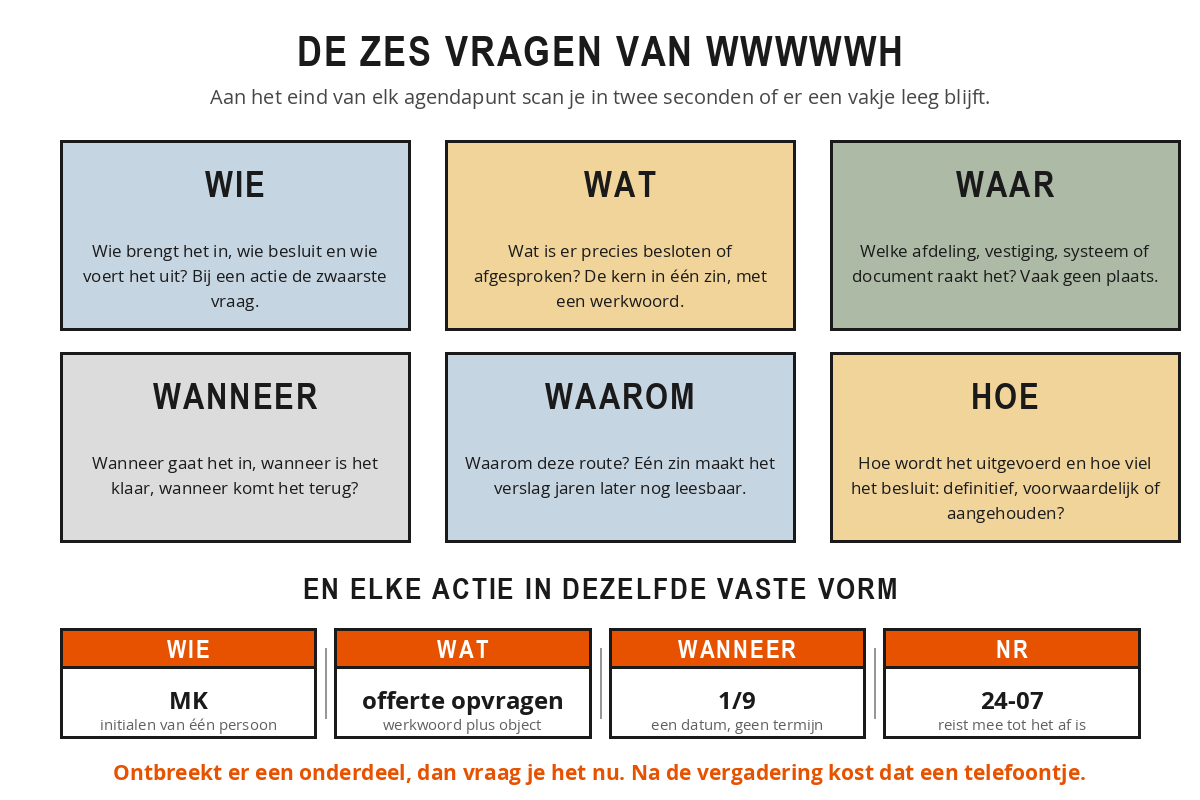
Who raises the item, who takes the decision and who carries it out? For an action point this is the most important of the six questions: without a name there is nothing left to come back to. What has been decided, agreed or reported exactly? You look for the essence in one sentence, so not "the supplier was discussed" but "the contract with supplier X will not be renewed". Where does it take place? That may be a location, but more often it is a department, an establishment, a system or a document. When does it take effect, when is it finished, when does it come back on the agenda? Vague indications such as "soon" or "after the summer" you write down literally if that is how they were said, but you flag them as something to follow up on. Why was this route chosen? This is the question that still makes the report readable years later, and one sentence is often enough: "because of the sixteen-week delivery time". And how is it carried out, and how was the decision reached? That could be a vote, a decision subject to conditions, or a working method that the meeting explicitly sets out.
The six questions are a checklist, not a form to fill in. For an announcement about building work you don't need to know why that particular contractor was chosen; for a decision on an investment you want to know exactly that. The purpose of the agenda item determines which questions you sharpen. For an informative item, What and When are the core. For an opinion-forming item, Who and Why come first, because you are recording which viewpoints exist and on what grounds. For a decision-making item, What, Who and When must all three be right down to the word, and How gives you the status of the decision.
The chair closes an item with: "Right, so the two of you will take that on and we will come back to it in the autumn."
Your scan turns up three empty boxes. Who are "they"? What exactly will they take on, the analysis or the implementation as well? And when is "the autumn", and will that be a progress report or a decision? Why two people are on this is not relevant in this case.
You ask: "For the minutes: who are 'they', and will they deliver a memo or a proposal? Do I put it on the September agenda or the November one?" Three lines of answer, and your note is complete: "AV and MK to deliver a memo, agenda 12 November."
Write the six letters in small print in the margin of your notepad, or at the bottom of your screen. You don't have to fill them in. They are only there to make your eye catch on the box that stays empty.
Your page in zones
A complete list of questions is of little use to you if the answers are scattered across three pages. So divide your page into fixed zones whose function never changes: your substantive notes in the middle, the actions in their own column on the right, your doubts as a question mark in the margin, and a strip along the bottom for the course of the meeting. That way you don't have to think about where something should go while you are writing.
That bottom strip is your process strip. It records who came in later or left early and at which agenda item, which documents were missing, which items were postponed and how a decision was reached: with everyone's agreement, with a note from a participant who was against, or by a vote with a result. Part of this simply belongs in the minutes, certainly for decisions with a long retention period. Another part is for you alone: an item that overruns by twenty-five minutes when ten were scheduled tells you that something is going on and that you need to take sharper notes. You don't describe tension and irritation in the minutes, but knowing that an item was sensitive does determine how carefully you choose your wording.
Your process strip reads: "10:40 MK left (up to and including item 6) / item 5 took 28 min instead of 10 / annex 5b missing / decision item 5 with note from RvD".
In the report that becomes: "Mrs Kramer leaves the meeting after agenda item 6. Item 5 was discussed without appendix 5b, which was not available in time. The decision was taken with a note from Mr Van Dijk, who states that he finds the financial substantiation insufficient." The fact that item 5 overran by eighteen minutes is not mentioned; that was the signal for you.
Every action in the same fixed format
The right-hand zone of your page fills up with the lines your colleagues look at most once the meeting is over. Always write those lines in the same order, because it is precisely because the order never changes that your eye immediately spots which part is missing.
- Who: the initials of one person. If no name is mentioned, put a dash and a question mark: "? – review draft". You ask about that mark before the agenda item closes.
- What: a verb with a concrete object. "Request quotes from three suppliers" is usable, "website" is not.
- When: a date in your own shorthand, for example 1/9. If all you hear is "soon" or "before the summer", note that in quotation marks, so that when writing up you can see that the meeting itself remained vague.
- Sequence number: the number under which the action enters the action and decision list, for example 24-07. Number them consecutively during the meeting, so you can refer back to them in the same meeting.
You only fill in the status when writing things up; during the meeting every new action is by definition open. At the end of each agenda item, run through your right-hand zone. If a name or a date is missing, that is the moment for a short question, while those involved are still on the subject. After the item, the same question costs three times as much time, because the whole table first has to shift back.
Not every statement with a verb in it is an action. "We should look at that some time" is an intention without an owner. Put it in the action list and three months later it will still be open, and your list loses its authority. Put it nowhere and it disappears. The solution is a parking list at the bottom of your page, with the initials of whoever raised it. At the end of the meeting you put that list forward: whatever the meeting does assign to a person moves to your action zone, and the rest goes into the minutes as an agenda suggestion or disappears.
An action point rarely arises at the moment the chair announces it. Usually it slips by in a subordinate clause: "I'll give them a call about that". A sentence like that is your signal to open a line in the right-hand zone, even if no date has been mentioned yet. A half-completed line is visible, a line you never opened is not.
Below are three statements as they might come up in a meeting. For each statement, work through the six questions of WWWWWH.
- "We're scrapping the paper form, which will save everyone a lot of work."
- "Marja has offered to take on that inventory, so that will be fine."
- "The proposal will go ahead as discussed, with that one adjustment Peter mentioned."
For each statement, note which of the six questions have not been answered, which missing detail makes the note unusable, and one short question with which you would close that gap, exactly as you would ask it out loud. Then compare your answers with a colleague. There is a fair chance that you will each identify a different gap as the most important one, and that difference says something about what your readership expects from the report.
Summary
- Selective listening is sharper listening: you hear everything, you note down only what helps the minutes along.
- Always main points: decisions, agreements and actions, positions with consequences, new facts, shifts and outstanding questions.
- Side issues are the run-up to the point, the repetition, the anecdote and the explanation of an appendix.
- Signal words such as "I propose", "so in summary" and "on condition that" tell you that something needs to be recorded. The chair's summary is a gift.
- WWWWWH stands for Who, What, Where, When, Why and How. At the end of each agenda item, you scan whether any box has been left empty.
- For an informative item, What and When carry the weight; for an opinion-forming item, Who and Why; for a decision-making item, What, Who and When, with How for the status of the decision.
- Divide your page into fixed zones: content in the middle, actions on the right, doubts in the margin, process at the bottom.
- Every action line has the same form: who (one name), what (verb plus object), when (a date) and a sequence number that travels along until the action is completed.
- An intention without an owner does not belong in the action list but on your parking list, which you put forward at the end.
A participant talks for two minutes about a project from last year and concludes with: "so I agree, provided there is a schedule in place first." What do you note down?
What do you use the six questions of WWWWWH for according to this chapter?
Someone says: "we should look into that some time." Nobody responds and the conversation moves on. Where does that belong?
Ready for the next step?
You have completed the free starter of Minute Taking. The next chapter in the full course is Types of meeting groups: what a team meeting, a management team meeting, a works council meeting and a meeting with varying experts require of you.
Take the 1-day training course →From €625,- excl. VAT · with an experienced trainer alongside you