


2. Choosing the form of the minutes
Four minute-takers, one meeting, four very different sets of minutes. Which form fits depends on what your readers need to be able to do with them. You make that choice in advance, not when you are already at your screen and notice that your notes don't match what you are typing.
After this chapter:
- You know the four common formats for minutes and how they differ from one another.
- You draw up an action and decision list containing everything a reader needs.
- You recognise when a formal decision list is required.
- You write concise minutes in which the main line of each agenda item remains visible.
- You use three questions to choose the format that suits your meeting.
Four forms on one scale
The four report formats lie on a continuous scale. On the left, only the outcomes end up in your report; on the right, the arguments and the speakers remain visible too. The further to the right, the more write-up time it takes and the less quickly anyone reads it.
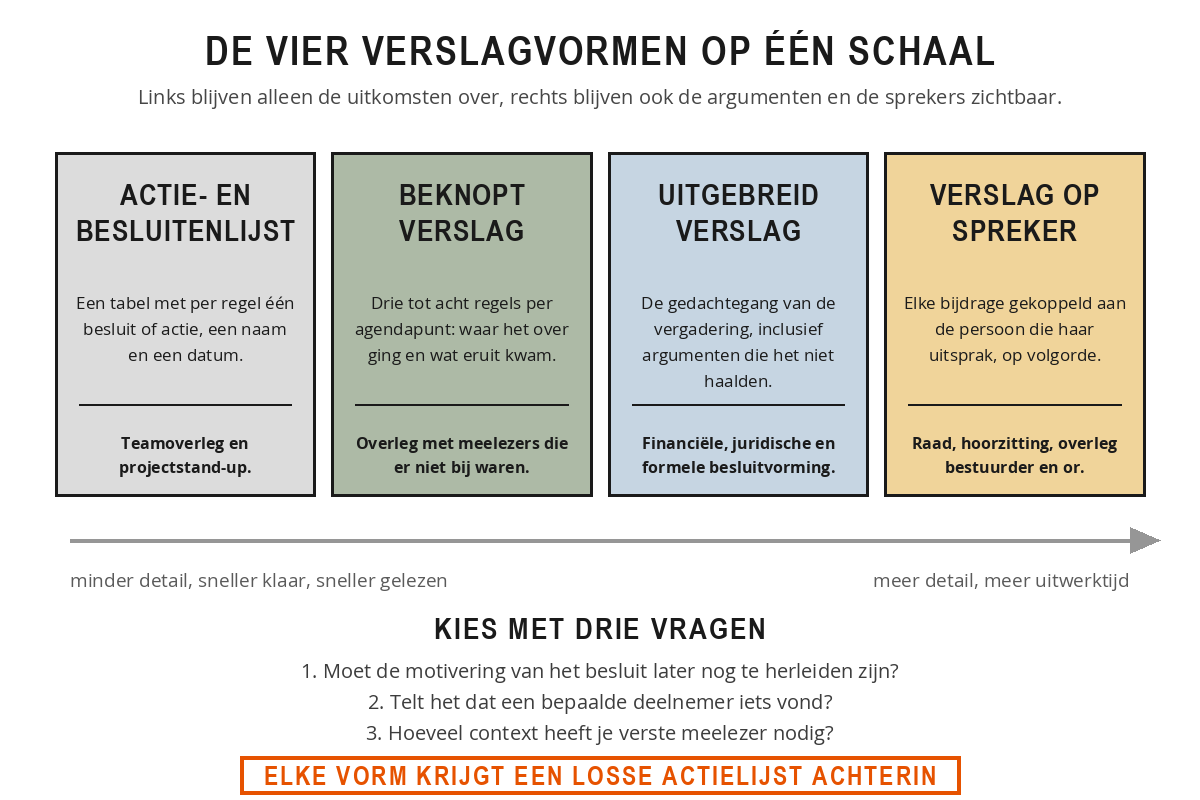
On the left is the action and decision list: a table with one decision or action per line, a name and a date. Alongside that, the concise report: three to eight lines per agenda item, stating what it was about and what came out of it. Then the detailed report, which sets out the meeting's line of reasoning including the arguments that did not prevail. And on the right the minutes attributed to speakers, in which every contribution is linked to the person who made it, in the order of the conversation.
The action and decision list
The shortest form leaves out the discussion. Anyone reading the list can see within thirty seconds what is expected of them. This form suits meetings that revolve around progress and the division of work: a weekly team meeting, a project stand-up, an operational departmental meeting. The participants heard the discussion themselves and do not need a summary, but they do need a reminder.
A usable list contains seven elements per line. A sequential number, so that you can refer to it in the next meeting without reading out the whole text. The date of the meeting, so that it remains visible how long an item has been on the list. The agenda item, in one or two words. The decision or the action, in a single active sentence beginning with a verb. The action owner: one name, no department and no "everyone", because an action without an owner is not an action. An deadline with a specific date, not "as soon as possible". And a status: open, in progress or completed, so that the list remains usable between two meetings.
An action is given a number when it arises and keeps that number until it is completed. That way, in the next meeting you can say "item 24-07 is still open" without having to explain the item again. Open actions are carried over unchanged with their original number; completed actions are listed once with the status "completed" and then removed.
Enter exactly one name for each action, even if a group does the work. That name is the point of contact. As soon as two names appear, everyone expects the other to start.
The formal decision list
Alongside the mixed list there is a stricter variant. This contains decisions only, numbered consecutively throughout the year, in a fixed wording that begins with the body taking the decision. Actions and explanatory notes are left out.
"Decision 2026-17: the board adopts the 2027 budget, with the exception of item 4.3 (accommodation). This item will be put back on the agenda for the meeting of 14 May. In favour: 5. Against: 1. Abstentions: 0."
You see this form in bodies that are formally authorised to take decisions: a board, a works council, a supervisory board. Where the retention period is long, this is often the document that survives the years, even when the ordinary minutes have long since been destroyed. Referring to "decision 2026-17" is a good deal more precise than "that decision from March".
If a decision is amended later, you record the new decision as a separately numbered decision with the sentence "this decision replaces decision 2026-17". Crossing out or altering an earlier decision makes the list unreliable.
The concise report
The concise minutes give a short summary of each agenda item in continuous sentences: what it was about, what considerations came into play and what the outcome is. You write the main line, not the conversation itself. You leave out speakers' names, unless someone takes on an action or objects explicitly. Keep to three to eight lines per agenda item. If an item is consistently longer, it contains detail that your most distant reader does not need.
"5. Service desk opening hours. The desk is currently open from 9.00 to 16.00. Visitor figures show that the last hour is barely used, while there are people waiting at the door before nine. Shifting to 8.30 to 15.30 raises the question of whether the morning shift can be staffed. Two employees indicated that an earlier start is difficult to combine with their travelling time."
"Decision: the new times will apply from 1 June, with a trial period of three months. Marleen de Groot will establish before 1 May which schedule changes are needed."
At the end you almost always put an action list. Readers who are only looking for their own tasks then do not have to scan through the text. That repetition is deliberate: an agreement hidden away in a paragraph is missed by half of the readers.
The detailed report and the report by speaker
Sometimes the outcome alone is not enough and the reader needs to be able to follow how it came about. The detailed minutes set out the meeting's reasoning for each agenda item, including the positions of individual participants, and close with the decision. Arguments that did not prevail are included as well.
That takes time, and the investment pays off if the reasoning behind a decision is needed later. That applies to decisions with legal or financial consequences, to meetings with a long retention period, to a clear difference of opinion within the group, to formal bodies whose rules state that positions must be traceable, and to subjects that recur across several meetings.
With minutes by speaker you go a step further: you link every contribution to the person who made it, in the order of the conversation. So you do not read "the meeting weighs the costs against the risk", but in turn what Fatima said, what Rens replied and how the chair wrapped up. That form suits meetings in which the position of the participants themselves carries meaning: council meetings, hearings, disciplinary cases, consultations between a director and the works council. For a team meeting it is too heavy, because as soon as names are attached to statements, participants start speaking more cautiously.
The same agenda item, at three levels of detail.
Action and decision list: "Decision: purchase of till system postponed until January. Action: Rens de Wit to request three quotations before 1 December."
Concise report: "The meeting discusses the replacement of the till system. The costs weigh heavily on the fourth quarter, while postponement increases the risk of breakdowns during the festive season. It is decided to postpone the purchase until January and first compare three quotations."
Detailed report by speaker: "Fatima el Amrani reports that replacing the till system will cost 38.000 euro and that this amount no longer fits within this year's budget. Rens de Wit counters that the current system already failed twice in November and that a breakdown during the festive season would mean lost revenue. Asked by Fatima el Amrani whether a temporary solution is possible, Rens de Wit answers that the supplier only provides support until March. The chair concludes that the purchase will be postponed until January, on condition that three quotations are available before 1 December."
If you are minuting by speaker, agree with the chair in advance how you will handle statements that someone later withdraws or qualifies. The usual agreement: you record the speaker's final position, not every intermediate step. Otherwise the minutes become a collection of loose thoughts rather than a record of positions.
Choosing with three questions
You do not choose between the four forms on instinct or out of habit, but on the basis of three questions you answer with your chair before the meeting.
- Does the reasoning need to be traceable? Does someone need to be able to trace a year from now why this choice was made? If so, the detailed minutes are the starting point.
- Does it matter that a particular person held a particular view? If so, you note it by speaker.
- How much context does your most distant reader need? Is a bare decision line enough for them, or will they lose the thread without an explanation?
You set the chosen format per meeting series and you do not switch it from one meeting to the next. Anyone used to finding the agreements in a table at the back will look for that table again next time. If the format changes without notice, some readers will miss their own action.
Map out three meetings for which you take minutes or could take minutes. For each meeting, answer:
- Which meeting is it, and how often does it meet?
- Do the reasons behind decisions need to be traceable later on, and what shows that they are?
- Does it matter that a specific participant held a particular view, yes or no?
- Who is the most distant secondary reader of this meeting, and what does that person not yet know?
- Which of the four formats does this produce, with or without a separate action list?
- Does that differ from what happens now? If so, what changes in concrete terms?
Discuss the outcome for at least one meeting with the chair before you actually change the format.
Summary
- The four formats increase in level of detail: the action and decision list, the concise minutes, the detailed minutes and the detailed minutes attributed to speakers.
- Each line of the action and decision list contains a number, the meeting date, the topic, the action in one sentence, one name, a specific date and a status.
- The number travels with the action until it has been completed, so that you can refer to it in the next meeting.
- A formal decision list contains only numbered decisions with their literal wording and serves as an archive document. An amended decision is given a new number.
- Concise minutes keep to three to eight lines per agenda item and leave out speakers' names.
- The detailed report suits financial, legal and formal decision-making. Minutes attributed by speaker belong in bodies where the position of individual participants carries meaning in itself.
- Choose using three questions: does the reasoning have to be traceable, do individual positions count, and how much context does your most distant reader need?
- You combine each format with a separate action list at the end, and you keep the chosen format consistent from meeting to meeting.
You are taking the minutes of a weekly team meeting about progress and the division of work. All participants are present and there are hardly any secondary readers. Which form is the obvious choice?
In the action list, "Purchasing team" is given as the action owner for an agreement. Why is that a problem?
In May the board amends a decision taken in March. How do you record this in the formal list of decisions?